

American Connect Assist Expands at U.S. Hubs
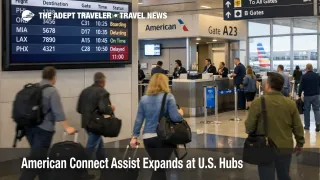
American Airlines is expanding Connect Assist, an AI powered tool that can recommend brief gate holds to help save tight connections at major U.S. hubs after early testing at Dallas Fort Worth International Airport (DFW) and Charlotte Douglas International Airport (CLT). The change matters most for travelers whose itineraries depend on hub bank timing, especially during peak connection waves and irregular operations when inbound delays compress already short layovers. If you are booking a tight connection, keep your contact details and app alerts updated, add a small buffer where you can, and know your threshold for switching to a reroute before the last workable flight leaves.
Connect Assist at U.S. hubs means American can use a data driven recommendation to decide when holding a departing flight for a few minutes is likely to help connecting passengers without creating a larger schedule hit elsewhere.
American described the concept publicly when it began testing the technology in May 2025, positioning it as an in house upgrade to an existing manual process used by operations and scheduling teams. Instead of relying only on ad hoc judgement, hub teams can review a structured recommendation that weighs whether a short hold is feasible given the broader operation.
As of early January 2026, reporting indicates the tool has moved beyond the original trial airports and is now being used at additional American hubs, including Chicago O Hare International Airport (ORD), Phoenix Sky Harbor International Airport (PHX), Miami International Airport (MIA), Philadelphia International Airport (PHL), and Los Angeles International Airport (LAX). American has also signaled that the technology is intended to keep expanding to more hubs over time.
Who Is Affected
This change primarily affects travelers connecting through American hub airports on itineraries where the connection is technically legal but operationally fragile, for example when a modest inbound delay turns a comfortable walk into a sprint. The biggest upside shows up on same day connections during hub departure banks, when many flights push at once and a single late arriving inbound can strand dozens of downstream passengers across multiple destinations.
It also affects families, travelers with limited mobility, and anyone with a long gate to gate transfer inside a large hub, because the practical connection time can be eaten up by terminal geometry, train rides, and last minute gate swaps. Even if a short hold is possible, it cannot erase the reality that some connections are too tight to be reliably saved, especially when the inbound arrives after the outbound boarding process is already deep into final checks.
Travel advisors and frequent flyers will notice the change in how they evaluate "risk acceptable" connections on American. A tool like Connect Assist can improve outcomes at the margin, but it does not change minimum connection time rules, and it does not guarantee a hold will happen. If you are connecting at a non hub station, or you are flying an itinerary that mixes carriers with separate operational control, the practical benefit can be smaller because the decision to hold depends on the specific flight, the gate situation, and the downstream rotation.
What Travelers Should Do
If you have a tight connection on American, start with the basics that make any potential assist more likely to help. Make sure your phone number and email are current in your reservation profile, turn on app notifications, and keep an eye on gate assignments as soon as they publish, because the best saved connection is still the one you can walk to without hesitation. When you have a choice, bias toward a slightly longer connection at the same hub, because a hold that saves a few minutes cannot solve a 25 minute cross terminal transfer.
Use a clear decision threshold for rebooking versus waiting. If your inbound delay pushes your expected arrival to inside the last boarding window, or you see a large gate change that adds distance, move immediately to standby and rebooking options rather than betting on a hold. The practical rule is simple, if making the connection requires everything to go perfectly, it is already a reroute candidate, and you should act while seats still exist on alternates.
Over the next 24 to 72 hours before departure, monitor three signals that determine whether a hold recommendation is likely to matter. First, watch the inbound flight's trend line, not just the current delay, because creeping delays usually worsen connection odds. Second, watch hub wide disruption indicators such as ground delay programs, deicing constraints, or ramp slowdowns, because those conditions reduce the operational slack needed for a hold. Third, watch your gate and terminal assignment stability, because a stable gate plan turns a short connection into a predictable walk.
How It Works
Holding a flight sounds simple, but at a hub it is a network decision. The first order effect is at the departure gate, a short hold can convert dozens of misconnects into made connections, which prevents rebooking churn, baggage retagging, and overnight hotel costs. That is the traveler facing upside, arriving as planned, and avoiding the cascade of missed onward plans.
The constraint is that every hold competes with the hub's larger operating rhythm. If a flight holds, it may miss an air traffic flow slot, lose its place in a departure bank, or arrive late enough at the next station to disrupt a later departure that was counting on that aircraft. Crew legality is another limiter, because a small ground delay can push a duty day over the edge, turning a hold into a cancellation risk later in the day. Gate availability matters too, because a late push can block an arriving aircraft that needs the same gate, which then creates new delays and new missed connections behind it.
This is where an algorithmic recommendation can help, because it forces the decision to account for more than the immediate group of connecting passengers. When American tested the technology at DFW and CLT, it described the goal as proposing holds only when the broader schedule impact is minimal. In practice, that means the tool is most valuable in the messy middle ground, where a small hold could help many customers, but only if it does not break a downstream rotation.
This fits into a wider airline push toward digital tools that reduce friction at the airport. American has also pointed to redesigned app capabilities and faster airport kiosks as part of the same customer experience strategy, and travelers will see similar "time at the front end" investments across competitors. For a comparable example of how premium travelers are being routed into different, faster ground flows, see Delta One Check In Expands At Eight U.S. Hubs. For a longer horizon view of why airlines are investing heavily in computing, data, and automation, and where the constraints may land next, see AI Data Centers And The Airline Supply Chain, A 2030 Outlook.