

France Snow Airport Closures Spread Beyond Paris
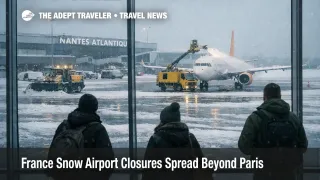
Snow and ice forced multiple regional airport closures across northern and western France, extending the winter disruption footprint beyond Paris. Travelers on domestic feeders, ski positioning flights, and anyone relying on same day rail connections into Paris or London are most exposed because a canceled short leg often collapses the entire itinerary. The practical move is to stop betting on same day fixes, shift to protected rebookings, and plan surface detours that do not depend on tight transfers.
France snow airport closures now function like a regional shutdown pattern, not a Paris only constraint, because several non Paris departure points are intermittently unavailable and recovery capacity is limited.
Officials reported closures affecting Nantes Atlantique Airport (NTE), Châlons Vatry Airport (XCR), La Rochelle Île de Ré Airport (LRH), Albert Picardie Airport (BYF) near Bray sur Somme, and Saint Nazaire Montoir Airport (SNR). The transport ministry also listed Brest Bretagne Airport (BES) in its morning situation report, but Brest airport later said the "closed" status was incorrect and that it remained operational. In Nantes, the transport minister said the airport should stay closed until around midday on January 7, which is a meaningful escalation for travelers who were hoping for a same day reset.
This widening footprint matters because it removes the short hops that reposition crews and aircraft into Paris banks. Even if Paris Charles de Gaulle Airport (CDG) and Paris Orly Airport (ORY) avoid fresh program cuts today, they can still absorb a backlog from yesterday's capacity reductions and from mispositioned aircraft arriving late. If you are connecting through Paris, the risk is not only your own flight, it is the cascading lack of replacement seats.
For Paris specific context and reroute logic, see Paris CDG, Orly 15% Flight Cancellations After Snow.
Who Is Affected
Travelers starting in western France and trying to reach Paris, London, or a long haul gateway are first in line for disruption, especially if their itinerary begins at Nantes, La Rochelle, or a smaller airport feeding a hub. If you are flying for a cruise embarkation, a tour start, or a fixed event, treat the first flight of the day as fragile, because aircraft may be out of position and deicing queues can rebuild quickly after a brief lull.
Same day rail dependent itineraries are also at risk, including travelers who planned to fly into Paris for an afternoon Eurostar or an evening TGV. When regional flights cancel, passengers shift to trains and last mile road transfers, which compresses availability and increases missed connection odds even if the rail network is running.
Road based itineraries, including airport transfers and ski access routes, can deteriorate fast under freezing conditions. If your plan depends on a long taxi or car rental move after a flight, a regional airport closure can become a forced overnight, not a simple diversion.
What Travelers Should Do
Act immediately to preserve options. If your airport is listed as closed or your airline has started rolling cancellations, move your booking to the next day if you can, and prioritize protected rebooking through the airline rather than buying an unconnected replacement segment. If you must travel today, build a larger buffer than usual between flight arrival and any rail departure, and assume baggage delivery, and ground transport, will be slower.
Use clear decision thresholds. If your first leg is canceled and the next available replacement arrives after your long haul bank has departed, rebook the long haul leg as well, do not wait for an airport reopening that may slip by hours. If you see repeated short delays stacking, deicing queues growing, or your inbound aircraft has not yet departed its origin, pivot to an overnight near a major hub city, because late afternoon recovery slots are the first to disappear when rotations break.
Monitor the next 24 to 72 hours like an operator. Track your airline's travel alert page, the departure board for your origin and your hub, and Météo France's neige verglas vigilance updates, especially heading into January 7, when a broader orange alert footprint is forecast. Also watch whether your airport publishes a reopening time window, and whether your airline is rebooking you via Paris, Brussels, or London, because that routing choice will determine whether rail, hotel, and minimum connection time risks increase.
Background
Airport closures during snow and ice events are not only about runway snow depth. They are often driven by braking action limits, the availability of plows and friction measurement, deicing fluid throughput, and the safe staffing needed to keep ramps and taxiways usable. Smaller regional airports can hit a hard stop faster than major hubs, and they can reopen more slowly because they have fewer parallel resources and fewer spare aircraft to restart the schedule.
Once a regional airport closes, the first order impact is obvious, flights cancel or divert. The second order impact is what breaks recovery. Aircraft that were supposed to overnight at a regional station instead end up elsewhere, crews time out, and the next morning's first departures vanish, which then removes the feeder flow into Paris and other hubs. That is why a disruption that begins outside Paris can still surface as missed long haul connections and "no seats available" messages inside Paris.
The disruption then propagates into the surface network. Passengers replace short flights with trains, coaches, and taxis, which increases demand on already constrained winter capacity. When rail seats tighten and road journeys slow under icy conditions, travelers miss onward departures, hotels fill near gateway stations and airports, and the system becomes less able to absorb irregular operations. With additional snow and ice vigilance expected, the recovery window can shift from hours to days, particularly for itineraries that require multiple tightly timed segments.
Sources
- Six people die as snow, ice and freezing temperatures wreak havoc in Europe
- Snow and ice cause deadly accidents in France, disrupt Europe travel
- Neige et verglas, encore des perturbations dans les transports
- DIRECT, Neige et verglas, restrictions et fermetures
- Neige, quelles sont les perturbations à prévoir dans les transports ce mardi ?
- Vigilance Météo France, Neige Verglas