

Paris CDG, Orly 15% Flight Cancellations After Snow
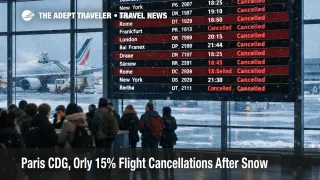
France's civil aviation authority has ordered a capacity cut at Paris Charles de Gaulle Airport (CDG) and Paris Orly Airport (ORY) after snowfall reduced normal operating margins. Passengers departing, arriving, or connecting through Paris should expect cancellations, longer boarding holds, and crowded rebooking channels through the late afternoon and evening on Monday, January 5, 2026. If you have a tight connection, a same day rail booking, or a fixed tour, switch to proactive rebooking now, and treat every onward segment as at risk until Paris banks recover.
The Paris CDG ORY 15% flight cancellations mean fewer arrival and departure slots, so one canceled leg can trigger missed connections and spill into Tuesday rotations even if the snowfall eases.
DGAC asked airlines to cancel 15% of flights, with reductions in effect until 800 p.m. CET at CDG and until 1130 p.m. CET at ORY. Airlines can choose which flights to cancel as long as the required reduction is met, which is why two travelers on the same airline can see very different outcomes depending on aircraft type, crew position, and onward connectivity.
Operationally, both airports are already showing meaningful delay tails. Flight tracking data on Monday shows CDG with departure delays averaging over an hour and arrival delays near an hour, while Orly is also reporting airborne arrival delays around an hour, and worsening at the time of posting. That pattern matters because when arrivals slide, gates tighten, and departures then queue longer for deicing and sequencing, which is how "15% canceled" turns into "most of the evening runs late."
Who Is Affected
Origin and destination passengers at CDG and ORY are the obvious first wave, but connection passengers are the ones most likely to get trapped by timing. CDG's late afternoon and evening banks carry a large share of long haul connectivity, including transatlantic flows and Africa itineraries, and when those banks fracture, reaccommodation can take multiple days because the next flights with seats are often tomorrow's peak departures.
Orly tends to be more point to point and short haul heavy, so the pain shows up differently. Expect tighter same day options when a short haul cancellation removes the "feeder" that would have carried you into a long haul departure from CDG, and expect families and leisure travelers to see longer call center and chat response times as airlines prioritize complex misconnects.
Travelers with onward rail, cruise, or tour commitments in Paris are also exposed. When aircraft arrive late into CDG, transfer windows shrink for Eurostar, TGV, and private transfers, and when rebookings push passengers to overnight stays, hotel inventory tightens around airport corridors and key rail hubs. If you are already in Paris and trying to reposition for a cruise or escorted tour, the most important question is whether your next morning departure depends on an aircraft and crew that can physically arrive tonight.
What Travelers Should Do
Act like you are already disrupted. Check your flight status before leaving for the airport, and use the official Paris Aéroport departures lists to confirm the operating flight number, terminal, and latest posted time, then cross check with your airline app for gate and reaccommodation options. If you are connecting, screenshot your original itinerary and your confirmed boarding passes now, because reroutes can reissue segments without preserving your preferred seats.
Use a simple decision threshold for rebooking versus waiting. If your inbound to Paris is projected to arrive less than 90 minutes before your onward departure, or if your app shows any "estimated" times that keep sliding later, move to a reroute immediately, because that is the window where gate holds, deicing queues, and flow control can erase your connection. Practical same day alternates often route via London Heathrow Airport (LHR), Brussels Airport (BRU), Frankfurt Airport (FRA), or Adolfo Suárez Madrid Barajas Airport (MAD), and you should treat Amsterdam Airport Schiphol (AMS) as a higher risk alternate today given parallel snow disruption in the region. If you need an intra Europe rescue when Paris inventory is gone, consider whether your airline can ticket you into a nearby hub first, then onward long haul tomorrow, rather than waiting for a like for like Paris connection that may not exist.
Over the next 24 to 72 hours, monitor stabilizing signals instead of rumors. You are looking for three concrete improvements, falling average delays at CDG and ORY, airlines removing or narrowing travel waivers, and the airport's departures board returning to normal bank rhythm rather than rolling 20 to 60 minute pushes. If those signals do not appear by late evening, assume Tuesday morning will start behind schedule, because late inbound aircraft and crew legality constraints tend to break the first wave of departures, even when weather improves overnight.
Background
Snow disruptions at major hubs propagate in layers, and Paris is a textbook case. The first order effect is straightforward: reduced runway throughput, deicing demand, and slower taxi operations shrink the number of safe movements per hour, which is why DGAC uses temporary percentage cuts to keep the system from gridlocking.
The second order effects are what make a "Monday evening problem" become a "Tuesday travel day problem." When arrivals stack up, aircraft park at remote stands or hold for gates, crews burn duty time, and some flights can no longer legally operate even after conditions improve. That creates aircraft out of position across Europe, breaks planned crew pairings, and reduces the spare capacity airlines rely on to recover quickly, which is why you can see scattered cancellations the next morning that look unrelated to the original snowfall.
Paris also amplifies disruption into other parts of the travel system because it is both a global connection node and a surface transport anchor. When flights into CDG slip, travelers miss pre booked rail departures, airport to city transfers run longer, and hotels absorb unplanned overnights. That pressure compounds when neighboring hubs are also constrained, since reroutes depend on the same pool of aircraft, crews, and seats. If you want a practical "stuck in the city" reset while you wait for rebooking, use Paris Travel Guide: The Ultimate 7-10 Day First-Timer's Itinerary to rebuild a low transfer plan that keeps you close to your hotel, your rail station, or your airport departure point.
For travelers comparing alternates, it helps to look at adjacent disruptions rather than assuming the nearest hub is safer. Amsterdam Airport Schiphol (AMS) has also been dealing with snow driven cancellations, and smaller regional airports can be even more brittle when deicing capacity is limited, as seen in northern Denmark. KLM Cancellations Amsterdam Schiphol Flights January 5 and Snow Delays at Aalborg Airport, AAL Connections at Risk are useful benchmarks for how quickly winter ops can spill across rotations and connection banks.