

Netherlands Rail Shutdown Breaks Schiphol Airport Links
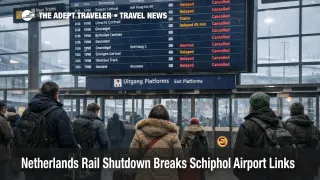
A Netherlands rail shutdown halted most passenger trains across the country, breaking airport and city links for travelers moving through Amsterdam Airport Schiphol (AMS) and the main Randstad rail corridors on January 6, 2026. Travelers relying on NS intercity services, airport rail access, or tight transfers into international rail and short haul flights are most exposed, with the Amsterdam, Netherlands, Utrecht, Netherlands, and Rotterdam, Netherlands region still operating under heavy constraints. The practical move is to treat rail as unavailable for time sensitive travel, switch to road transfers where you can, and plan for an overnight near your departure point if you cannot build a large buffer.
The Netherlands rail shutdown is not a single delay event, it is a layered systems failure combining winter switch malfunctions with an NS IT disruption that prevented the operator from starting large parts of its timetable, which is why "wait for the next train" is not a workable plan for many itineraries.
ProRail said NS did not start operating most passenger trains on Tuesday morning because an IT outage in a key planning system coincided with widespread switch faults linked to winter conditions, and it cautioned there was no clear estimate for full normalization while the Randstad remained especially constrained. NS had separately warned that it was operating a winter timetable on January 6, 2026, with fewer trains on some routes, even before the broader shutdown conditions hardened.
Who Is Affected
Airport bound travelers are the first group to get stranded because Dutch trips are often built around a rail spine that feeds the terminals. Schiphol has warned that there is no train traffic to or from the airport, and it expects that gap to persist into the early evening, which pushes travelers into taxis, pre booked cars, and limited coach capacity at the same time winter road conditions slow driving speeds.
City to city travelers inside the Netherlands are also exposed, including travelers attempting day trips, hotel changes, or same day meeting travel, because the failure mode is network wide rather than corridor specific. ProRail's updates described a combination of switch failures and traffic control constraints that can suppress throughput even after some trains restart, and that matters because partial restarts do not reliably restore timed connections through major nodes.
International rail passengers are a third group that often gets surprised by "the last mile problem." Even if an international segment operates, Dutch network limits can prevent you from reaching the departure station, or can force last minute stop changes that break onward plans. Eurostar's service updates for January 6 flagged limited service on the Dutch network and disruption around Amsterdam Centraal, including some services affected by delays or altered stops, which raises the risk of missed check in windows and failed same day connections.
Finally, travelers caught between modes, for example flight rebooks, cruise embarkation travel, or multi city hotel itineraries, face a compounding problem. When rail collapses, travelers compete for the same small pool of alternatives, so taxis surge, rental cars disappear, and the nearest workable hotels around major stations and the airport fill quickly.
What Travelers Should Do
Start with a hard reality check on whether rail is optional for your itinerary. If you must reach Schiphol, or you must catch a long distance train with a fixed departure, switch modes early rather than arriving at a station hoping service returns. Book a taxi or car service if you can, or move to an airport area hotel before your departure, because waiting to decide tends to push you into the most expensive and least available options.
Use decision thresholds that match what you could lose if the connection fails. If your plan includes a once daily long haul flight, a protected international rail booking, a same day event, or separate tickets where a missed segment would be treated as a no show, rebook to a different day or a different departure point once your buffer drops below a practical road transfer plus check in margin. If your travel is flexible, and you can accept arriving late, delaying travel until the operator restores stable, published timetables is usually better than chasing partial restarts that can collapse again under switch faults.
Monitor the right signals over the next 24 to 72 hours rather than watching a single departure board. Check ProRail disruption updates for the operational picture, check NS for timetable and journey planner guidance, check Schiphol for airport ground access messages, and check your international operator, including Eurostar, for stop changes and check in timing. Winter weather related switch faults and control constraints can create rolling failures, so the key is whether the network is stabilizing, not whether one train briefly appears on a screen.
Background
Dutch rail disruptions propagate fast because the system relies on tightly timed switches, centralized traffic control, and precise crew and rolling stock planning to keep dense intercity frequencies moving through a small number of critical nodes. When switches fail in freezing conditions, trains cannot be routed efficiently through junctions, which reduces capacity and forces dispatchers to protect the safest, simplest movements first. When a planning IT failure hits at the same time, the operator can lose the ability to staff and sequence trains at scale, turning a weather disruption into a network start up problem rather than a recoverable delay.
For travelers, that means the first order impact is not just fewer trains, it is missing the "connective tissue" that makes the Netherlands easy to traverse in a day, including airport rail links and cross platform transfers. The second order ripple moves into aviation and international rail, because rebooked flights and trains still require reliable ground access, and broken feeder service increases misconnects into hub airports and international departures. It also hits lodging and local transport because stranded travelers shift to hotels near major stations and the airport, while taxis, rideshares, and private cars absorb demand they were not sized to carry in peak winter conditions.
This rail failure layer is especially important this week because winter disruption has already pressured Amsterdam's air and international rail options. Travelers comparing recovery paths should also read Schiphol Flight Cancellations Hit AMS January 5, 2026 and Eurostar Netherlands Trains Suspended, Paris Limits Jan 5 to understand how surface transport failures can break otherwise workable reroutes.
Sources
- ProRail, Treinverkeer: verstoring door winterweer en IT-storing
- Amsterdam Airport Schiphol, Winter Weather Updates
- Eurostar, Disruptions, Travel Updates
- NS, NS rijdt dinsdag 6 januari winterdienstregeling
- Reuters, Dutch train traffic halted due to snow and ice
- Tweakers, IT storing in planningstool legt NS treinverkeer plat