

Sydney CBD Protest March Ban Disrupts Airport Transfers
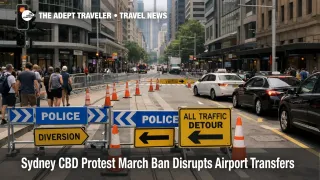
New South Wales, NSW, has tightened how protest marches can operate in central Sydney, Australia, by extending a Public Assembly Restriction Declaration that prevents authorities from approving public assemblies across three metropolitan policing areas that include the central business district, CBD. Visitors are most affected if they rely on predictable street access for trains, taxis, rideshares, tours, and event arrivals in the CBD. The practical move is to add buffer time, plan alternate pickup points, and avoid time critical chains that depend on a single road corridor working normally.
The Sydney CBD protest march ban changes travel plans because public assemblies cannot be authorised under the Summary Offences Act 1988 during the declaration period, which removes the usual protections tied to an approved march route and timing.
NSW Police says the current extension restricts public assemblies across the Central Metropolitan, North West Metropolitan, and South West Metropolitan policing areas, and Form 1 applications for authorisation will not be accepted. NSW Police also says gatherings are still permitted, but police may issue move on directions when people obstruct traffic or pedestrians, or when behavior is viewed as intimidating, harassing, or likely to cause fear in another person. In practical travel terms, that combination can reduce the number of scheduled, pre planned march routes on paper while increasing the odds that disruption appears as fast moving cordons, shifting pickup zones, and sudden diversions when groups assemble without an authorised route.
If your January plans already include tight airport connections, this policy driven street volatility can stack with separate operational constraints at Sydney Kingsford Smith Airport (SYD). Travelers should treat the city and airport system as coupled this week, not as two independent risks, and consider reading Sydney Runway Works Cut Options at SYD Through Jan 9 if they are departing Sydney or connecting onward.
Who Is Affected
Travelers staying in central Sydney are the primary group, especially anyone moving between hotels, major rail stations, ferry wharves, and waterfront attractions on a fixed schedule. Even when an assembly is peaceful, the lack of an authorised framework can mean faster enforcement decisions, quicker road closures, and more frequent rerouting that breaks the reliability of mapping app ETAs. Visitors who depend on door to door rides, including families, groups with multiple bags, and travelers with mobility constraints, are more likely to feel the friction first because curb access can change block by block.
Airport bound travelers are also exposed, not because the declaration changes airport operations directly, but because it can change the predictability of the surface trip that feeds the flight. Sydney Kingsford Smith Airport sits close enough to the CBD that a city traffic shock can compress check in time, baggage cutoffs, lounge access time, and, for domestic travelers, terminal transfer timing. The risk rises further for anyone on separate tickets, cruise passengers positioning for an embarkation day, or travelers trying to protect a same day onward connection, because a late city departure can erase the last workable flight options.
The footprint matters outside the CBD as well. NSW Police says the restriction applies across three metropolitan policing areas, so visitors transiting to and from the CBD through the north west or south west corridors can still encounter blocks or detours if gatherings form near transport nodes, shopping districts, or event venues. In those situations, disruption tends to propagate outward, first as localized police direction at the source, then as diverted vehicles flooding parallel routes, and then as rail crowding when travelers switch modes at the same time.
What Travelers Should Do
Start with immediate buffers and a mode backup. If you have a flight, a timed tour, or a ticketed event in the CBD, plan to leave earlier than you normally would, and pick a fallback that does not depend on a single street staying open, such as a rail segment to bypass the densest blocks, followed by a shorter rideshare or taxi leg. If you are meeting a tour group, arrive early enough that you can walk around a cordon without losing the booking, because short notice street control can move the practical meeting point even when the attraction itself remains open.
Use decision thresholds instead of waiting for conditions to improve. If rideshare ETAs start swinging, if multiple drivers cancel, or if your route time doubles compared with normal for the same distance, treat that as the trigger to switch modes or depart immediately. For airport runs, a conservative rule is to protect the flight, not the schedule, if you are inside the CBD and conditions start shifting, it is usually cheaper to sit at SYD earlier than planned than to miss a departure and buy a new ticket during a disruption window.
Over the next 24 to 72 hours, monitor whether the restriction is extended again after 3:00 p.m. local time on January 20, 2026, and watch how organisers respond, because that is what will determine whether disruption concentrates into static gatherings or shifts into more mobile, harder to predict movement. NSW Police public updates are the most direct signal for the legal operating environment, and local transport alerts and live traffic conditions are the most practical signal for whether a CBD day is likely to behave normally. If you want a broader street disruption playbook for tour timing and airport buffers, the same traveler logic applies in other major cities experiencing protest related perimeter control, see Protests Near Mexico City U.S. Embassy, Polanco Delays.
Background
In New South Wales, many organised marches rely on an authorisation pathway often referred to as a Form 1 process under the Summary Offences Act 1988, which can provide specific legal protections for an approved public assembly, such as protection from certain obstruction related offences when the event follows the authorised framework. NSW Police says the Public Assembly Restriction Declaration prevents public assemblies from being authorised in the affected policing areas for the duration of the declaration, and that Form 1 applications will not be accepted, which means an assembly can still occur, but it operates without the same protective structure if streets are blocked or pedestrians are obstructed.
The NSW Government framed these Public Assembly Restriction Declaration powers as a targeted, time limited measure that can be used after a terrorist incident is formally declared under the Terrorism (Police Powers) Act 2002, with 14 day declarations that can be extended in 14 day blocks for up to three months. For travelers, the way this propagates through the system is mostly logistical. The first order effect is at street level, police direction and cordons can change how vehicles, buses, and pedestrians move through the CBD. The second order ripple shows up in transfer reliability, missed rail connections, and tour and dining timing failures when multiple travelers try to reroute at the same time. A third layer is accommodation and inventory pressure, if city friction contributes to missed departures or late arrivals, it can create unplanned hotel nights, and expensive last minute rebooking behavior in both transport and lodging.
If this volatility pushes you into a last minute domestic replan, or an unplanned overnight that changes how you exit or re enter Australia on a tight timeline, confirm your entry status and conditions rather than assuming flexibility, see Australia Entry Requirements For Tourists 2025 2026.
Sources
- Public assembly restriction declaration extended
- NSW Police Commissioner makes declaration to restrict public assemblies in wake of Bondi Terrorist Attack
- NSW Government to act to protect community safety following terrorist attack
- NSW Police commissioner extends restrictions on Sydney protests for another fortnight
- Sydney protest restrictions extended for 14 days as activist group vows to file legal challenge this week