

Sydney Runway Works Cut Options at SYD Through Jan 9
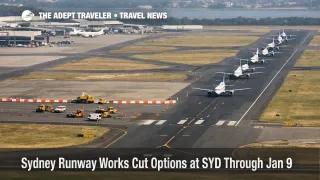
Sydney Kingsford Smith Airport (SYD) is operating with less runway flexibility this week because runway works have taken the east west Runway 07/25 out of service, and Airservices says the closure is expected to last through Friday, January 9, 2026. Travelers transiting Sydney, Australia, especially those connecting from international arrivals to domestic flights, should plan for a higher chance of knock on delays when peak banks get tight. The practical next step is to build buffer time into airport transfers and connections, and to decide now what your reroute threshold is if your flight slips.
The Sydney airport runway works matter because losing Runway 07/25 reduces the airport's ability to shift runway configurations when winds, thunderstorms, or air traffic control, ATC, flow constraints reduce the arrival or departure rate on the remaining runways.
Who Is Affected
Travelers departing from SYD, arriving into SYD, or connecting through SYD are the primary group, with the most exposure on itineraries that depend on tight turns between an inbound flight and a domestic onward segment. Sydney's schedule is built around banks of arrivals feeding departures, so when an inbound aircraft arrives late and the airfield has fewer runway mode options available, delays can compound quickly and ripple into missed connections.
Domestic travelers are often the first to feel the pinch, because domestic departures tend to be the easiest place for airlines to resequence, retime, or cancel in order to protect long haul operations. That matters for travelers heading to cities that have fewer daily frequencies, because a single disrupted departure can push you into next day travel, even when the disruption driver is only a runway configuration constraint.
Travelers with separate tickets, self transfers, or cruise and tour start times are also more exposed. If your itinerary is not protected as a single booking, a misconnection can become a new purchase at the worst possible moment, when remaining same day seats are already being consumed by other disrupted passengers.
What Travelers Should Do
Start with immediate actions and buffers. Recheck your flight status and your airline's travel alert language before you leave for the airport, and treat connection windows as fragile until you are actually through the gate for your onward flight. If you have a domestic connection at Sydney, plan extra time for terminal transfers, bag recheck, and security, and avoid adding a separate ground transfer in Sydney unless it is truly necessary.
Use decision thresholds for rebooking versus waiting. If your inbound flight is running late and your onward departure is one of the last practical options of the day, it is usually smarter to change earlier while inventory still exists rather than hoping the system recovers at the end of the day. If your airline offers a fee free change or a flexible rebooking pathway, take it before airport queues build, because the fastest way to salvage your trip is almost always through the airline app, not a counter line.
Over the next 24 to 72 hours, monitor the right signals. Watch whether delays stay concentrated in a single bank or spread across the full day, and track whether your airline begins proactively offering alternate routings. If same day Sydney options evaporate, look at alternate gateways such as Canberra Airport (CBR) or Newcastle Airport (NTL), but only after you account for ground transfer time and the risk that you will still need to overnight. If an overnight in Sydney becomes likely, confirm whether you can legally enter Australia under your passport and visa situation, because that can become the hidden constraint when plans break. Australia Entry Requirements For Tourists 2025 2026
Background
Sydney has three runways, two parallel north south runways, plus the east west Runway 07/25. When 07/25 is unavailable, the airport loses a key option for wind and flow management, and that reduces the ability to "catch up" after a disruption because fewer configurations may be available to safely sustain the prior arrival and departure rate.
That first order constraint propagates through the wider travel system in predictable ways. At the source, arrival spacing can increase, departure queues can lengthen, and the day's schedule becomes more sensitive to small disruptions such as late inbound aircraft and temporary ATC restrictions. The second order ripple shows up in domestic misconnects and airline network recovery, because aircraft and crews that miss one turn can miss the next, pushing delays into later flights and raising the odds of cancellations that force overnight stays. A third layer is traveler behavior and local inventory, as disrupted passengers rebook onto fewer remaining flights, compete for nearby hotel rooms, and compress ground transport demand around the airport precinct.
For recent examples of how capacity constraints can cascade beyond the initial cause, see Greece Air Traffic Radio Failure Delays Flights Nationwide and Landing System Outage at Milan Bergamo Delays BGY Flights.