

Brussels Airport Snow Cancellations Disrupt Connections
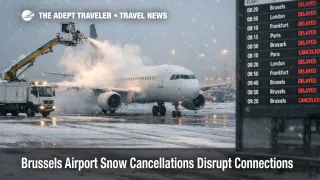
Snowfall and de icing operations are cutting capacity at Brussels Airport (BRU) on Wednesday, January 7, with the airport warning that delays can persist through the entire day as aircraft require de icing and crews clear snow from runways and taxiways. Brussels Airport also confirmed targeted cancellations to keep the remaining schedule viable, a pattern that typically shows up when airports need to protect runway availability, gate turnover, and staffing while winter operations slow every movement on the airfield. If your itinerary depends on a short connection, treat today as a reroute or rebook problem, not a normal delay day, because the recovery window can close fast once aircraft and crews fall out of position.
The airport's latest reporting shows 40 flights cancelled, split evenly between departures and arrivals, with delays expected across the board as de icing and snow clearance continue. That scale matters less than the timing, because even a modest number of cancellations can remove key feeder flights that supply onward banks, especially for Schengen and UK oriented short haul connectivity where many travelers are on separate tickets or tight minimum connection times.
Who Is Affected
Travelers connecting through Brussels Airport are the most exposed, particularly those arriving on short haul feeders and connecting onward within Europe or to the UK, where a small arrival delay can turn into a missed flight when boarding closes on time. De icing also tends to create uneven delays, so a connection that looks safe at booking can become fragile if your inbound aircraft is held for treatment, then faces gate congestion on arrival.
Passengers starting in Brussels are also at higher risk of day long knock on effects. When outbound aircraft depart late, airlines burn turnaround buffer, crew duty margins tighten, and later rotations can see additional cancellations that were not visible in the morning. Checked baggage travelers face a separate vulnerability because late inbound bags and compressed connection handling can trigger misroutes when onward flights depart on schedule while inbound flights arrive late.
Rail and intercity travelers using Brussels as a hinge point are affected too, but the main issue is that rail is not a guaranteed escape hatch today. Eurostar posted an adverse weather warning for January 6 through January 8, noting that trains are likely to see severe delays and last minute cancellations, which can undercut the common plan of shifting a disrupted air connection onto rail at Brussels Midi or Zuid.
Finally, travelers rerouting via the Netherlands should assume cross border friction. On Wednesday morning, Dutch network problems led to multiple services being held at the Belgian border station at Essen, affecting EuroCity and EuroCity Direct services toward Rotterdam and Amsterdam, which is exactly the sort of constraint that turns a theoretical reroute into a missed departure.
What Travelers Should Do
If you are traveling today, act early and set hard buffers. Check your specific flight status directly with your airline, then verify it against Brussels Airport's live flight information, and leave extra time for ground access because the airport warns that road traffic and public transport can also be affected in winter weather. If your inbound leg is delayed and your connection is under pressure, move now, call or message the airline, get reprotected, and avoid arriving at the gate hoping the system will hold for you.
Use a clear decision threshold for rebooking versus waiting. If missing the connection would force an overnight, break a separate ticket, or jeopardize a long haul segment that only runs once daily, rebook to a later same day option only if you still have meaningful slack, otherwise shift to the next day and protect the trip. If your trip is flexible and the purpose tolerates late arrival, you can try to ride out delays, but do it with a backup plan in hand, including a realistic hotel option, because cancellations can expand later in the day when crews time out.
Over the next 24 to 72 hours, monitor stabilization signals, not just your departure board. Watch whether the national warning window extends, because Belgium's Royal Meteorological Institute warned of extensive slippery conditions from the afternoon of January 7 into the evening of January 8, which can prolong both airport operations constraints and surface transport delays. Also track Eurostar and cross border rail advisories if you plan to switch modes, since adverse weather has already triggered warnings about severe delays and last minute cancellations on the network.
Background
Winter operations ripple through the travel system in layers. The first order effect at Brussels Airport is reduced airfield and turnaround capacity, because aircraft must be de iced and runways and taxiways must be cleared, and those tasks can temporarily close critical surfaces for safety, lowering arrival and departure rates even when the airport remains open. When the Airport Operations Centre can see that delays are likely, airlines may cancel selected flights to match schedule volume to the reduced capacity and to prevent gridlock that would otherwise strand more passengers and aircraft.
The second order ripple hits connections and network recovery. A delayed inbound aircraft arrives late to a gate, the onward flight departs late, and the next rotation inherits the delay, which is how disruption spreads across multiple countries even when snowfall is local. That propagation is especially important this week because nearby hubs have also been constrained by the same weather system, reducing the availability of easy reroutes and raising the odds that airlines run out of same day seats for rebooking.
A third layer is mode shift pressure, and today it is less reliable than many travelers assume. Eurostar's own updates flagged a high risk of severe delays and last minute cancellations through January 8, which can weaken the rail fallback for Brussels based itineraries, including connections that rely on Brussels Midi or Zuid as the pivot station. Cross border rail into the Netherlands has also seen disruption at the border interface, which matters because many travelers try to escape a constrained airport by repositioning to another hub.
A final ripple is lodging and price compression. When passengers are forced into unplanned overnights, hotels near the airport and central Brussels fill quickly, and remaining inventory tends to reprice upward, while last minute air seats on the remaining operating flights become scarce. That is why the practical playbook is to protect the itinerary early, accept that same day recovery may be limited, and choose the option that survives a slip into the next morning rather than chasing a sequence of fragile same day fixes.
Related Adept Traveler coverage can help you evaluate two common recovery paths that may also be constrained this week, including rail knock on effects and long tail schedule changes: Netherlands Rail Shutdown Breaks Schiphol Airport Links and Eurostar Brussels Paris Trains Canceled Through Feb 8.
Sources
- Brussels Airport Winter Weather Advisory
- Winter weather: Brussels Airport cancels 40 flights, code orange warning extended
- Snow forces 40 flight cancellations at Brussels Airport
- RMI Warnings Overview Belgium
- Eurostar Travel Updates
- Trains from Belgium stopped at Dutch border as winter weather causes disruption
- Western Europe braces for another wave of snow and ice