

Alaska Airlines Boeing Order Adds 737-10s, 787s
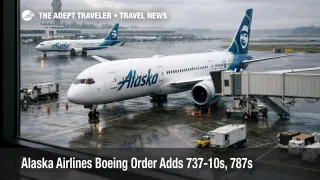
Alaska Airlines Boeing order news became official in Seattle, Washington, after Alaska Air Group and Boeing announced the carrier's largest aircraft deal, covering 105 Boeing 737-10 jets, five Boeing 787 widebodies, and purchase rights for 35 more 737-10s. The travelers most likely to feel the effects are Alaska and Hawaiian flyers who rely on Seattle as a connecting hub, plus anyone watching new long haul service to Europe and Asia. The practical next step is to treat this as a capacity and route pipeline rather than an instant schedule change, then watch for new route announcements, aircraft assignment updates, and any certification driven timeline shifts.
The Alaska Airlines Boeing order extends planned deliveries through 2035 and is designed to add seats on core domestic routes while scaling widebody flying for longer international missions tied to Seattle's growth as a global gateway.
Who Is Affected
Near term, the biggest impact is on travelers already planning to use Seattle Tacoma as a gateway to new international service that Alaska has put on sale for 2026. Alaska has already said daily Seattle service to London Heathrow begins May 21, 2026, and daily seasonal Seattle service to Rome begins April 28, 2026, with additional long haul ambitions tied to the expanding 787 fleet plan. For many travelers, that means more one stop itineraries via Seattle, but also a higher premium on connection padding when international banks are tight and weather or air traffic control constraints ripple across the Pacific Northwest.
Domestic flyers are also in scope because the 737-10 is a high capacity single aisle variant intended for dense routes, and Alaska frames it as both replacement and growth. More seats on the same departure times can lower the carrier's unit costs, and that frequently shows up as more competitive pricing in some city pairs, plus a reshuffling of which routes get larger aircraft versus more frequencies. If you regularly fly Alaska in the West Coast corridor, or connect across the carrier's network, the change you will notice first is not the airplane model number, it is schedule and seat map shifts as Alaska reallocates capacity route by route.
Internationally, Alaska is also integrating Hawaiian Airlines under the Alaska Air Group umbrella, while keeping two brands in the market. That matters because widebody flying, loyalty alignment, and passenger service systems have to work cleanly for long haul expansion to feel reliable to travelers. Alaska's own announcement ties its widebody plan to a goal of reaching at least 12 long haul international destinations from Seattle by 2030, which implies more Europe and Asia growth beyond the initial 2026 route set.
What Travelers Should Do
If you are booking Seattle centered international travel for spring and summer 2026, focus on the schedule you can buy today, and protect your trip against operational knock on effects. Build longer buffers for same day domestic to international connections at Seattle Tacoma International Airport (SEA), and avoid separate tickets when you can, because a single delay can still break a self built itinerary even when the long haul flight operates.
If you are planning travel beyond 2026 based on the promise of more capacity, set decision thresholds for when you will lock in flights. If your trip is discretionary, consider waiting for published schedules and consistent aircraft assignments rather than booking purely on speculation about future routes. If your trip is fixed, for example a wedding or a cruise departure, book the best available routing now, and prioritize changeable fares or points bookings so you can move if Alaska later launches a better nonstop or a cleaner connection.
Over the next 24 to 72 hours, monitor three things: Alaska's route announcements, any updates on 737-10 certification timing, and Alaska Air Group integration milestones that affect day of travel tools like rebooking and same day changes. If your itineraries involve Hawaii connections, keep an eye on airport side constraints and timing, especially if you connect through Daniel K. Inouye International Airport in Honolulu (HNL), since terminal work and system cutovers can change connection comfort and reliability even when flight times stay the same, as covered in Hawaiian Hawaii Airport Renovations Through 2029.
Background
Aircraft orders do not change tomorrow's departure board, but they are one of the main levers airlines use to reshape networks over several years. The first order effect is fleet availability, when an airline has guaranteed delivery slots, it can plan new routes, add seats to peak departures, and retire older aircraft without shrinking the schedule. Alaska is explicit that the 737-10 is aimed at renewing and expanding its single aisle fleet, and that the 787 plan is tied to long haul growth from Seattle.
The second order ripple spreads through at least two other layers of the travel system. One layer is connections and aircraft rotations. When a carrier upgauges routes to higher seat aircraft, it can consolidate frequencies, which changes connection patterns and can create tighter banks at hubs. That can improve one stop access to international destinations, but it also concentrates disruption, because a single delayed inbound can strand more passengers, and it can be harder to reaccommodate everyone on later flights when the plane is already full.
Another layer is crew, gates, and airport infrastructure. Widebody flying requires different staffing, longer turn times, and gate compatibility, and it often increases the need for recovery slack because long haul delays can cascade across multiple days of aircraft utilization. On the passenger side, that shows up as schedule reliability risk during growth phases, plus hotel demand spikes near hubs when irregular operations force overnights. It also intersects with entry requirements, since new long haul routes can fail in practice if travelers are not prepared for documentation checks or new electronic authorizations at check in, so if London is in your plan, UK Entry Requirements For Tourists In 2026 is the evergreen reference worth keeping handy.
A final operational variable is certification and delivery timing. Multiple outlets note that the 737-10 is still pending FAA certification, and Alaska has publicly retained flexibility to adjust within the 737 MAX family if timelines slip. For travelers, the key takeaway is straightforward: route expansions and capacity increases are more reliable once the planes are delivered and consistently assigned, and less reliable when they depend on future certification and production schedules.