

Storm Goretti Germany Trains Halted North of Hanover
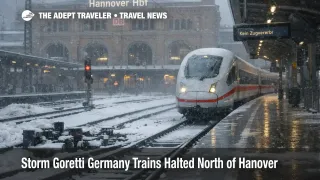
Heavy snow, ice, and strong winds from Storm Goretti disrupted transport across northern and parts of central Germany, prompting Deutsche Bahn to suspend long distance rail service across the north. The immediate effect was an abrupt loss of intercity capacity on routes that normally feed Hamburg, Berlin, and the Ruhr, with trains held short of the worst affected areas to protect passengers, staff, and rolling stock. If you are traveling within Germany or connecting onward into the Netherlands, Denmark, or other nearby markets, assume that your original routing may not operate as planned, and that recovery can lag the weather once trains and crews are out of position.
The disruption matters because the rail system does not fail in a neat, local way. When snowdrifts and icing block switches and overhead power equipment, trains are not only canceled, they are physically trapped away from their next assignments. That turns a few hours of severe weather into a multi wave timetable problem, especially when one of the network's critical nodes cannot run trains reliably.
Who Is Affected
Travelers most exposed are those whose itineraries depend on north south and east west long distance corridors touching the Hanover region, which functions as a high leverage junction for Germany's intercity network. Deutsche Bahn reported that the broader Hanover rail area was fully stopped for a period, making long distance service in the north effectively impossible and spilling disruption onto routes between Berlin and Hamburg, and between Berlin and North Rhine Westphalia.
International rail passengers are also in the blast radius even if the storm does not directly hit their origin city. Deutsche Bahn listed connections that could not be served during the disruption window, including services on corridors such as Hamburg to Copenhagen, Amsterdam to Hanover, Westerland or Kiel to Hamburg, Binz or Rostock to Berlin, and Norddeich or Emden to Hanover and the Ruhrgebiet. When any of these segments drops, the practical outcome is fewer rebooking options on the same day, longer queues at staffed counters, and a higher chance that your best alternative involves a detour through a less disrupted hub.
Even travelers who planned to switch from rail to air can be affected because the same weather system degraded operations at northern airports, and because rail is the default fallback when short haul flights cancel. When both layers strain at once, hotels near major stations, and ground transport such as taxis and long distance buses, tighten quickly as stranded passengers look for a safe overnight reset.
What Travelers Should Do
Take immediate steps to reduce uncertainty and protect your itinerary. Check DB Navigator and bahn.de for your specific train number and routing, then recheck shortly before you leave, because restoration often happens in stages and cancellations can be posted in batches. If you have a time fixed commitment, such as an event, a cruise, or a separate ticket onward, add buffer now, and proactively secure an overnight option near a major hub if your last viable train is at risk.
Set a clear decision threshold for rerouting versus waiting. If your long distance train crosses the northern corridor affected by the suspension, or relies on the Hanover area junction, treat a cancellation, a short turn, or a missing inbound trainset as your trigger to reroute through a less exposed hub and to move earlier in the day rather than later. Waiting can work when the system is running limited service and you have flexibility, but it tends to fail when rolling stock and crews are not yet repositioned, even after the snow stops.
Over the next 24 to 72 hours, monitor recovery signals, not just the forecast. Watch whether Deutsche Bahn continues to publish "cannot be served" route lists, whether the long distance network in the north is running a stable pattern rather than sporadic departures, and whether passenger guidance expands ticket flexibility across additional travel dates. Also monitor other regional disruptions that can compound the same trip, such as icing impacts at Central Europe airports, because rail detours only help if the broader transport stack is functioning. For context on how weather disruptions cascade across connected networks, see Freezing Rain Central Europe Airports, Delays Linger.
Background
Deutsche Bahn's long distance network is built around timed connections and shared equipment cycles, so a severe winter storm creates two different problems at once. The first order effect is operational safety: snowdrifts, icing, and switch failures reduce safe throughput or force a hard stop in the most exposed regions. Deutsche Bahn's own updates highlighted that snowdrifts, icing, and related switch issues were central constraints in the north, and that rail stoppages around Hanover removed a core junction from service.
The second order ripple is where travelers feel the extended pain. When long distance trains are held at upstream stations, the equipment cannot rotate to its next assignment, and crews can time out under duty limits. That mismatch then propagates outward into other layers of travel. Connections degrade because fewer trains arrive into hubs at the expected times, which forces rebooking onto already limited remaining services. Cross border rail corridors suffer when Germany's north cannot reliably feed the international segments, which can push travelers onto flights or long distance buses that were not part of the original plan. Finally, local mobility in affected northern cities is strained because regional rail and urban S Bahn services are often constrained by the same conditions, which increases the risk of missed airport check in times, late hotel arrivals, and higher last mile costs.