

Freezing Rain Central Europe Airports, Delays Linger
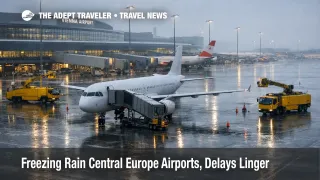
Freezing rain glazed runways across Central Europe, forcing Vienna International Airport (VIE), Budapest Ferenc Liszt International Airport (BUD), M. R. Stefanik Airport Bratislava (BTS), and Vaclav Havel Airport Prague (PRG) into temporary closures or severely restricted operating modes. The hit landed hardest on travelers with same day connections and anyone starting a trip on a tight schedule, because cancellations and diversions broke aircraft rotations in multiple directions at once. The practical next step is to assume knock on delays through the weekend, verify where your inbound aircraft actually is, and rebook around the disrupted hubs before airport queues and hold times spike.
The freezing rain Central Europe airports disruption matters because diversions do not end when the precipitation stops, they create an inventory and crew placement problem that can degrade schedules for days.
Reports from January 13 described flights diverting into larger alternates such as Munich Airport (MUC), Frankfurt Airport (FRA), Cologne Bonn Airport (CGN), and Venice Marco Polo Airport (VCE), a typical pattern when multiple mid sized hubs lose safe braking action or de icing throughput at the same time. Even after departures restart, airlines often need several cycles to rebuild the planned aircraft and crew sequence, which is why a morning reopening can still translate into evening cancellations on routes that depend on the same displaced aircraft.
If you have been tracking the earlier Lapland cold wave, the underlying dynamic is similar but spread across more hubs at once, which raises the odds that your aircraft is not where the schedule says it should be. For background on how winter operations can strand travelers even without classic snowstorms, see Deep Freeze At Kittila Airport Strands Lapland Tourists. For a broader view of how delays compound across networks once flow constraints start, see Flight Delays and Airport Impacts: January 16, 2026.
Who Is Affected
Travelers most exposed are those transiting the region on separate tickets or tight connections, because a diversion can quietly break your plan hours before your scheduled departure time. If your inbound aircraft diverted to an alternate and did not reposition back, the flight number may still show as "on time" until the airline formalizes the cancellation or aircraft swap, which is why checking the inbound tail and actual arrival airport can be more predictive than watching the clock.
Passengers flying smaller city pairs through Vienna, Budapest, Bratislava, or Prague can also see longer recovery times than travelers routed via mega hubs, because fewer daily frequencies mean fewer same day replacement seats. That constraint matters for travelers headed to cruises, tours, conferences, or rail connections that do not wait, especially when rail and road conditions are degraded by the same ice event.
Hotels and corporate travel managers are indirectly affected near the diversion airports and major rail nodes. When multiple flights divert or cancel into the same alternates, the immediate demand spike is for rooms, late check in flexibility, and ground transport, and that can tighten availability and raise prices even for travelers who never intended to stop there.
What Travelers Should Do
Take immediate actions that reduce uncertainty and protect cost. Check your flight in your airline app, then cross check the inbound aircraft's actual arrival airport in a flight tracker so you know whether your plane is displaced, and if it is, start rerouting now instead of waiting for a gate announcement. Add transfer buffer if you must travel to the airport by rail or road, because freezing rain events can degrade rail operations and make driving slow and accident prone.
Set a clear decision threshold for rebooking versus waiting. If your trip includes a same day onward connection, a fixed departure like a cruise, or any separate ticket, treat a diversion of your inbound aircraft as your trigger to rebook via a larger hub or to shift to an alternate airport, even if your flight still shows as scheduled. If you are on a single ticket, ask the airline for rerouting options that avoid the most disrupted hub, and prioritize getting protected onto any viable itinerary over holding out for the original flight number.
Over the next 24 to 72 hours, monitor the signals that indicate whether recovery is stabilizing. Watch whether arrival rates remain capped at Prague, whether Vienna and Budapest are running normal departure banks without rolling gate holds, and whether your airline is issuing waivers that let you change dates or routings without fare difference. Keep an eye on rail operator updates for airport rail links and intercity corridors, because ground alternatives only help if they are running reliably.
How It Works
Freezing rain is operationally disruptive because it can create a near invisible ice layer that refreezes faster than crews can clear it, reducing runway braking action and slowing de icing throughput to the point where safe departure and arrival rates collapse. The first order effect is straightforward, flights cancel, flights divert, and the airport's departure sequence breaks because aircraft cannot be turned on schedule. The second order ripple is where travelers feel the multi day pain, aircraft end up parked at alternates, crews time out or become unavailable due to duty limits, and the next day's schedule inherits the mismatch.
That mismatch propagates outward across at least two other layers. Connections degrade across airline networks because late arriving aircraft miss their next legs, and hubs that absorbed diversions see gate pressure and ground handling strain that can delay their own departures. At the same time, rail and road systems are often hit by the same icing conditions, which means the usual "just take a train" fallback may be partially constrained, and airport access can become a timing risk rather than a solution. As a result, hotel inventory near alternates and major stations can tighten quickly, and travelers who would normally ride out a delay at the airport may be better off locking in accommodation early and resetting to a next day plan.
Sources
- Freezing rain and ice disrupt travel across central and eastern Europe
- Ice closes Vienna airport, disrupts flights in Prague
- Flights diverted and trains delayed as freezing rain and ice hit central and eastern Europe
- Letisko Bratislava closure update post
- Air passenger rights, EU rules on rerouting and assistance