

Cumbria Landslip Disrupts Cumbrian Coast Rail
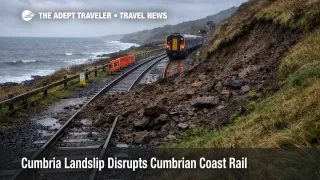
A landslip on the Cumbrian Coast Line closed the railway between Drigg and Seascale in Cumbria, disrupting Northern services that connect coastal Lake District bases and West Cumbria towns. For travelers, the practical impact showed up as trains not running through the middle of the coastal corridor, with services on key legs curtailed and connections breaking for same day itineraries. National Rail reported the disruption as affecting routes between Preston, Lancaster, and Barrow in Furness and Corkickle, and also between Millom and Workington, before marking the incident cleared on the morning of December 18, 2025.
This matters because Millom and Corkickle are not just intermediate stops, they function as the edges of where trains can realistically turn back when the line is blocked further north. When that happens, the rail network stops behaving like a continuous coastal loop, and starts behaving like two separate stubs that cannot hand passengers across the gap without road transport. In this event, National Rail's incident page showed the line reopening with disruption expected into the morning commute window, then clearing at 9:51 a.m. on December 18, 2025.
Who Is Affected
You are most exposed if your plan relied on the scenic coastal rail segment as the backbone of a multi stop itinerary, especially if you were moving between Barrow in Furness area accommodations and West Cumbria stops like Whitehaven, Corkickle, and Workington, or if you were trying to chain rail into local buses for trailheads and small villages. National Rail explicitly listed the affected corridor as spanning both the southern approach from Preston and Lancaster through Barrow in Furness to Corkickle, and the northern portion between Millom and Workington, which is exactly the span tourists use to move between Lake District edges and the industrial coast.
Travelers checking into rural lodging are a special risk group because "late but same day" is often not operationally neutral in small properties, where hosts may have limited reception hours, limited staff, and stricter key handoff arrangements. The moment a rail suspension pushes you into taxis, last minute buses, or split routing, arrival times become uncertain, and costs climb fast because there are fewer vehicles and fewer parallel routes than in large cities. Even if you are not staying on the coast, disruption on this line can still reach you if your Lake District plan depends on a timed rail handoff to a bus corridor, or a prebooked pickup.
What Travelers Should Do
If you are traveling in the next few days during unsettled weather, plan as if another short notice closure is possible on the Cumbrian Coast Line, and build a buffer you can actually use. Check National Rail and Northern updates before you leave your accommodation, not just before you depart the origin station, and treat "part suspended" as meaning your whole chain is fragile because the last mile substitutes may be thin or unavailable.
Use a decision threshold for rebooking versus waiting. If your itinerary requires arriving by a fixed time for a rural check in, a guided hike, or a nonrefundable activity, do not keep waiting once your first reliable rail leg is canceled or severely delayed, shift to a West Coast Main Line gateway plan and rebuild the rest of the day from there. In practice, that often means aiming for bigger nodes that have more trains, more accommodation inventory, and more transport options, then moving onward when service stabilizes.
Over the next 24 to 72 hours, monitor three things in parallel. Watch for any fresh severe weather that saturates ground and increases earthwork risk, watch for any operator notices about curtailed turnback patterns, and watch for signs of constrained recovery like repeated cancellations after reopening. Network Rail notes that heavy rain saturating the ground is a common trigger for landslips, and that even after an initial slip, slopes can remain weakened and more likely to move again, which is why disruption can recur during the same weather pattern.
Background
Landslips are one of the clearest examples of how a local infrastructure failure propagates through the travel system. The first order effect is simple, debris blocks or destabilizes the track, trains cannot safely proceed, and operators have to terminate short or reroute where alternative lines exist. Network Rail's own explainer is blunt about why this is not like a road obstruction, trains cannot swerve around debris, and services often have to be rerouted until debris is removed and the infrastructure is checked as safe.
The second order ripple is where travelers feel the pain. When a rural line is split, trainsets and crews end up on the wrong side of the blockage, and the next planned trips on either side may be canceled even if the weather improves, because you cannot instantly "rebalance" the fleet. Then the pressure moves outward, taxis and any replacement buses get overloaded, hotels near the last reliable station tighten up as stranded travelers need beds, and day tours and timed transfers start failing because guests arrive late or not at all. In Cumbria, that can also mean road transfers become longer and more expensive, because detours around coastal pinch points can add meaningful driving time, and winter conditions can constrain what operators are willing to run.
This specific landslip occurred in a wider winter disruption context where saturated ground and high winds have been affecting multiple UK transport modes. For related UK weather driven travel planning, see Storm Goretti UK Ferries And Airports Disrupted Jan 9.
Sources
- Lines reopened: disruption between Barrow-in-Furness and Corkickle expected until 10:00 (National Rail incident page)
- Landslips (Network Rail, delays explained)
- Landslip in West Cumbria cancels trains (Cumbria Crack)
- Landslip Closes Cumbrian Coast Line Between Drigg and Seascale (DP Simulation UK Railway News)