

NATS Radar Outage, Birmingham Airport Flight Delays
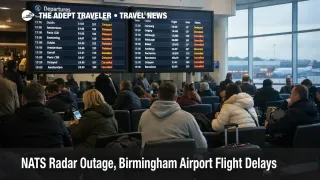
A radar related air traffic control disruption halted arrivals at Birmingham Airport (BHX) overnight after a power line fault cut power to a National Air Traffic Services, NATS, radar site. The biggest impact hit inbound passengers and anyone on short haul rotations that depend on quick turnarounds, including UK, Ireland, and near Europe routes that feed onward connections. Travelers should treat January 12, 2026, as a recovery day, check whether their aircraft is out of position, and be ready to reroute via larger UK hubs if their flight is pushed deep into the day.
The Birmingham Airport NATS radar outage reduced arrival capacity and forced diversions, which then cascaded into delays and cancellations as airlines rebuilt workable aircraft and crew rotations.
NATS said the radar serving Birmingham was restored shortly before 130 a.m. on Monday, January 12, 2026, after engineers worked with National Grid on a power cut in Shropshire. Reporting also cited National Grid saying power was restored by about 125 a.m. Even after a technical fix, passengers often feel the disruption later because diverted aircraft are not where the schedule expects them to be, and crews can hit legal duty limits while waiting for a late aircraft to arrive. More than 20 flights were reported as canceled, diverted, or heavily delayed, with some delays exceeding four hours.
Who Is Affected
Inbound passengers were the most exposed because arrivals were suspended during the disruption window, which meant flights either diverted to alternates such as East Midlands Airport (EMA) and Liverpool John Lennon Airport (LPL), returned to origin, or held until a new plan was issued. If you diverted to an alternate airport, the practical pain point is not only the delay, it is that your ground transport, rail ticket, car hire pickup, and hotel check in were probably built around Birmingham, not a different city at midnight.
Outbound passengers can also be affected even when departures are still operating, because aircraft and crews do not appear on demand. A Birmingham departure that looks fine on the board can still slip if the inbound aircraft was diverted earlier, or if a replacement aircraft is being ferried in from another base. That is why the first morning bank is often the most fragile, and why the mid morning to midday window can be more reliable once rotations are rebuilt.
Connecting travelers are a special risk case. If your itinerary depends on a protected connection through London Heathrow Airport (LHR), London Gatwick Airport (LGW), or Manchester Airport (MAN), a Birmingham delay can push you out of the day's connection bank and into overnight reaccommodation. If you are on separate tickets, the risk rises because you can lose the onward segment entirely, and you may have to buy a new ticket at last minute prices. For broader winter context that can compound recovery, see Storm Goretti UK Snow, Wind Risks for Travel Jan 8 to 9.
What Travelers Should Do
Start by verifying whether your aircraft is actually arriving into Birmingham, not just whether your flight is still listed. If the inbound aircraft shows a diversion or a late arrival from an alternate, assume your departure time is unstable and delay nonessential trips to the airport until your airline confirms a realistic gate plan. Build extra buffer for ground transport, and keep essentials, medications, chargers, and one change of clothes in cabin baggage in case you are rebooked or diverted.
Use a clear decision threshold for rerouting versus waiting. If your flight is delayed into the last viable connection window for your onward plan, or if you must reach a fixed event such as a cruise embarkation, a wedding, or a nonrefundable tour start, push for a reroute through London or Manchester while seats still exist. If you have flexibility and multiple daily options, waiting can be reasonable, but only if you are prepared for an involuntary overnight and the cost and availability of nearby hotels.
Over the next 24 to 72 hours, monitor three things: airline rebooking waivers, aircraft positioning, and airport operations updates. Waivers matter because they let you move flights without change fees, positioning matters because a disrupted aircraft can take multiple legs to return to plan, and airport updates matter because winter conditions can trigger a second shock even after the radar issue is fixed. If you are flying easyJet out of Birmingham on an early departure that still looks intact, using Twilight Bag Drop at Birmingham Airport for easyJet can reduce morning friction when the terminal is dealing with uneven recovery.
How It Works
Air traffic control, ATC, uses radar and other surveillance feeds to maintain safe spacing and an orderly flow of arrivals and departures. When a key radar feed is lost or degraded, controllers can still operate safely, but they may have to reduce the arrival rate, increase spacing, or temporarily suspend arrivals while contingency procedures are applied. That first order capacity cut is what travelers see as holding, diversions, and long delays.
The second order ripple is schedule physics. A diverted inbound aircraft often ends up parked at an airport where it was not meant to be, and the crew may time out while waiting, which can then cancel the next leg even if the airport is technically open. Airlines may swap aircraft, consolidate two flights into one, or reroute passengers across other hubs, all of which increases pressure on limited seats and creates longer reaccommodation queues. The third order effect spreads beyond aviation, because diverted passengers need ground transfers from alternate airports, rail tickets get missed, and local hotel inventory tightens as stranded travelers absorb last minute rooms.