

Frankfurt Airport Flight Cancellations, 102 Flights Jan 12, 2026
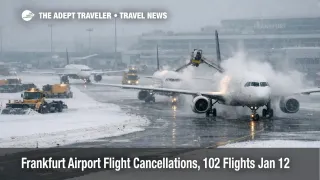
Snowfall and icy conditions cut operations at Frankfurt Airport (FRA) on Monday, disrupting one of Europe's busiest connection points. Airport operator Fraport said 102 of the day's 1,052 scheduled flights were canceled, and the count could rise as conditions evolve. Travelers with tight same day connections should assume longer lines, slower rebooking, and a higher chance of forced overnight stays, then pivot early to protected rebooking or an alternate routing before queues build.
Frankfurt Airport flight cancellations are now a measurable capacity cut, not just "winter delays," because the airport was already operating with a smaller schedule for the day. Fraport said disruption was expected to last until at least midday local time, which matters because Frankfurt's most connection heavy departure and arrival waves sit inside that window for many Europe to long haul and long haul to Europe itineraries.
The weather signal around Frankfurt, Germany, also pointed to operational friction beyond runway clearing. The German Weather Service warned of widespread freezing rain and significant ice risk across Hesse on January 12, with only gradual improvement in some higher elevation areas into the night. That combination typically slows aircraft deicing, increases taxi and braking action constraints, and makes ground access to the terminals less reliable, even if the snowfall itself eases.
Second order effects show up fast when Frankfurt loses departures, because aircraft and crews that should have rotated onward end up parked or delayed. When that happens, later flights can cancel even after conditions improve, simply because the plane, the crew, or both are in the wrong place, and airlines protect longer haul and higher load factor flights first. That is why the practical traveler problem is not only "Is my flight delayed," but also "Will my rebooking options evaporate once the next bank hits."
Who Is Affected
Travelers departing from Frankfurt Airport (FRA) are directly exposed to cancellations, gate holds, and extended deicing timelines, especially if they are traveling on the first or second flight of an aircraft rotation. Travelers connecting through Frankfurt are often hit harder than origin and destination passengers because a single cancellation can break multiple onward itineraries, and rebooking desks must triage hundreds of misconnects into limited remaining seats.
The highest risk group is anyone with a tight same day connection through Frankfurt on Star Alliance carriers, particularly when a schedule trim lands inside major connection banks. A two hour connection that normally feels safe can become a coin flip if the inbound arrives late, the gate changes, and the outbound closes on time because it is one of the few flights still operating.
Separate ticket itineraries are also exposed. If the inbound is delayed or canceled, the onward carrier may treat the traveler as a no show, and winter disruption days are when same day walk up fares and last seat inventory become most punishing. Travelers starting in smaller European cities feeding Frankfurt can also see knock on cuts, because airlines often cancel short haul feeders first to protect scarce runway slots for long haul and higher yield departures.
Finally, travelers trying to bail out to rail should assume constraints, not a clean escape hatch. Deutsche Bahn warned that freezing rain could bring delays and short notice cancellations in central, southern, and southeastern Germany on January 12, and it also cited precautionary speed reductions on parts of the network, including the Cologne to Frankfurt high speed connection.
What Travelers Should Do
Start with immediate triage. Check your operating carrier's flight status, then look for a same day change or waiver before heading to the terminal, because reaccommodation lines build fastest once the first cancellation wave hits. If you must travel today, protect slack by moving to a later connection or by shifting to a routing that keeps you on one ticket, with checked bags through to the final destination.
Use a clear decision threshold for rebooking versus waiting. If your itinerary has a time critical event, a cruise embarkation, an unmissable meeting, or a last onward flight of the day, treat the cancellation count as a signal to buy certainty, even if it means an earlier overnight near the airport or a longer reroute. If the trip is flexible, waiting can work, but only when you have a confirmed, protected rebooking option in hand, not a hope that standby will clear.
Over the next 24 to 72 hours, monitor three things in parallel: Frankfurt's cancellation totals and recovery pace, the German Weather Service updates for ice risk in Hesse, and Deutsche Bahn service notices for the rail corridors you would actually use as a backup. If the weather remains in a freezing rain pattern, expect uneven recovery, because the system has to unwind aircraft and crew positioning, not just clear runways.
How It Works
A snowfall and ice day at a hub like Frankfurt propagates in layers. The first order impact is reduced movement capacity, as runways and taxiways must be cleared, aircraft must be deiced, and operations must be paced to match safe braking action and visibility. Even small reductions matter at a hub because arrivals and departures are interlocked, a delayed arrival blocks gates, which delays the departure that needs that gate, which then pushes the next inbound into holding.
The second order ripple is network positioning. When 102 flights drop out of the schedule, aircraft that should have flown to another base do not get there, and crews can time out under duty limits. Airlines respond by canceling more flights that are "easiest" to cancel operationally, often short haul segments that have multiple later options, but those are the very flights many travelers need to make connections.
The third order ripple lands outside aviation. As travelers scramble for alternatives, airport hotels tighten, rideshare and taxi availability becomes inconsistent, and rail becomes the obvious substitute for nearer city pairs. That is why Deutsche Bahn disruption notices matter on a Frankfurt cancellation day, because a rail slowdown removes the most common contingency plan for Germany and nearby cross border trips, while also pulling more stranded flyers into the same trains that regular passengers were already planning to use.
For related weather disruption context from the same winter pattern, see Storm Goretti Turkey Flooding Disrupts Roads, Ferries.