

Storm Goretti Turkey Flooding Disrupts Roads, Ferries
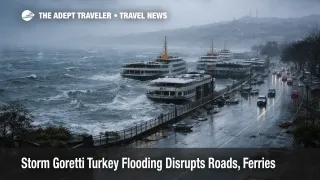
Storm driven flooding and gale conditions tied to Storm Goretti's wider weather pattern are now hitting farther southeast, with spillover impacts showing up in Turkey and across parts of the western Balkans. In Turkey, severe winds have been strong enough to damage structures, and authorities have warned of transport disruption risks that range from roof debris to flooding and difficult driving conditions. In Istanbul, multiple city ferry lines have been suspended due to adverse conditions, which turns what is normally a simple cross city move into a timing risk that can cascade into missed rail departures, tour starts, and hotel check in windows.
In the western Balkans, flooding impacts have been acute in Albania, where authorities reported rising river levels, inundated areas, landslides, infrastructure damage, and road blockages, and urged residents to avoid unnecessary travel in affected zones. Reuters reporting also describes evacuations from flooded homes, and broader regional disruption across neighboring Balkan countries from snow and winter weather, which can compound recovery because alternate overland routes are also stressed.
This is a different operational problem than the earlier northern Europe phase of the same storm story. When a rail corridor or an airport trims schedules, travelers often still have usable road backups. When roads flood and ferries stop, the backups collapse into a smaller set of viable nodes, and delays become overnight problems instead of same day inconveniences.
Related coverage for context: Storm Goretti Northern Europe Flights, Trains Cut and Storm Goretti UK Ferries And Airports Disrupted Jan 9.
Who Is Affected
Travelers in northeastern Turkey and along exposed coastal and marine corridors are the most exposed when high winds create debris hazards and when sea conditions force service suspensions. Even if your hotel area is not flooded, transport links can still fail, and that is what breaks itineraries.
Istanbul visitors are directly affected if they rely on city ferries for cross Bosphorus movement, island access, or time critical transfers between neighborhoods. Anadolu Ajansı reported that multiple Şehir Hatları routes were paused due to adverse conditions, and Şehir Hatları' own status page lists numerous lines that are not operating until further notice. If your plan assumes a ferry ride as a fixed time block, treat it as variable until normal operations are explicitly restored.
In Albania and nearby western Balkan corridors, travelers moving by car, private transfer, or intercity bus are the most exposed because flooding and landslides directly remove road capacity. Albania's Ministry of Defence described multiple regions as most affected and warned of road blockages and evacuations, while Reuters reported evacuations around towns near the Vjosa River as water levels rose, plus wider Balkan disruption from snow and related winter impacts.
What Travelers Should Do
If you are inside the affected footprint, prioritize immediate buffers over optimism. Convert same day overland stacks into single anchor moves, and protect the overnight at a hub where you still have multiple onward options. In Istanbul, assume ferry dependent cross city plans can fail without much notice, and build an alternate that does not require water crossings.
Use a clear decision threshold for rebooking versus waiting. If your next leg requires driving through low lying areas, river valleys, or landslide prone slopes, delay the overland segment rather than trying to thread partial closures, because road conditions can degrade faster than they improve during heavy rain and runoff. In Albania, official guidance explicitly urges avoiding unnecessary travel in flooded or landslide prone zones, which is a strong signal to stop treating the itinerary as fixed.
Over the next 24 to 72 hours, monitor the operator status pages that directly control your choke points, plus civil protection updates for the specific region you must traverse. For Istanbul, that means checking the live cancellation status for your exact ferry line, not a general weather forecast. For Albania and neighboring corridors, that means tracking where flooding and road blockages are being reported, because one blocked segment can force long detours that break bus schedules and hotel check in timing.
How It Works
Flooding and gale events disrupt travel in layers, and the most important part is how quickly the disruption propagates beyond the obvious hazard zone. First order impacts start at the source: water over roads, landslides, debris, and wind conditions that force marine operators to pause services for safety. Istanbul's ferry suspensions are a clean example, once ferries stop, cross water movement becomes a bottleneck, and travelers re route onto bridges, road tunnels, or longer surface routes that are already strained by weather and debris risks.
Second order ripples hit connections and vehicle, crew, and asset positioning. When a ferry line or an intercity bus route misses rotations, the next day's timetable can remain uneven even if conditions improve, because equipment and staff are out of place, and safety inspections often stage the restart. That is when missed connections climb, because travelers who would normally rebook onto later same day departures get pushed into the next day, and the remaining seats or rooms in safer nodes tighten quickly.
Third order impacts land on lodging and local services. Albania's civil protection updates describe evacuations and emergency response across multiple regions, which is a strong sign that some travelers will be displaced into limited accommodation markets. When that happens, even travelers outside the floodwater footprint can feel the disruption through scarce last minute rooms, higher transfer pricing, and reduced tour reliability as operators wait for safe access and for clients to arrive.
Sources
- Widespread power cuts, travel disrupted as Storm Goretti hammers northern Europe
- One dead in floods in Albania as rain and snow grip Balkans
- Notice on the situation caused by adverse weather conditions in the country
- Meteorolojik Uyarı
- İstanbul'da deniz ve teleferik ulaşımına hava muhalefeti engeli
- İptal Seferler