

Venezuela Security Alert, Depart Immediately Guidance
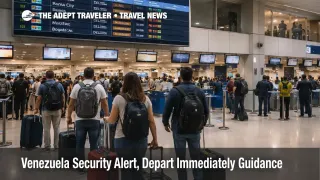
The U.S. State Department has reiterated that Venezuela remains at Level 4, Do Not Travel, and it is telling U.S. citizens and lawful permanent residents in the country to depart immediately. The guidance matters because the U.S. government says wrongful detention and arbitrary enforcement can escalate quickly, and because routine and emergency consular services are still suspended. Travelers with Venezuela in near term plans should treat this as a trip ending change, and shift to alternate destinations or defer until official guidance meaningfully relaxes.
The Venezuela security alert depart immediately message turns what can look like a normal flight availability problem into a time sensitive risk decision. Even if some flights operate, the planning baseline is that conditions can deteriorate without much warning, and that U.S. government on the ground help may not be available.
Who Is Affected
U.S. citizens and lawful permanent residents in Venezuela are the most directly targeted audience for the depart immediately instruction, including travelers who entered on Venezuelan or other foreign passports. The State Department also warns that the U.S. Embassy in Caracas has been non operational since March 2019, which reduces the practical backstops travelers often assume exist when plans break.
Non U.S. travelers can still be affected in two ways. First, when a major government elevates and re amplifies risk language, airlines, insurers, employers, and assistance providers often tighten their own rules around coverage, routing, and duty of care decisions. Second, when more people attempt to leave at once, the exit system constricts, meaning fewer seats, longer connection times, higher prices, and more overnight stays in intermediary hubs.
Travelers transiting the Caribbean, or connecting through nearby hubs, should also factor aviation risk notices. The FAA has issued hazard advisories for the Maiquetia flight information region tied to military activity in or around Venezuela, and a recent Congressional Research Service summary describes how Caribbean airspace actions in early January 2026 disrupted flights even beyond Venezuela itself. Those notices can translate into reroutes and tighter rebooking inventory when airlines try to keep flights away from higher risk airspace.
What Travelers Should Do
Travelers currently in Venezuela should prioritize a fast, simple commercial exit plan, even if it is not the most comfortable itinerary. Choose the first viable flight sequence that gets you to a stable hub, then rebook the rest from there, because minimizing road movements and discretionary stops reduces exposure when conditions are volatile. Keep travel documents and proof of onward travel accessible, and assume you may need extra screening time at the airport.
Use decision thresholds that favor leaving over waiting. If your best option requires multiple separate tickets, tight same day connections, or long surface transfers, treat that as a warning sign and look for an alternative routing or an earlier departure. If you have any passport irregularities, do not try to "push through" on hope, because document flags can turn into detention or refusal events at borders. For a quick primer on how sudden passport status issues can collapse a trip, see U.S. Passports Flagged Lost Can Block Entry Abroad.
Over the next 24 to 72 hours, monitor three things in parallel: official travel guidance, airline schedule changes, and airspace advisories that can reshape routings. The FAA hazard advisory posture around Venezuela and the wider Caribbean can change the practical availability of seats, even when your airline is still selling an itinerary. If you are using travel insurance or a security assistance provider, contact them before you depart so approvals, case numbers, and escalation paths are already in place if you misconnect or need urgent support.
Background
State Department travel advisories are not just informational, they are operational inputs for the travel system. When the guidance is Level 4, Do Not Travel, and the language urges travelers to depart immediately, airlines tend to see a surge in one way demand, assistance providers see higher call volume, and rebooking queues thicken at the same regional hubs. That is the first order effect, more travelers trying to move through a constrained set of exit pathways at the same time.
The second order ripples show up in connection reliability and aviation routing. Even if your specific flight does not overfly Venezuela, hazard advisories for the region can lead carriers and dispatchers to choose longer routings, and longer routings consume time, crew duty windows, and spare aircraft flexibility. When a bank of flights is delayed or retimed, that disruption propagates into missed onward links, forced hotel nights in intermediate cities, and slower reaccommodation for everyone sharing the same constrained inventory. In the Venezuela case, the State Department also points to U.S. transportation restrictions history, including the long standing suspension of U.S. Venezuela air service, which limits the number of straightforward itineraries available when demand spikes.
Sources
- Venezuela International Travel Information
- Prohibitions, Restrictions and Notices, Federal Aviation Administration
- KICZ ADISORY NOTAM A0011 26 SVZM
- U.S. Military Action in Venezuela Triggers Caribbean Airspace Closures and Flight Disruptions
- DOT Order 2019 5 5, Suspension of Air Service to and from Venezuela