

Wellington Wind Flight Cancellations, Rebooking Delays
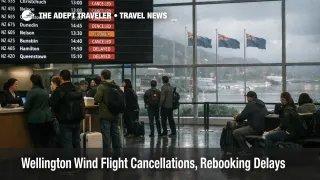
Wellington wind flight cancellations disrupted service through Wellington International Airport (WLG) after extreme gusts made approaches and departures unreliable, triggering widespread airline schedule changes. Air New Zealand customers traveling to or from Wellington, New Zealand were the most directly affected, especially anyone connecting onward on the same day. Travelers should pivot quickly to self service rebooking, add overnight buffer where timing matters, and treat the recovery as a network reset rather than a single afternoon delay.
The practical change for travelers is that Wellington wind flight cancellations created a rebooking backlog with limited remaining seats, so the main risk shifted from the wind itself to the speed, and flexibility, of reaccommodation.
Radio New Zealand reported that passengers on more than 50 Air New Zealand flights were affected after high winds in Wellington, with gusts reported over 100 km or h. Air New Zealand leadership described "widespread disruption across our network," and emphasized that rebooking volumes can constrain seat availability for multiple days as the airline works aircraft and crews back into sequence.
Wellington Airport has also been explicit about the operating reality in severe wind, airlines may cancel flights even when the terminal remains open, and clearing a backlog often depends on whether carriers can add services or reshuffle rotations once conditions stabilize. In other words, a weather improvement does not automatically mean an immediate schedule recovery, because the network has to "catch up" with the right planes and crews in the right places.
Who Is Affected
The highest risk group is anyone whose itinerary depends on Wellington as a hinge point, meaning a domestic segment into or out of Wellington followed by a time sensitive onward commitment such as a long haul departure, a cruise embarkation, a tour start, or a meeting with no realistic same day substitute. When a Wellington sector cancels, the traveler is not just delayed, they are competing with everyone else from the same cancellation wave for a limited pool of seats on later flights.
Travelers on separate tickets are also exposed because a disrupted domestic segment can break an international plan without triggering protection from the onward carrier. Air New Zealand's own disruptions guidance draws a bright line between connections on the same ticket, where the airline will try to make it work, and separately booked travel, where the traveler often has to negotiate each segment independently.
There is also a second order accommodation effect that builds fast in New Zealand domestic disruptions. When passengers roll forward by a day, Wellington hotels, and hotels in destination cities, can tighten at the same time, because both the origin and the endpoint can end up holding stranded travelers. If Cook Strait conditions are also rough, ferry cancellations can remove an alternate path and keep more passengers competing for the same air inventory.
What Travelers Should Do
Start with immediate triage that assumes inventory is tight. Use Air New Zealand's app, Manage Booking, and travel alerts to see what the system has already protected you onto, then move quickly if the option does not meet your needs, because the best remaining seats tend to disappear as each cancellation wave feeds the same queue. If you are not at the airport yet, do not rush into terminal lines unless you have confirmed you cannot self serve a workable change.
Set decision thresholds for rebooking versus waiting. If you are within one canceled sector of an international departure, treat "same day" as a bonus, not a plan, and price an overnight in Wellington, or at your international gateway, before the late day scramble starts. If the flight you need is the last practical departure of the day, or you are traveling on separate tickets, lean toward moving to the next day earlier rather than later, because a late cancellation can leave you with no realistic salvage options.
Over the next 24 to 72 hours, monitor three signals, Wellington wind warnings and forecasts, Wellington Airport flight status trends, and Air New Zealand's disruption guidance for how to confirm, or change, protected rebookings. If you see repeating peaks of cancellations, or repeated references to constrained seat availability, assume the recovery is still in progress and keep buffers in your ground plans, lodging, and onward connections.
How It Works
Wellington disruptions in extreme wind are often less about a formal airport closure and more about operating limits that reduce the number of safe movements per hour. When airlines cancel a bank of flights, the immediate effect is obvious, passengers miss departures and inbound aircraft do not arrive. The second layer is aircraft, and crew, mispositioning, the plane that should have flown a later rotation is now in the wrong city, and crews can time out under duty rules, which turns a delay into an additional cancellation even after conditions improve.
Air New Zealand's disruption guidance is built around this reality, the airline will try to get you onto the next available option, but the constraint in a weather event is frequently seat supply, especially when loads are already high. That is why self service speed matters, it is often the difference between securing a workable same day reroute and being pushed into the next day's inventory.
For travelers, it helps to understand how warning language maps to travel risk. MetService's severe weather framework reserves Red warnings for only the most extreme events, and that is a practical signal that transport disruption can be widespread, not just localized, which increases the chance that your backups, including ferries, and road transfers, are stressed at the same time.
When rebooking feels unusually constrained, it is also worth remembering that many airline networks are operating in a tighter capacity environment than pre pandemic norms, which can make disruption days more punishing because there is less slack to absorb misconnects. For a deeper explainer on why constrained seat supply can amplify disruption recovery, see FAA Delays on Boeing 737 MAX 10 Hit Airline Capacity.
Related disruptions elsewhere show the same recovery mechanics, weather reduces throughput, cancellations break rotations, and rebooking backlogs become the dominant traveler problem. Two comparable recent examples are Zurich Airport Freezing Weather Cancels SWISS Flights and Frankfurt Airport Flight Cancellations, 102 Flights Jan 12, 2026.
Sources
- More than 50 flights cancelled as high winds batter Wellington
- 'Extreme wind' sees dozens of flights cancelled at Wellington Airport
- Strong winds in Wellington cause major disruption to airline schedules
- Flight cancellations, Wellington Airport
- Flight disruptions due to cancellations or delays, Air New Zealand
- Receive travel alerts, Air New Zealand
- Severe Weather Outlook, MetService
- Bluebridge ferry to recommence sailing after days of cancellations