

Avelo RDU and ILM Base Closures Cut Nonstop Flights
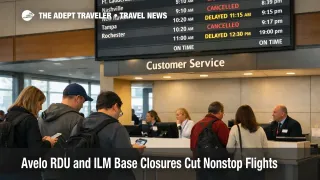
Avelo Airlines confirmed it will close its operating bases at Raleigh-Durham International Airport (RDU) and Wilmington International Airport (ILM), shifting those stations from "based crew and aircraft" operations into thinner, spoke-style flying from other hubs. Leisure travelers who rely on Avelo for nonstop weekend trips out of the Triangle and the North Carolina coast are the most exposed, because a base closure typically reduces the airline's ability to recover quickly when anything slips. The practical next step is to recheck your schedule now, price out backups on carriers with more daily options, and decide early whether you can tolerate a limited frequency route.
North Carolina workforce filings make the timing concrete. The North Carolina Department of Commerce WARN summary lists March 6, 2026 as the effective date for a permanent closure action tied to Avelo locations in Morrisville and Wilmington, with 78 impacted workers at RDU and 82 at ILM. Local reporting in the Raleigh market matches that same March 6 date for the crew base shutdown.
Who Is Affected
Travelers are affected in two different ways, and it helps to separate them. First are people with tickets on routes Avelo is eliminating or retiming as part of its network simplification, because those trips can shift onto different days, different hubs, or disappear entirely with only limited same-carrier alternatives. Second are travelers who remain "served" on paper but lose resiliency in practice, because the airport is no longer a base with spare crews, spare aircraft coverage, and easier same-day swaps.
Avelo's own statement says it will continue serving Raleigh-Durham from Tweed New Haven Regional Airport (HVN) and Frederick Douglass Greater Rochester International Airport (ROC). For Wilmington, Avelo says it will continue service from Nashville International Airport (BNA), Tweed New Haven (HVN), Tampa International Airport (TPA), and Baltimore-Washington International Thurgood Marshall Airport (BWI). That means some nonstop options remain, but the schedule is now structurally more fragile because the airline is feeding those airports from other bases rather than launching and recovering locally.
What Travelers Should Do
Start with immediate protection steps and buffers. Pull up your Avelo reservation and verify whether your flight number, day of week, and departure time still match what you purchased, then screenshot the current itinerary and keep it with your trip records. If your trip is within two weeks of March 6, 2026, treat any schedule change notice as a prompt to reprice alternatives immediately, because the cheapest backup seats often vanish first on low frequency leisure routes. If you are building a larger trip, add a buffer night before anything you cannot miss, such as a cruise embarkation, a wedding, or a first-day check-in with a strict deadline.
Use clear decision thresholds for rebooking versus waiting. If your plan depends on a single Avelo flight for that day, and arriving late would meaningfully break the trip, the rational move is usually to switch now to an airline and routing that offers multiple same-day departures, even if it costs more. If your trip is flexible by a day, you can often wait longer, but only if you also accept the risk of being pushed into the next operating day when reaccommodation options are limited. For some travelers, nearby alternates can also be a pressure valve, for example Charlotte Douglas International Airport (CLT) or Piedmont Triad International Airport (GSO) for the Triangle, and Myrtle Beach International Airport (MYR) or Jacksonville International Airport (JAX) for the coast, but only if the drive time still keeps the trip viable.
Over the next 24 to 72 hours after any schedule change message, monitor three signals rather than guessing. Watch whether your specific route still appears for sale on Avelo's route map and booking engine, watch seat availability and price movement on the competing carriers you would switch to, and watch systemwide operational conditions that could amplify disruption if you end up traveling on a thin schedule day. A practical tool is your daily delay risk check when you are rebooking, because weather or air traffic flow constraints can turn a marginal itinerary into an overnight quickly, even when the schedule looks fine. For that layer, see Flight Delays and Airport Impacts: January 13, 2026.
How It Works
A crew base is not just a branding label, it is a recovery tool. When an airline bases aircraft and crews at an airport, it can start the day with aircraft already on the ground, keep reserve staffing within reach, and swap airplanes or crews more easily when a flight runs late. Once the base is removed, the station often becomes dependent on inbound aircraft and crews arriving on time from elsewhere, which increases the odds that an upstream delay becomes your cancellation, and then reduces the number of same-day options to fix it.
That base-level change propagates through the travel system in predictable layers. The first-order effect is schedule thinning, fewer departures and fewer unique routes, which raises the "single point of failure" risk for weekend leisure travel. The second-order effect is reaccommodation pressure, when a flight cancels, the airline has fewer later departures of its own to rebook you onto, and competitors may have limited seat inventory, especially on peak days. The third-order ripple is on the ground layer, hotel nights, rental cars, and rideshare demand can spike in the local market when travelers are forced into overnight stays, and that cost often lands on the traveler unless the cancellation trigger is clearly within the airline's controllable scope.
Avelo has framed the base closures as part of a broader balance sheet and fleet transformation, including simplifying around core bases and removing six Boeing 737-700 aircraft to focus on a more efficient 737-800 operation. In traveler terms, that usually means fewer fringe routes, more concentration in selected markets, and more volatility on low frequency leisure flying during the transition period.