

Greece Air Traffic Control Outage Audit 2026
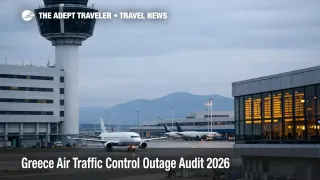
Greece air traffic control outage risk moved from rumor to documented reliability concern after a government commissioned report said a radio communications blackout on January 4, 2026, forced authorities to temporarily clear Greece's airspace. Travelers connecting through Athens International Airport Eleftherios Venizelos (ATH), or stacking Athens with onward island flights, face the highest knock on risk because reduced airspace capacity can quickly turn into missed connections and limited same day rebooking. The practical move is to add buffer time, avoid fragile separate ticket chains, and monitor for air traffic flow restrictions that can reappear during busy travel peaks.
The Greece air traffic control outage audit matters because it points to aging communications infrastructure, not a one off staffing event or a forecastable weather window, which means the failure mode can recur without much warning until upgrades are completed.
Who Is Affected
Athens hub travelers are the first group exposed, including anyone connecting onward to the islands, or routing via Athens as a mid trip transit point between Europe, the Middle East, and North America. When en route capacity is cut, arrivals get metered, departures miss their slots, and the day's schedule loses its "bank" structure, which is how tight connections fail even if your first flight departs only modestly late.
Island connections are the second group at risk because a short domestic leg can be the most time sensitive segment in the chain. If your Athens arrival slides into the late afternoon or evening, you can run into fewer remaining departures, fewer open seats, and higher odds that the next available flight is the next day. That misconnect pattern is what drives second order hotel compression in Athens, plus knock on rental car and tour rescheduling costs across the islands.
Travelers on airlines with dense rotations through Greece are also exposed even when they are not flying to Athens. Diversions and airborne holds can push crews toward legal duty limits, which turns an airspace constraint into a crew and aircraft positioning problem that lingers beyond the technical fix. That is why the operational pain often shows up later, as cancellations and equipment swaps, rather than only during the exact outage window.
What Travelers Should Do
Start by building time buffers that assume your Athens arrival could be metered even on clear weather days. If you are connecting from an international flight to an island flight at Athens, plan a longer connection than you normally would, and avoid separate tickets unless you can tolerate a missed connection without losing the onward segment. If your trip includes a ferry or cruise embarkation after flying into Athens, treat same day flight to port as a high risk chain, and consider positioning a day earlier when the costs of a miss are high.
Set decision thresholds before travel day. If you see a material departure hold building, or your inbound aircraft is already running late, move early rather than waiting for the airport to become crowded. A useful trigger is whether your protected connection margin has fallen below what would still work if your inbound is metered on arrival. Once you cross that threshold, ask for a reroute that avoids a tight Athens connection, or shift the island leg to the next morning, when more recovery options usually exist.
Over the next 24 to 72 hours before you fly, monitor for signals that point to air traffic control constraints rather than airline specific issues. In the January 4 incident, YPA described widespread interference, loss of multiple operational communication lines, and the need to manage the Athens Flight Information Region in coordination with Eurocontrol, including reducing the rate of aircraft served and then increasing it as recovery progressed. When that kind of language appears, assume knock on delays can propagate across multiple airports, and recheck your connection plan, your seat protection options, and your hotel flexibility in Athens.
How It Works
Air traffic control, ATC, constraints travel through the system differently than a localized airport ground delay program. The first order effect is reduced en route and terminal capacity, which forces flow management, airborne holding, diversions, and departure slot misses. In the January 4 incident, YPA described "massive interference" across frequencies, concurrent telecom line failures, crisis response activation, and on site inspections across multiple transmission and reception sites, plus an airborne check involving an HCAA aircraft and an EETT technician. That description is a classic resilience stress test, multiple dependencies fail, controllers move to backup procedures, and the network shifts into rate limiting to preserve separation and safety margins.
Second order ripples spread fast because airline schedules are built on precise aircraft and crew sequences. When arrivals are metered and departures lose their timing, aircraft end up in the wrong place for the next leg, and crews run out of legal time while waiting. That is how a several hour disruption can create an all day recovery problem, with cancellations and tight rebooking inventory that persists after radios are back. Travelers feel this as fewer same day options, longer queues, and higher odds of an unplanned overnight, especially at Athens during evening arrival banks.
The audit layer adds another dimension, confidence and time horizon. Investigators said the outage was "low risk" for flight safety, and ruled out a cyberattack, but they also pointed to outdated voice communication systems and telecom infrastructure that is no longer supported by manufacturers, plus prior warnings from OTE dating back to 2019. The report called for upgrades and a formal crisis response mechanism with OTE, while officials referenced an upgrade plan expected to complete in 2028. That mix, workable safety outcomes, plus lingering infrastructure age, is what creates repeat risk for peak season travelers, the system can run safely on fallback procedures, but it may not run on schedule.
For related traveler playbooks on resilience and knock on recovery mechanics, see NATS Radar Outage, Birmingham Airport Flight Delays, and for Athens area trip stacking where a separate ground disruption can compound misconnect risk, see Greece Taxi Strike, Athens Airport Transfers Jan 13-14. For deeper system context on why modernization speed matters as much as governance, see U.S. Air Traffic Control Privatization: Reality Check.
Sources
- Greek airspace blackout linked to old systems, not cyberattack, report says (Reuters)
- Some Greek flights resume after air traffic radio collapse (Reuters)
- Greece says no indication of cyberattack in airspace shutdown (AP News)
- Massive FIR interference limits flight takeoffs, arrivals (eKathimerini)
- Greece Sets Up Special Committee to Probe FIR Athens Frequency Incident (GTP Headlines)