

United Economy Meal Preorder Required Starting March 1
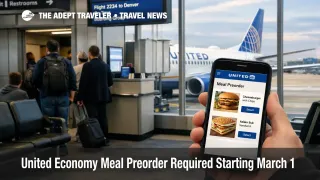
United Airlines is expanding meal ordering for economy travelers by letting passengers preorder fresh items like burgers and sandwiches in the airline's app or on its website. The change applies to United Economy customers on flights longer than 1,190 miles within the U.S., Canada, Mexico, and the Caribbean. The practical next step is to get used to ordering in advance, because United says that starting March 1, 2026, preorders will be the only way to buy fresh entrees in economy.
The United economy meal preorder change turns a once optional planning step into a requirement for anyone who wants a fresh onboard entree, instead of relying on onboard availability.
Today's rollout has two pieces that matter differently depending on your travel style. First, United is opening a new ordering path, you can select eligible items beginning five days before departure and up to 24 hours before departure, which should reduce the common problem of walking onboard and finding your preferred option sold out. Second, United is changing the rules of purchase: on March 1, 2026, the fresh entree category becomes preorder only for economy, while snack boxes, packaged snacks, and beverages remain available for purchase onboard without preordering.
United frames the operational goal as tighter catering accuracy and lower waste, and it publicly estimates the move could keep more than 100,000 pounds of unused food out of landfills each year.
Who Is Affected
The most directly affected travelers are United Economy passengers on medium haul and longer flights where fresh retail food is part of the onboard offering today. The mileage threshold matters because it is a proxy for both flight time and catering pattern, shorter segments often have limited service, while longer segments tend to stock more paid options, and they are also where sell outs are most frustrating.
This will show up often on transcontinental and longer hub to hub flying, plus many leisure runs into Mexico and the Caribbean where travelers are more likely to board at non meal hours, connect from shorter feeder flights, or arrive at the gate with limited time to buy food. The policy also matters for travelers who intentionally skip airport food because of price, limited options, or dietary preferences, since the onboard fallback for a fresh entree disappears once the preorder window closes.
Travel advisors and corporate travelers should treat this as a small but real reliability change. Travelers who land and go straight into meetings, or travelers stringing tight connections, lose the ability to decide mid flight that they need a fresh meal, which pushes the planning burden earlier in the trip timeline.
What Travelers Should Do
If you are traveling before March 1, 2026, start practicing the workflow now on eligible flights. Open your trip in the app or on the website when the five day window opens, confirm you can see the preorder option, and place your order early enough that you can still adjust if your schedule changes. Even in the preorder era, buy a simple backup snack in the terminal when you are facing a long day or you have a tight connection.
If you are traveling on or after March 1, 2026, use a clear decision threshold: if a fresh entree onboard is important to you, whether for dietary consistency, timing, or cost control, then preordering is mandatory and you should do it as soon as the window opens. If you do not care about fresh food and you are fine with a snack box or packaged items, then you can ignore the preorder step, but you should assume you will not be able to upgrade your choice once onboard.
Over the next 24 to 72 hours before departure, monitor two things that can quietly break plans. First, watch for aircraft swaps and reaccommodations, because a last minute change can alter eligibility or reset your order, and once you are inside 24 hours you may not be able to reorder on the new flight. Second, watch your connection risk, because if an irregular operation pushes you onto a new segment late in the day, the safest move is to treat onboard food as uncertain and buy what you need after security before you board.
For related context on how inflight lineups can vary by route and provisioning, see American Airlines Non Alcoholic Beer And Menus Feb 1. For a conservative approach to what you consume onboard beyond food, see U.S. Airline Drinking Water Safety Scores, 2026 Study.
Background
Inflight food in economy is a logistics problem disguised as a menu. Fresh retail items have limited shelf life, limited oven capacity, and limited storage space on different aircraft types, and they must be loaded correctly at each catering station across the network. When an airline stocks fresh items based on forecast, it risks throwing away food when demand is low, and it risks disappointing customers when demand is high and items sell out early in the cabin.
Preordering shifts that uncertainty earlier. The first order effect is a more predictable load for the catering partner and a higher probability that a traveler gets the exact item they wanted. The second order ripple shows up across the travel day: travelers who used to wait and decide onboard now need to decide before they leave for the airport, which can increase terminal purchases when people miss the window, and it can also change how travelers buffer connections because a same day reaccommodation can erase the ability to reorder.
There is also an operational ripple that travelers feel indirectly. When the cabin crew is not trying to manage disappointment around sell outs, service can run more smoothly, and the airline can reduce the number of catered items that are loaded but never purchased. United also says it plans to expand the preorder menu with additional items in summer 2026 and to add preorder exclusive premium beverage options later in 2026, which suggests it sees preordering as a broader retail channel rather than a one off operational tweak.