

San Antonio Runway Closure Impacts SAT Flights Jan Mar
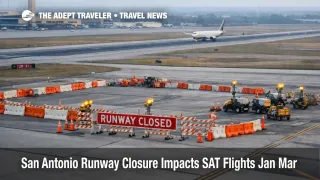
A multi week runway project at San Antonio International Airport (SAT) will temporarily reduce operational flexibility while crews repair pavement and upgrade airfield lighting. Travelers flying through San Antonio between January 12 and March 6, 2026 are the most affected group, especially anyone on late day departures or tight connections that leave little room for delays. The practical move is to build time into your plan now, pick earlier flights when you can, and treat weather days as higher risk for rolling delays.
The San Antonio runway closure shifts arrivals and departures off Runway 13R 31L and onto the remaining runway configuration, which can tighten capacity and slow recovery when disruptions hit.
San Antonio officials say Runway 13R 31L will be fully closed from January 12 through March 6, 2026 so construction crews can work continuously, replacing sections of concrete, upgrading electrical lighting systems to energy efficient LED technology, and re establishing pavement markings. The project is partially funded through the Federal Aviation Administration Airport Improvement Program, and the closure timeline was coordinated with the FAA control tower and airfield partners to minimize impacts. During the closure window, aircraft landings and take offs are expected to operate exclusively on Runway 4 22, which changes the airport's flexibility when wind and visibility conditions are not ideal.
For nearby residents, the airport has flagged that neighborhoods to the northeast and southwest of the airfield may experience winter air traffic patterns during the closure period because operations will concentrate on the remaining runway. For travelers, that same concentration is the key operational story: when you remove a runway option, the airport has fewer ways to keep traffic moving if the weather shifts, arrival spacing increases, or a peak push period compresses the schedule.
Who Is Affected
Any traveler using San Antonio International during the closure window, January 12 through March 6, 2026, should expect occasional schedule padding and day of travel adjustments, even if most flights still operate normally. The highest exposure is for itineraries with tight connection windows, last flight of the day segments, and separate tickets where one delay can strand the onward portion without protected reaccommodation.
Business travelers on same day turns are exposed in a specific way: the trip may look safe on paper, but a modest departure delay out of San Antonio can erase meeting time or force a rebook when you have fixed commitments on the other end. Leisure travelers are more likely to feel the impact through downstream ripple, missed connections that turn into late arrivals, hotel check in timing problems, and lost prepaid tour slots when the day slides.
Connections matter because San Antonio feeds a long list of nonstop destinations that include major hub cities used for onward travel, including Atlanta, Georgia, Dallas Fort Worth, Texas, and Houston Intercontinental, Texas. When a departure bank runs late, the misconnect risk typically shows up at the hub rather than at the origin, and late day recoveries are harder because there are fewer remaining flights and less crew duty time margin.
What Travelers Should Do
Start with buffers that actually reduce risk. If you have flexibility, choose an earlier departure out of San Antonio International, and avoid the last connection of the day through your hub. On travel days with forecast low ceilings, gusty winds, or storms in Texas or along your route, add extra time for check in, security, and boarding, and consider carrying on instead of checking bags if a delay would make a rebook likely.
Use clear decision thresholds for rebooking versus waiting. If your connection is already tight, or if you are on separate tickets, treat a small departure delay as a reason to change flights early, before the later banks fill up. If your itinerary includes a must make event, such as a cruise departure, a wedding, or a time fixed tour, it is rational to rebook to arrive the prior evening, because single runway operations reduce the airport's ability to catch up after even minor disruptions.
Over the next 24 to 72 hours before you fly, monitor three things: your airline's schedule change emails, the day of travel flight status for your inbound aircraft, and any weather driven traffic management initiatives that could slow arrivals and departures. For broader context on how capacity constraints propagate into missed connections and late day cancellations, see Flight Delays and Airport Impacts: January 16, 2026.
Background
Runway closures rarely cancel travel on their own, but they change how resilient an airport is when normal variability hits. The first order effect is simple: fewer runway options mean fewer ways to balance arrival and departure flows, especially when winds favor one direction, visibility drops, or spacing increases for safety. Even when airlines keep published schedules intact, the airport's ability to recover from a short disruption is reduced, which is why travelers often feel the impact later in the day rather than at the start.
The second order ripple spreads through the system in layers. If departures out of San Antonio slip, aircraft and crews arrive late to the next station, which can shorten turn times, trigger gate conflicts, and push the next segment behind schedule. Those delays then concentrate at hubs where many passengers connect onward, raising the odds that a missed connection turns into a forced overnight, baggage delivery delays, and last minute hotel demand spikes near the hub airport. When disruptions stack, airlines protect the system by canceling the least recoverable flights late in the day, which can disproportionately affect travelers headed to smaller spoke cities after a hub connection.
San Antonio's project is also a reminder that growing airports are making interim investments to keep core infrastructure reliable until larger rebuilds occur. The airport's stated goal here is to address critical pavement areas and modernize lighting and markings to maintain safe operations, extending the runway's functional life while a future reconstruction effort is planned.