

South Florida Storms Slow Miami Flights Jan 18
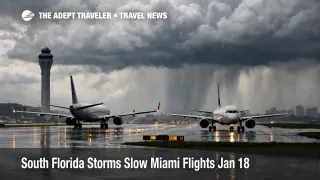
Thunderstorms in South Florida are expected to constrain air traffic flows into Miami International Airport (MIA) and Fort Lauderdale Hollywood International Airport (FLL) on Sunday, January 18, 2026, with FAA traffic managers flagging routing initiatives that can slow arrivals and complicate tight connections. Travelers connecting through Miami and Fort Lauderdale, especially onto Caribbean and Latin America departures, are the most exposed to rolling arrival metering, longer taxi times, and late gate availability as storms flare. The practical move is to protect connection time now, treat afternoon banks as less reliable than the timetable suggests, and monitor FAA advisory updates as reroutes and spacing programs evolve.
The traveler facing change is simple, South Florida storms Miami flights are more likely to run late because air traffic control may reroute departures, meter arrivals, and reduce acceptance rates to keep the system safe and stable.
FAA's Current Operations Plan Advisory for January 18 calls out thunderstorms in South Florida, noting that coded departure routes are in use for Miami and Fort Lauderdale through 1800Z and that Miami Center has a Severe Weather Avoidance Plan statement through 0000Z. Those tools are designed to move demand away from weather constrained airspace, but they can lengthen flight times, reshuffle arrival banks, and cause uneven delays that are hard to predict from gate displays alone. The same advisory also lists multiple flow constrained areas affecting Miami flows through the day, which is a signal that reroutes and metering may continue well past the first storm cells.
Airport status pages can still look calm early, and that can be misleading on thunderstorm days. As of the FAA's published airport status, Miami may show on time conditions at a given moment, but the operations plan is a forward looking warning that the constraint risk rises as convective weather and demand build. If your itinerary depends on a tight connection, the planning advisory matters more than the snapshot.
Who Is Affected
Travelers connecting through Miami are affected first because MIA is a major bridge between U.S. domestic feed and international departures to the Caribbean, Central America, and South America. When storms reduce arrival throughput or force longer routings, the knock on effect is missed connection windows, followed by crowded rebooking lines for limited seat inventory to island markets and secondary cities where there are fewer later flights.
Fort Lauderdale connections are also at risk, particularly for travelers using FLL as an alternate to Miami, or those combining low cost domestic arrivals with cruise or resort transfers. When both MIA and FLL are under the same convective umbrella, "self rerouting" by switching airports does not always help, because the constraint can be the airspace and traffic management programs rather than a single runway.
Same day cruise embarkations are the most fragile itinerary type today. Late arrivals compress the timeline for baggage, rideshare pickup, and highway transfers to PortMiami and Port Everglades, and a moderate air delay can become a missed boarding problem when check in cutoffs are fixed. Hotel check ins and prepaid tours can also fail in a cascade when passengers arrive after desk hours, or when operators cannot hold timed entries.
You are also indirectly affected even if Miami is not your destination. Reroutes and departure metering often show up as delays at your origin airport, because the FAA generally prefers to hold flights on the ground rather than stack aircraft in airborne holding near constrained terminals. That is why a clear sky departure city can still produce a late takeoff when the constraint is downstream in South Florida.
For broader context on how FAA flow decisions propagate through the day, see Flight Delays and Airport Impacts: January 16, 2026, and for deeper system level context, see U.S. Air Traffic Control Privatization: Reality Check.
What Travelers Should Do
If you are traveling today, add real buffer where it actually absorbs risk. For domestic to international connections at Miami or Fort Lauderdale, protect at least two hours, and aim for closer to three hours if you must clear and recheck bags, change terminals, or connect to a smaller Caribbean or Central America market with limited later departures. If you are flying in to join a cruise, treat a same day arrival as a gamble, and shift to an arrival on Saturday, January 17, 2026, or book the earliest possible flight bank so you have daylight recovery options.
Use clear decision thresholds for rebooking versus waiting. If your connection is under 90 minutes at Miami during the afternoon bank, or if your onward flight is the last nonstop to an island or a small Latin America city, proactive changes usually beat hoping for a short lived storm gap. If you are on separate tickets, or your plan depends on checked bags, raise that threshold further, because a minor late arrival can strand your bags even when you sprint to the next gate.
Over the next 24 to 72 hours, monitor the ATCSCC advisories for any extension of Miami and Fort Lauderdale coded departure routes, continued SWAP statements for Miami Center, and any new ground delay programs or ground stops that may appear on the FAA airport status pages. Watch your flight's filed route changes and estimated en route time, because reroutes can quietly add block time even when the departure looks close to schedule, and those minutes are what break tight international and cruise transfer plans.
Background
Thunderstorms break airline schedules differently than steady rain. Convective cells can close specific departure fixes, arrival routes, or airspace corridors for short windows, and that forces air traffic control to meter aircraft, spread arrivals out, or send flights around the weather. The FAA uses multiple traffic management initiatives to balance demand with capacity, including coded departure routes that allow quick reroutes when standard routings are constrained, and SWAP statements that outline expected impacts and mitigation strategies for severe weather events.
Once those constraints start, the disruption propagates in layers. First order effects hit at the source, aircraft may sit at the gate waiting for an expected departure clearance time, taxi out slows when ramp demand surges, and arrivals are spaced farther apart when routes are restricted. Second order ripples then spread into the connection system, late inbound aircraft miss their next departure slot, gates fill, turns lengthen, and crews lose duty time margin, which raises the chance of late day cancellations even after storms weaken. A third layer is the regional reroute effect, flights routed around South Florida weather can arrive in different banks than planned, which strains baggage, customs processing waves, and onward connections into Latin America and the Caribbean.
That is why a "normal" airport status early in the day is not reassurance on a thunderstorm afternoon. The operational signal is the existence and duration of traffic management initiatives in FAA advisories, because those initiatives tell you the system is already planning for constrained capacity as demand ramps up.
Sources
- Current Operations Plan Advisory (ATCSCC ADVZY 026 DCC 01/18/2026)
- Miami International Airport Status (MIA)
- Fort Lauderdale Hollywood International Airport Status (FLL)
- Miami Airport Delay Information (fly.faa.gov MIA)
- Severe Weather Avoidance Plan (SWAP) Definition and Guidance
- Coded Departure Routes (CDR) Definition and Guidance
- FAA Glossary of Terms (SWAP)