

Storm Harry Malta Ferries Disrupted January 19
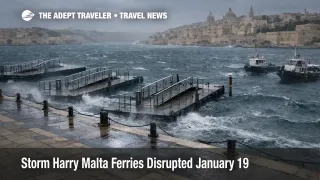
Storm Harry is disrupting ferry travel around Malta on January 19, 2026, after gale force winds triggered a red warning and forced multiple operators to suspend sailings. Travelers moving between Malta and Gozo, the Valletta harbour crossings, and Malta Sicily connections via Pozzallo are seeing cancellations, delays, and unreliable transfer timing. If you have a same day flight out of Malta International Airport (MLA) or a fixed check in, plan a reset to an overnight on Malta's main island or reroute to flights, and build large buffers before you head to any terminal.
The Storm Harry Malta ferries disruption removes enough capacity across short harbour hops and inter island routes that even brief suspensions can cascade into missed flights, missed hotel check ins, and forced overnights.
Virtu Ferries published a storm schedule update showing all listed departures on Monday, January 19, 2026, as cancelled between Malta and Pozzallo, Italy, and additional cancellations on Tuesday, January 20, 2026, with later sailings marked weather permitting on parts of Wednesday, January 21, 2026, before amended and extra trips appear on Thursday, January 22, 2026. Separately, reporting in Malta described rough seas disrupting Gozo ferry services and suspending Valletta's harbour ferries between Valletta and Sliema, and between Valletta and the Three Cities, as the wind strengthened through the day. Local reporting also indicates Gozo Channel shifted docking to the Cirkewwa South Quay, warned of delays, and warned that some trips may be cancelled or the service suspended if conditions worsen.
Who Is Affected
Day trippers and commuters moving between Malta and Gozo are the most exposed because both the primary vehicle ferry link and the fast ferry option can degrade at the same time, leaving long queues when service resumes and limited ways to "make up time" later in the day. Travelers staying on Gozo with planned departures via Malta International are especially vulnerable because the trip combines a maritime leg plus a road transfer, and Storm Harry risk is not only a cancellation, it is the rolling delay that erodes your airport buffer.
Passengers booked on Virtu Ferries between Malta and Sicily are affected immediately when sailings are cancelled, because there is no like for like same day maritime substitute once the catamaran is off the board. This matters most for travelers using Sicily as a bridge in a larger itinerary, for example onward rail from Pozzallo or connecting flights from Catania, Italy, because a missed sea leg often becomes an unplanned overnight.
Visitors using Valletta's harbour crossings to move between Sliema, Valletta, and Cottonera, Malta, should treat the day as a ground transport day instead. The operational impact is not only the lost crossing, it is the knock on demand for taxis, rideshares, and buses that can slow down the whole corridor at the same time hotel check in windows are closing.
What Travelers Should Do
Take immediate steps that reduce uncertainty. Check operator service updates first, then decide whether you are traveling at all, because showing up early does not help if sailings are suspended. If you must move, shift to a conservative plan, travel earlier than you normally would, and assume that road transfers will slow as demand moves from water to wheels.
Set decision thresholds that force action before you are boxed in. If you have a flight departing Malta International within the same calendar day, do not attempt a tight Gozo to ferry to airport chain, and treat a suspension notice, a docking diversion, or a cancelled fast ferry as your trigger to move your flight, or to overnight on Malta's main island. If you are on separate tickets, act even earlier because reaccommodation is not guaranteed, and late day recovery can collapse again as conditions peak.
Over the next 24 to 72 hours, monitor wind warning updates and the operators' own wording about weather permitting sailings, because that tells you whether service is stabilizing or still fragile. If you are building a wider Europe itinerary, it can help to compare how other transport systems behave under weather stress, including Freezing Rain Central Europe Airports, Delays Linger and Eurostar Disruption London Paris Trains Late January, where recovery tails and capacity limits are often the real trip killer, not the first cancellation.
Background
Malta's ferry network functions like a set of short, high frequency "bridges" that keep islands, harbours, and onward connections in sync. When wind and swell cross operating limits, the first order effect is simple, boats stop, or run with degraded docking plans, and the timetable becomes uncertain. The second order ripple is where trips break, passengers bunch into the next available sailing, vehicle queues grow at terminals, and the road network absorbs displaced demand from harbour crossings.
That ripple propagates across at least two additional layers quickly. Airport connections become fragile because the maritime segment is no longer predictable, and even a modest delay can erase the safety margin you built for check in and security. Hotels and short stay rentals feel the shock when travelers decide to stage near Valletta, Sliema, or Cirkewwa, Malta, or when they are forced to overnight after a return sailing fails, tightening last minute inventory and raising prices for everyone else arriving that evening.
For Sicily connections, the system effect is even sharper because a cancelled catamaran can remove an entire day of capacity for a specific booking. When that happens, travelers either shift to flights, or they reset the trip by one or more days, which can cascade into rebooked rail tickets, missed tour start times, and changed car pickup windows.