

Bogotá Protest Marches Block Key Roads, Airport Runs
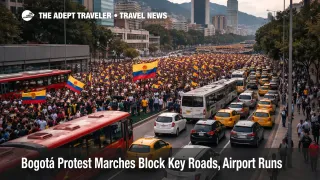
Planned demonstrations tied to national protest calls have been flagged in Bogotá and other major Colombian cities, and the practical travel consequence is not usually violence, it is mobility failure. Official security style alerts for the January 7, 2026 nationwide demonstration explicitly warned that marches ahead of the main event were likely and that traffic disruptions would be serious around protest locations. For visitors, that turns an ordinary afternoon itinerary into a missed flight risk if you are counting on predictable crosstown travel.
The Bogotá pattern is easy to see in municipal mobility reporting from mid to late January 2026. On January 19, 2026, Bogotá's city portal reported a demonstration on Avenida Caracas at Calle 54 that produced heavy congestion and forced operational changes to TransMilenio, including temporary loss of trunk passage, contraflow operations, and station impacts. That kind of corridor pinch point is exactly what breaks tight airport runs and timed pickups, because the blockage is not just slow traffic, it can be turn restrictions, lane closures, and sudden reroutes that invalidate your planned path.
Bogotá protest traffic has become a near term planning constraint during January 2026 calls, because afternoon marches can choke central corridors and disrupt airport transfers, tours, and intercity departures.
Who Is Affected
Travelers staying in central Bogotá, especially near Plaza de Bolívar, La Candelaria, Centro Internacional, and the embassy district, are the most exposed because demonstrations often target symbolic civic spaces and the arteries that feed them. The January 7, 2026 nationwide protest call listed Plaza de Bolívar as the Bogotá focal point, and it named additional rally locations in other cities including Medellín, Cali, Bucaramanga, Cartagena, and Santa Marta, which is a reminder that the same problem can hit multi city itineraries that rely on precise ground timing.
Visitors with same day flights from El Dorado International Airport (BOG) are exposed even if they never intend to attend a demonstration. When a march touches trunk corridors or a few key connectors, taxi and rideshare ETAs can fail at exactly the moment you need reliability, late afternoon into early evening. Travelers connecting onward by intercity coach are also at risk, because buses and drivers can be delayed reaching terminals, and departures can slide or be consolidated when passenger flows break.
Tours that cross downtown, or that depend on fixed hotel pickup windows, are vulnerable because guides and vehicles can be blocked from reaching the pickup point. When that happens, operators often choose the least bad outcome, cancel, delay, or shift the pickup to a different meeting point, and that creates a second layer of disruption for travelers who have dinner reservations, museum tickets, or domestic flights later the same day.
What Travelers Should Do
If you have a flight, a long distance bus, or a fixed start time tour on a day when demonstrations are expected, treat midafternoon through early evening as a no cross city window. Either move earlier, or reposition, for example, finish downtown activities by early afternoon and return to your hotel before march timing builds, or stay closer to your next departure point the night before so you do not need to traverse chokepoints.
Use a decision threshold instead of optimism. If you are more than 90 minutes from El Dorado on normal traffic, or if your routing would cross the city center, plan as if you may lose an extra hour beyond the usual congestion, and be willing to rebook or move your departure time earlier if you cannot secure a reliable pickup. When Bogotá mobility bulletins show active demonstrations affecting trunk corridors, assume your first driver attempt may fail and build enough slack for a second attempt or a detour.
Over the next 24 to 72 hours, monitor two signals, where gatherings are planned, and which corridors are being reported as impacted in real time. Embassy style alerts and OSAC reporting can flag the date, the general location, and the likelihood of march related traffic disruption. For street level decisions, watch Bogotá's official mobility updates for corridor level impacts and transit changes, then align your movement to avoid the affected spines rather than trying to cut through them.
Background
In Colombia, national protest calls often propagate through the travel system by breaking urban mobility first, then cascading into air and bus schedules. The first order effect is road capacity loss near protest sites and marching routes, which slows private vehicles, taxis, rideshares, and buses. The second order ripple hits airport transfers when travelers cannot reach El Dorado on time, and it hits public transport reliability when trunk systems adjust service patterns, sometimes by skipping stops, running contraflow segments, or pausing movement through a blocked stretch, all of which can strand travelers far from where they need to be.
The third layer is itinerary knock on effects. When afternoon mobility fails, hotels field more late check ins, tours either compress or cancel, and airline and bus rebooking queues intensify because many travelers miss the same departure bank. That is why your buffer strategy matters more than predicting whether a specific march will be large. If you plan your movement so you do not have to cross the city during the most likely march window, you avoid the system wide cascade. For additional context on how Bogotá roadblocks and demonstrations can disrupt airport access, see Colombia Roadblocks Can Disrupt Airport Transfers.