

Spain Protest Roadblocks Disrupt City Access
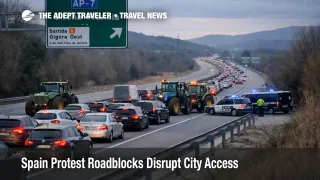
Regional protest actions in Spain are creating rolling roadblocks that can block access to city centers and key arterial routes, with Catalonia repeatedly seeing major corridor disruption that matters to visitors moving between hotels, tours, and airports. Travelers using road based transfers are the most exposed, because closures have targeted highways and access points, not only symbolic gathering plazas. The practical next step is to treat any same day transfer as time sensitive, check official traffic advisories before leaving, and be ready to switch to rail or adjust pickup points if vehicles cannot reach central addresses.
The Spain protest roadblocks issue changes trip reliability because the disruption propagates through the travel system fast. When a motorway segment is blocked, detours push traffic onto parallel routes that were not built for that load, which then slows taxis, scheduled shuttles, and private drivers, and can cascade into late hotel arrivals and missed time locked attractions. If you are connecting to flights or long distance rail on separate tickets, a single blocked corridor can turn a normal buffer into a misconnect.
Who Is Affected
Visitors in Catalonia, Spain, are among the most affected when roadblocks hit the main north south and east west corridors that feed Barcelona, Spain, Girona, Spain, and the French border. Catalan reporting has described farmers maintaining roadblocks on routes including the AP 7 and A 2, plus additional closures on regional highways, and actions that have also affected access roads tied to Tarragona, Spain. Those kinds of choke points matter because they are hard to route around quickly when they sit on the primary spine roads used by airport transfers and intercity drivers.
Travelers with airport deadlines are next on the exposure list, particularly anyone relying on cars to reach Josep Tarradellas Barcelona El Prat Airport (BCN), Girona Costa Brava Airport (GRO), or Adolfo Suárez Madrid Barajas Airport (MAD). Even when a protest is concentrated in one area, cordons and diverted traffic can spill into the broader network, and navigation apps can keep proposing blocked approaches while drivers loop for legal turns. For context on how this plays out in Madrid when cordons affect a high value corridor, see Madrid Protest Blocks Serrano Transfers Jan 4-5.
Tour groups and independent travelers with fixed start times are also affected because their margin is usually smallest. A one hour delay on an approach road can wipe out a timed entry, a guided tour rendezvous, or a cruise shore excursion meeting point, and the recovery options may be limited if the group is moving on the same day. In addition, when traffic pushes late arrivals into a narrower band, hotel front desks and transport providers get hit with simultaneous demand, which can delay check in and create scarcity in taxis and rideshares.
Finally, travelers driving themselves are affected because real time restrictions can change the optimal route mid trip. The Dirección General de Tráfico, DGT, maintains live traffic tools and a restrictions map that can surface closures and controlled segments, which is especially useful when the disruption is not confined to a single neighborhood.
What Travelers Should Do
If you are traveling within or through affected regions, start by adding buffer time to any road based move, especially airport runs and cross city transfers. Check the DGT traffic restrictions and incidents tools shortly before you depart, and again if you stop for fuel or food, because a corridor that is clear at noon can be blocked later. If you are in Madrid, the city also publishes a list of traffic incidents tied to planned demonstrations, which can help you decide whether to shift a pickup point or avoid a specific frontage.
Use decision thresholds so you do not burn hours waiting on an approach road that may not reopen on your timeline. If your transfer is to an airport or a long distance train and you are inside two to three hours of a hard deadline, reroute immediately rather than hoping the blockage clears, and prioritize modes that are not road dependent, such as metro or regional rail, where available. If you are on separate tickets, treat the connection as fragile and move earlier than you normally would, because rebooking options can shrink when many travelers are delayed at the same time.
Over the next 24 to 72 hours, monitor three things: official traffic advisories, local reporting on whether actions are continuing or pausing, and whether protest activity is shifting from highways to city centers, or the other way around. In Catalonia, multiple reports have described multi day roadblocks linked to farmer protests, and local outlets have reported specific city access disruptions and road closures in places outside Catalonia as well, which is why it is safer to check corridor specific status than to assume the issue is isolated to one city. For broader Spain protest timing patterns in major cities and how mid day windows can affect movement around central gathering points, see Spain Student Rallies at Noon: Barcelona and Madrid Disruption Map.
Background
Roadblocks are operationally different from a march confined to a single plaza because they target the network, not the venue. When a motorway or approach road is blocked, traffic demand does not disappear, it reroutes, and that rerouting concentrates vehicles onto fewer parallel links, which can jam access to hotels, attractions, and pickup zones well beyond the original blockage. For travelers, the second order ripple is usually felt first as unreliable transfer times, then as missed timed entries and tour cancellations, and then as downstream schedule compression, where a late arrival forces you to drop stops the next day to recover sleep or repositioning time.
Spain's road information ecosystem makes this somewhat manageable if you use it aggressively. DGT publishes live road information and restrictions mapping, while some cities publish planned demonstration related incident notices that highlight which streets and windows are expected to see controls. Layer in credible local reporting for whether actions are escalating, pausing, or relocating, and you can often make a simple reroute call early enough to protect the rest of the day.
Sources
- Mapa de Restricciones de Tráfico, Dirección General de Tráfico
- Información e incidencias de tráfico, Dirección General de Tráfico
- Incidencias de tráfico debidas a manifestaciones, Ayuntamiento de Madrid
- Farmers to maintain roadblocks across Catalonia over the EU Mercosur deal
- Farmers warn AP 7 blockade will stay unless government delivers tangible action
- Agricultores y ganaderos españoles retoman las protestas y cortan varias carreteras, Cadena SER
- Unos 80 tractores cortan la N 120 en Ourense, Cadena SER
- Spanish farmers protest against EU Mercosur agreement, EFE