

Madrid Protest Blocks Serrano Transfers Jan 4-5
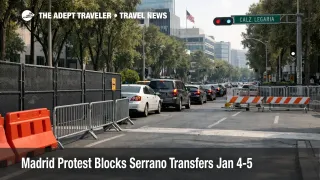
Demonstrations tied to the Venezuela crisis have been flagged near the U.S. Embassy area on Calle Serrano in Madrid, with a large police presence and the potential for rolling, block level traffic restrictions. Visitors and residents moving through Salamanca and the nearby Paseo de la Castellana corridor are the most exposed to sudden detours and longer travel times. The practical move is to treat Sunday, 01/04/2026, and Monday, 01/05/2026, as "plan B" transfer days, and route via Metro or allow extra road time if you must ride.
The Madrid protest Serrano transfers issue matters because even a single cordoned frontage on Serrano can force vehicles onto parallel streets, then back up key north south flows that travelers rely on for airport runs and cross town repositioning.
Local reporting on Sunday described a crowd filling most of a block on Calle Serrano, with police controlling crossings and keeping the embassy frontage secure. Separately, the U.S. Embassy warning circulated by Spanish media flagged planned gatherings on Sunday and again on Monday beginning at 12:00, and noted that access in the embassy area could be affected. For travelers, that combination usually means intermittent closure of the immediate curb lane, restricted turns at nearby intersections, and pickup and drop off points moving a block or two away from where your map app wants to stop.
Who Is Affected
Travelers staying in the Salamanca neighborhood, near Serrano, Velázquez, or the Castellana axis, are most likely to feel the disruption first because police tend to establish an outer perimeter, then expand or contract it based on crowd size and counterflow risk. If your hotel is inside a cordon, you may still be able to walk in and out normally, but vehicles may be diverted to a nearby block for luggage drop offs, which is a common pain point for families, business travelers, and anyone with mobility constraints.
Anyone transferring to Adolfo Suárez Madrid Barajas Airport (MAD) during protest windows should treat road timing as unstable, even if the airport itself is operating normally. The problem is not the terminals, it is the city side approach and the knock on effect of taxis and rideshares rebalancing away from restricted zones, which can turn a routine pickup into a longer wait, a moved pickup pin, or both. The second order ripple shows up when late arrivals compress rail and tour schedules, especially for travelers trying to make fixed departures from Atocha or Chamartín, or timed tickets and group tours that do not wait.
What Travelers Should Do
If you are moving today or Monday, build a buffer that assumes at least one unplanned detour and one changed pickup point. From central districts, plan to leave 30 to 60 minutes earlier than you normally would for an airport run, and consider switching the "last mile" into the affected area to Metro plus a short walk instead of insisting on curbside pickup on Serrano. If you have checked bags and must use a vehicle, message your driver before pickup and be ready to walk to a wider avenue for a cleaner stop.
Decide whether to rebook based on how tight your hard deadlines are. If you are aiming for a short international check in window at Madrid Barajas, or you have a nonrefundable long distance rail departure, treat that as a rebooking threshold and move earlier, even if it means extra time at the airport or station. If your plans are flexible and you can absorb an extra hour, waiting can be rational, but only if you can switch to Metro quickly when surface streets lock up.
Over the next 24 to 72 hours, watch official traffic and transit advisories, plus credible local media, rather than relying on a single navigation app ETA. The City of Madrid's traffic incident pages can signal planned closures that overlap with your route, and police direction on the ground can override what maps are showing in real time. If you are near the embassy area when crowds build, follow signage and officer instructions, avoid filming security posts up close, and choose parallel routes on wider corridors that are easier for authorities to keep flowing.
Background
Protest related traffic disruption in Madrid rarely behaves like a single, clean closure, because the city's mobility system is layered. The first order effect starts at the protest footprint itself, where police may restrict vehicle access, limit crossing points, and create a pedestrian buffer that pushes curb activity outward. That immediately reduces capacity on a small set of streets, then forces taxis, rideshares, and delivery vehicles onto parallel routes, which increases turning conflicts and slows buses that share the same constrained lanes.
The second order ripple is where travelers feel it most. When vehicles get displaced from Salamanca and the Castellana corridor, airport transfers can become less predictable, not because the distance is large, but because the approach routes to ring roads and main arteries become harder to access cleanly. That, in turn, drives missed check in windows, missed train departures, and late arrivals to timed tours, all of which have higher financial penalties than a longer ride. On top of that, early January mobility in Madrid can already be stressed by seasonal events and planned restrictions, so a protest window can stack on existing measures and make "normal" Sunday and Monday patterns a poor baseline for planning.
For travelers who want to sanity check risk, it is useful to compare two Madrid realities. Operational disruptions at the airport, such as staffing or ground handling constraints, can strand you inside the terminal system. Street level disruption, like this, can strand you outside it, where your main tool is flexible routing and time buffer. If you are also tracking airport side issues this week, see Madrid Barajas Ground Handling Strike Delays for how terminal side disruption changes rebooking strategy. If your wider Spain itinerary includes domestic flights or road transfers elsewhere, Málaga Flooding Diverts Flights, Costa Del Sol Roads is a useful reminder that surface access can be the hidden failure point even when airports are technically open.
Sources
- La Embajada de EEUU en España avisa de protestas contra la política estadounidense en varias ciudades el fin de semana
- Conflicto EE.UU. - Venezuela hoy: última hora en directo | Vídeo
- Demonstration Alert: Demonstrations against U.S. policies (January 3, 2026)
- Spain Travel Advisory | Travel.State.gov
- Medidas especiales de tráfico durante la Navidad 2025-2026 - Ayuntamiento de Madrid
- Cortes de tráfico Cabalgatas de Reyes 2026 - Ayuntamiento de Madrid