

Greece Ferry Sailing Bans Hit Islands January 21, 2026 Greece Ferry Sailing Bans Hit Islands January 21, 2026
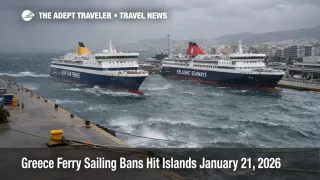
Severe weather and gale force winds disrupted Greece's coastal transport network on January 21, 2026, prompting sailing bans and widespread ferry cancellations from the ports of Piraeus, Rafina, and Lavrio, Greece. Island travelers are most affected, especially those bound for the Cyclades, the Saronic Gulf, and longer Aegean crossings where there is little same day substitution once ships are held in port. The practical move is to treat the day as an itinerary reset, check operator bulletins before you leave for any terminal, and be ready to shift to an overnight on the mainland if your trip depends on a fixed check in or a same day connection.
The Greece ferry sailing ban changes island plans by removing scheduled capacity in short windows, which quickly turns into missed hotel check ins, rebooked sailings, and crowded reallocation to the next available departure.
Operator notices published for January 21 show route specific cancellations and knock on adjustments into January 22, with examples including cancelled departures from Piraeus on key Cyclades patterns and revised restart plans once conditions allow normal operations again.
Who Is Affected
Travelers starting in Athens, Greece, or connecting through Athens International Airport Eleftherios Venizelos (ATH) are exposed when their plan relies on a same day ferry onward to an island hotel, a cruise, or a timed tour pickup. When ferries stop, passengers often stack into a smaller pool of later sailings, and even a short ban can turn into an overnight because terminals cannot instantly absorb the backlog.
Cyclades itineraries carry outsized risk because many schedules hinge on morning departures and midday arrivals. When a morning bank is cancelled, the next practical option may be a different vessel, a different port, or the next calendar day, and that shift can break prebooked transfers on islands like Mykonos, Paros, Naxos, and Santorini, where the vehicle you expected may not arrive, or your driver may be reassigned.
Crete and longer Aegean routings can be affected in a different way, even if some services resume sooner, late recoveries reduce choice and can strand passengers on the wrong side of their itinerary, particularly if they are splitting tickets between ferry and flight. The national ripple can also extend beyond Attica when weather pushes restrictions onto other maritime corridors, limiting the ability to reroute via alternate mainland ports.
What Travelers Should Do
Take immediate actions that reduce uncertainty. Confirm the status of your specific sailing directly with your ferry operator, and do not assume a port will be operating just because conditions look calm from shore, because bans are driven by marine forecasts, sea state, and channel exposure. If your departure is cancelled, rebook as early as possible into the first stable window rather than waiting for a late day attempt, and plan your ground transfer to the port only after you see an updated departure that is still shown as operating.
Set decision thresholds for rebooking versus waiting. If you must be on an island by a fixed time, or you have a flight, a cruise, or a nonrefundable check in the same day, treat a cancellation notice or a continued sailing ban as your trigger to overnight in Athens, Greece, or near the port, then depart on the first reliable sailing the next day. If you are traveling on separate tickets, act earlier, because your ferry delay can become an uncovered loss once seats and cabins on the next departures sell out.
Over the next 24 to 72 hours, monitor restart signals rather than headlines. Watch the Hellenic National Meteorological Service marine warnings for wind easing in the Aegean, then look for operator language that shifts from cancelled to operating, or weather permitting, because that tells you whether the system is stabilizing or still fragile. If you need a quick mental model for how ferry disruptions can cascade into rebook pressure and forced overnights, compare the recovery patterns in Storm Harry Malta Ferries Disrupted January 19 and Nordic Cold Snap Airport and Ferry Delays January 2026, where capacity, backlogs, and limited substitutes are the real drivers after the first suspension.
Background
A sailing ban is a safety control used by port authorities and maritime officials when wind and sea conditions exceed operating limits for certain classes of vessels or specific routes. In practice, this is why island access can break down quickly, the system does not degrade smoothly, it snaps from normal schedules to ships held in port, and then resumes unevenly as conditions improve and backlogs clear.
The disruption propagates through the travel system in layers. First order effects hit at the source, ferries do not depart, and arrivals do not happen, which strands passengers, separates vehicles from islands that depend on deliveries, and forces operators to reshuffle crews and vessels to rebuild the timetable once the ban lifts. Second order ripples show up immediately in at least two other layers. Airline substitution pressure rises on routes where travelers try to replace a ferry with a domestic flight via Athens, and that can tighten same day seats and increase misconnect risk if the weather is also affecting air operations. Hotel inventory tightens in Athens and port side areas when passengers choose, or are forced, to overnight to protect onward plans, which can raise prices and reduce last minute availability for everyone arriving the same evening.
For this specific weather window, national forecasts and marine warnings point to gale force conditions across parts of the Ionian and Aegean, which is the kind of setup that can keep restarts fragile even after an initial lull. That is why travelers should plan for a recovery tail, not just a single cancelled sailing, especially on routes that normally have only a few departures per day in winter.