

Suez Canal Route Risk Hits Red Sea Cruises
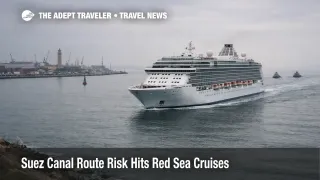
Suez Canal route risk is back on cruise and coastal travel planning radars in January 2026 as major container carriers split on whether the Red Sea corridor is stable enough for routine transits. Travelers on Red Sea, Egypt, and Eastern Mediterranean cruise, yacht, and ferry itineraries are the most exposed, because the same security and insurance assumptions that drive cargo routing also shape passenger vessel risk committees and port readiness. The practical move now is to treat any Suez linked itinerary as "operationally flexible," and to plan for short notice schedule edits that can affect flights, hotels, tours, and provisioning.
The Suez Canal route risk signal is sharper because Maersk and CMA CGM are making visibly different calls within the same month. Maersk said it is returning its Middle East and India to U.S. East Coast service (MECL) to trans Suez routing as a structural change, with sailings beginning in late January 2026. CMA CGM, by contrast, said three major services, FAL1, FAL3, and MEX, will operate via the Cape of Good Hope, citing a complex and uncertain international context.
For travelers, this divergence matters less as a shipping business story, and more as a real time indicator that the corridor can flip from "testing a return" to "pulling back" quickly. When cargo lines switch routes, ports re sequence arrivals, tug and pilot plans change, and berth windows get re allocated. Cruise operators that share port infrastructure, bunkering services, and marine support in the same hubs can then face tighter slot availability, last minute curfew constraints, or revised security postures that push ships into different call orders.
Who Is Affected
Passengers on cruises that advertise Red Sea calls, Suez Canal transits, or an Egypt plus Eastern Mediterranean arc are in the primary impact zone, especially on world cruises and repositioning voyages where a single routing decision can add days at sea or replace multiple ports. The most operationally sensitive itineraries are those that thread together turnaround logistics across more than one region, for example a voyage that ends in the Mediterranean after starting in the Gulf, the Indian Ocean, or South Asia, because airline tickets, hotel check ins, and visa timing are all tied to fixed dates.
Yacht crews and ferry travelers are also exposed, but in different ways. For yachts, the risk concentrates in insurance, crew movement, and the availability of safe routing and services if a planned corridor becomes unattractive on short notice. For ferries, the bigger vulnerability is indirect, port congestion and revised maritime security measures can disrupt harbor operations, which can reduce sailing reliability even when the ferry route itself does not enter the highest risk zone.
Travelers staying at island resorts, or remote coastal properties that depend on predictable container arrivals, can feel second order effects. If carriers reroute around the Cape of Good Hope, transit times lengthen and schedule reliability can degrade, which can delay deliveries of food, beverage, linen, maintenance parts, and retail inventory. When the "right" shipment misses a port window, substitute sourcing often costs more, and that can show up as limited choice, higher onsite prices, or reduced service hours. Maersk and CMA CGM are not the only decision makers here, but their routing posture is a strong proxy for how insurers and security advisors are reading the corridor week to week.
What Travelers Should Do
If you are sailing a Red Sea or Suez adjacent itinerary, act as if an itinerary change email could arrive within hours, not weeks. Re confirm independent shore tours, private transfers, and timed entries with flexible cancellation terms, and keep your embarkation and disembarkation day hotels on changeable rates when possible. If you have separate tickets for flights, rail, or ferries, add buffer now, because the hardest fixes happen when a ship arrives late and there are no same day alternatives.
Use decision thresholds rather than vibes. If your itinerary includes a Suez transit, Bab el Mandeb proximity, or a Red Sea call that would be hard to replace, treat any new security advisory, insurer warning, or cruise line "operational update" as a trigger to re price reroutes or to re book onto an itinerary that never enters the corridor. If your trip is mostly Eastern Mediterranean, but includes one Red Sea segment, the threshold can be simpler: rebook if that segment is essential to your plans, wait if you are satisfied with the ship experience and accept swapped ports and added sea days.
Over the next 24 to 72 hours, monitor three things consistently. First, your cruise line's itinerary page and emailed advisories, because that is what governs compensation, refunds for excursions, and any port substitution. Second, maritime risk advisories that influence insurers and port security posture, because a shift there tends to precede itinerary edits. Third, port authority notices in the specific turnaround ports you use, because even without a full reroute, congestion and berth changes can compress arrival windows and make independent plans fail.
How It Works
The Suez Canal is a chokepoint, when traffic diverts away from it, the entire timing of global shipping changes. A diversion around the Cape of Good Hope typically adds distance, fuel burn, and days at sea, and it also changes which ports see bunching and which ports see gaps. Even when a carrier like Maersk signals a return for one service, another carrier like CMA CGM can decide the risk and schedule tradeoffs still favor the longer route, and that mix creates uncertainty across port operations rather than a single predictable "new normal."
Cruise impacts propagate in two layers. First order effects are maritime, port slot timing, pilotage scheduling, bunkering plans, and security measures in ports that sit near, or support, Red Sea and Suez adjacent traffic. Second order effects are travel system knock ons, re timed port calls can force cruise lines to swap the order of ports, shorten time ashore, or replace a call entirely, which then affects onward flights, hotel check ins, and tour operator staffing. When a ship's route changes, crew flow and resupply logistics can change with it, which is why provisioning can become uneven, even for voyages that never enter the highest risk waters.
For background on how security risk has already reshaped passenger sailings through the corridor, see Red Sea Security Reroutes 2026 World Cruises and Red Sea Piracy And Slow Suez Return Keep Cruises Wary. Those patterns remain relevant now because the underlying constraint is not just a single carrier decision, it is the combined behavior of insurers, naval risk assessments, and operators that do not want to be the outlier when conditions change quickly.
Sources
- Maersk's MECL service returns to trans Suez route
- FAL 1, FAL 3 and MEX to operate via the Cape of Good Hope
- Shipping group CMA CGM scales back Suez sailings on geopolitical risks
- Maersk to resume Suez Canal sailings for MECL service
- How Egypt is reviving the Suez Canal after maritime attacks sank traffic