

Canada Advisory: US Entry Limits, 30 Day Rule
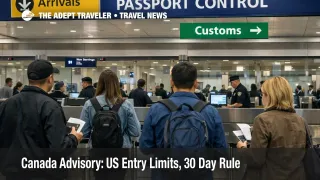
Canada's travel advice for the United States now highlights two separate trip stoppers that can show up at check in or at the border. First, it flags a U.S. presidential proclamation that restricts entry for nationals of certain countries, a change that can make a traveler ineligible for admission even with flights and hotels booked. Second, it calls out a U.S. requirement for foreign nationals staying more than 30 days to be registered, with Canada warning that penalties can apply if a traveler is not properly registered and cannot show proof.
The Canada advisory US entry limits matter because airline document checks and U.S. inspection decisions can turn a normal itinerary into a same day denial, especially for travelers using a second passport or planning long stays.
Who Is Affected
The entry limits are not aimed at Canadian passport holders as a group, but they can still catch Canada based travelers in two common scenarios, dual nationals traveling on a restricted passport, and non Canadian residents departing from Canada on passports covered by the proclamation. The U.S. State Department guidance tied to Presidential Proclamation 10998 says the restrictions apply based on nationality and, in many cases, on visa class, with a full suspension for certain nationalities and a partial suspension for others that can include visitor and student categories. The same State Department guidance also says the proclamation's scope is generally limited to foreign nationals outside the United States who did not hold a valid visa on the effective date, and it lists categorical exceptions such as lawful permanent residents and dual nationals traveling on a non designated passport.
The 30 day registration point is broader. Canada's advisory says Canadians and other foreign nationals visiting the United States for periods longer than 30 days must be registered with the U.S. government, and it directs travelers to check U.S. Citizenship and Immigration Services guidance to see whether they need to register and how to confirm if registration was automatic on entry. This matters most to snowbird style trips, extended family visits, long work assignments with frequent cross border movement, and students or exchange visitors whose stays easily exceed 30 days.
What Travelers Should Do
Start with document triage before you get to the airport. Confirm which passport you will use for the trip, then cross check that passport against the Proclamation 10998 restrictions and any visa class limits, and do not assume that a connecting itinerary or a departure from Canada changes a nationality based rule. If your trip is planned for more than 30 days, also confirm what proof of lawful admission and registration you will have on hand during the stay, for many travelers that means ensuring you can access and present your I 94 admission record and any supporting documentation that shows your current status.
Use a hard decision threshold for whether you should travel or rebook. If you are a national of a restricted country and you do not clearly fall under an exception, or you do not have a valid visa that is recognized as outside the proclamation's scope, treat this as a high probability denied boarding situation and reroute the trip away from the United States until you have official clarity. If you hold a valid visa, you are traveling on a non designated passport as a dual national, or you fit a listed exception, you still should travel with printed and digital copies of your proof, because airline agents and border officers will apply the rule as written and may not have time to troubleshoot edge cases at the counter.
Over the next 24 to 72 hours, monitor official channels and one operational channel. The official channels are the Government of Canada travel advice page, the U.S. State Department guidance tied to Proclamation 10998, and USCIS registration guidance for stays of 30 days or more. The operational channel is your airline's travel document check, because that is often the fastest way to see how rules are being applied at the point of departure. If you want context on how fast consular and screening changes can ripple into real traveler delays and rebooking costs, see U.S. Immigrant Visa Pause, 75 Countries, Starts Jan 21.
How It Works
Entry restrictions move through the travel system in a predictable way. When a presidential proclamation changes admissibility by nationality or visa class, the first order impact often appears before a traveler ever reaches a U.S. port of entry, because carriers are required to check documents and can be penalized for transporting inadmissible passengers. That is why travelers can be denied boarding at check in even when they believe they can explain their situation at arrival.
The second order ripple shows up in itinerary collapse costs. When a traveler is stopped at check in or refused entry, the disruption is not just the missed flight, it is also the chain reaction across hotels, car rentals, onward connections, and prepaid events. Because rebooking often happens inside a same day scramble, fares can be higher, inventory thinner, and new hotel nights more likely, especially for families and long stay travelers who have more sunk costs tied to fixed dates.
The 30 day registration rule has a different propagation pattern. Many travelers are already registered through normal immigration processes, but Canada is flagging that travelers should confirm and carry proof, because a long stay increases the odds that an employer, school, landlord, or a routine compliance interaction will require documentation. For Canadian citizens in particular, some carriers note that for stays of 30 days or more, travelers should be prepared to present an I 94 record issued on entry if asked, which makes it important to confirm you have a retrievable record and to keep it accessible while in the United States.
Sources
- Travel advice and advisories for United States (USA)
- Restricting and Limiting the Entry of Foreign Nationals to Protect the Security of the United States
- Suspension of Visa Issuance to Foreign Nationals to Protect the Security of the United States
- Alien Registration Requirement
- Expanded "Travel Ban" to Take Effect January 1, 2026
- Proclamation of December 16, 2025 Travel Ban Effective January 1, 2026
- Restricted entry of foreign nationals to the United States