

Southwest Assigned Seating Jan 27, Subway Middle Seat
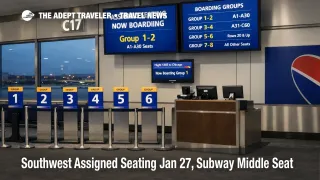
Southwest Airlines is starting assigned seating on flights departing on or after Tuesday, January 27, 2026, ending its long running open seating approach across the network. That change affects how you pick a seat, how your boarding position is determined, and how likely you are to land in a middle seat even if you are used to checking in early. If you are flying that first day and draw the middle seat, Subway is trying to soften the blow with a one day giveaway that rewards a limited number of middle seat travelers who upload proof of their assignment online.
The Subway promotion is straightforward but time boxed. Subway says 737 passengers who are "sandwiched" in a middle seat on January 27 can submit a selfie and proof of the middle seat assignment at SubwayMiddleSeat.com, and the first eligible claims receive a $20 Subway gift card while supplies last. The company says the offer is open to legal residents of all 50 U.S. states and Washington, D.C., ages 18 and up, and it is valid only on January 27, 2026.
On the airline side, Southwest's assigned seating rollout is tied to new seat types and new fare bundles. Southwest describes three seat categories, Standard seats farther back, Preferred seats closer to the front, and Extra Legroom seats in forward and exit row areas, with boarding priority generally improving as the seat type and fare tier improve. In practice, this turns seat choice into a planning step rather than a boarding lottery, and it turns boarding into a more typical group based queue where your seat location matters.
Who Is Affected
Any traveler with a Southwest flight departing January 27, 2026, or later is in scope, even if they booked months ago under the old expectations. The biggest behavior shift hits travelers who built a routine around checking in early to protect a better seat, because early check in no longer guarantees a preferred location once seats are assigned. It also hits groups and families, since assigned seating can be a win if seats are selected early, but it can be a loss if seat selection is delayed and the remaining inventory is scattered.
Fare choice now matters more to seat outcomes. Southwest's published fare bundle comparison shows that its Basic tier is designed around an assigned seat at check in, while higher tiers include choosing from Standard, Preferred, or Extra Legroom seats earlier in the process. If a traveler is on the price sensitive end and picks the fare that does not include meaningful seat choice, the middle seat risk rises on high load flights, especially on peak day departures.
The operational ripple is also real at the airport. Any time a carrier changes boarding logic, the first days tend to produce more gate questions, more last second seat swap requests, and more travelers who are surprised by how their boarding position works. That can slow the human parts of the system, like boarding announcements, line sorting, and overhead bin contention, even if the underlying schedule is running normally. When the gate area gets slower, connections become more fragile, and that can spill into missed onward flights, more same day rebooking demand, and more pressure on hotels near airports when travelers are forced into unplanned overnights.
Subway's giveaway is only relevant to a subset of travelers, but it is a useful signal about what many passengers dread most in this transition. If a traveler is flying January 27 and is flexible about seat location, the promotion is a minor upside. If a traveler is not flexible, the promotion does nothing to solve the real planning problem, which is avoiding a seat outcome that breaks comfort, work needs, or group seating.
What Travelers Should Do
Treat seat assignment as a planning task, not a day of travel surprise. Before you leave for the airport, open your reservation and confirm whether you already have a seat, whether your fare allows changes without an upgrade, and whether you can move out of a middle seat while inventory still exists. If you are traveling as a group, lock seats together early rather than hoping for swaps at the gate, because the easiest time to solve seating is before airport time pressure starts.
Use a simple decision threshold for paying to change the outcome versus waiting. If sitting together, avoiding a middle seat, or securing extra legroom is a must for the trip to work, then treat the cost of a better seat tier or a seat upgrade as part of the fare, and do it while there are choices. If you can tolerate any seat, waiting can be rational, but only if you accept that fuller flights will leave the middle seat as one of the most common remaining outcomes.
Over the next 24 to 72 hours, monitor Southwest communications inside its app and on your trip details for any gate process clarifications, because early rollout days often come with small procedural tweaks. For January 27 travelers specifically, monitor the SubwayMiddleSeat.com terms before departure if you want to participate, since eligibility hinges on submitting proof during that single day, and the gift cards are capped while supplies last. If your day is tight or connection heavy, also keep a backup plan for self service changes in case airports get crowded, and tools like the workflow described in American Airlines App Update Adds Delay Rebooking Tools are a good model for what to look for in any carrier app during disruption.
How It Works
Open seating worked because Southwest could turn boarding order into a proxy for seat choice. You checked in, you got a position, you boarded, and you picked from what remained. Assigned seating flips that logic around. Seat choice becomes an inventory problem managed before boarding, and boarding becomes a flow problem managed at the gate to load the aircraft efficiently while protecting the value of higher tier products.
The first order effect is straightforward. Travelers now need to understand when seats are selected or assigned for their fare type, and they need to verify the seat outcome before arriving at the airport. The second order ripple is where planning gets brittle. When more travelers care about the seat, more travelers interact with the reservation system closer to departure, and that increases the volume of changes, upgrades, and customer questions in the days leading into travel. At the airport layer, any mismatch between what a traveler expects and what they see on their boarding pass tends to show up as gate discussions, seat swap negotiations, and overhead bin competition, which can slow boarding and compress connection buffers.
The transition also changes how passengers distribute themselves in the cabin. Under open seating, late boarders often filled remaining middles and aft rows, while early boarders clustered forward. Under assigned seating, travelers are pre distributed, which can smooth some behavior but can also create new friction, like travelers expecting bin space tied to their boarding group rather than improvising based on when they board. That matters most on the first few weeks after January 27, when habits lag policy, and that is exactly the window where travelers should assume more variability in how fast boarding and turn times feel.
Subway's campaign is not operationally important, but it is a clear traveler facing reminder that a policy change can create a new class of small but real trip irritations. The best travel response is to remove uncertainty early, pick the seat outcome you can live with, and leave extra time on the first days of a new system so that small surprises do not break a larger itinerary.