

Adelaide Airport Baggage Fault Slows Check In Lines
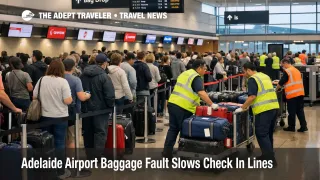
An electrical fault disrupted the main baggage handling system at Adelaide Airport (ADL), forcing airlines and ground teams to improvise manual baggage handling in the terminal. Local reporting and broadcaster updates described long queues forming at check in during the early morning peak, with passengers directed through ad hoc steps to get tagged bags to the right place for loading while the conveyors and automation were offline.
The incident was reported to have begun shortly before 6:00 a.m. Australian Central Daylight Time (ACDT), with the airport indicating the system was restored by mid morning on January 17, 2026. Some travelers reported waits of roughly 40 to 45 minutes in the check in hall, and the most acute stress landed on those traveling with checked bags on early departures, where bag drop cutoffs can be less forgiving than the passenger security lane.
Even when an airport restores baggage automation quickly, the traveler experience can stay uneven for a while because the queue that built during the outage does not vanish instantly. Airlines still have to tag, accept, and clear the backlog of bags, then reconcile any manual processes with normal tracking so travelers can see accurate status in their apps.
The Adelaide Airport baggage system fault matters because baggage automation failures choke departures in the one place most travelers cannot bypass, the point where a bag enters the system. When that handoff slows, the risk shifts from a minor delay to missed bag acceptance deadlines and last minute rebooking decisions.
Who Is Affected
Any passenger departing Adelaide with a checked bag is exposed when the baggage system goes offline, regardless of airline, because most carriers rely on the same terminal handling infrastructure to move bags from check in to screening and make up. The highest friction tends to hit families, groups, and leisure travelers who check multiple bags, plus travelers on international services who often arrive with more luggage and tighter documentation routines at the counter.
Travelers on separate tickets, or on itineraries that require a same day connection through Melbourne Airport (MEL) or Sydney Airport (SYD), face a second layer of risk. A slow bag drop line can compress the time available for security, gate boarding, and any downstream connection buffer, even if the departure eventually pushes close to schedule. If a bag misses the flight while the passenger boards, the trip becomes a baggage recovery problem on arrival, and that can wipe out time, tours, and onward transfers.
Passengers who are mobility limited, traveling with medical items, or checking odd size luggage can be disproportionately affected because airports often route oversize and special items through different acceptance points during workarounds. Those travelers should assume an agent interaction may take longer than normal during a baggage handling outage, even after the main fault is repaired.
What Travelers Should Do
For departures during or immediately after an outage window, the practical move is to arrive earlier than the airline's published minimums, then work backward from your carrier's bag drop cutoff rather than your scheduled departure time. If you have flexibility, a carry on only pivot can remove the single biggest bottleneck, and it also gives you more options to switch flights without worrying about where your checked bag is routed. Keep bag tags and receipts accessible, and take a quick photo of each tag number, because manual steps increase the value of having the identifier ready if tracking goes stale.
Use a clear threshold for rebooking versus waiting. If the check in queue time threatens the airline's bag acceptance deadline, or if you can see that the line is not moving fast enough to reach security and the gate comfortably, rebook while seats still exist, especially for flights later the same day. If you are inside a protected connection on one ticket, prioritize protecting the first flight, then let the airline reflow you downstream, but if you are on separate tickets, treat the entire itinerary as fragile and rebook proactively once your margin collapses. Tools that push disruption guidance and rebooking options into airline apps can reduce time lost at service counters, and travelers should ensure notifications are enabled before arriving at the airport. American Airlines App Update Adds Delay Rebooking Tools
Over the next 24 to 72 hours after any baggage system incident, monitor two things, airport updates about stability, and airline guidance about bag tracking accuracy. A restored conveyor does not guarantee that all bags processed during the manual period are correctly reconciled into the tracking feed. Watch for app status that fails to advance beyond check in, or for missing scan events after boarding, and escalate early if your bag appears stuck, because the sooner an airline can confirm location, the more likely it can be loaded onto a near term flight instead of waiting for the next day's capacity.
How It Works
Modern terminals use a tightly sequenced chain to move checked bags from the counter to screening, sorting, and loading. The baggage handling system is the conveyor, scanning, and routing backbone that connects airline check in positions to checked baggage screening equipment, and then to the make up area where bags are built into loads for specific flights. When an electrical fault knocks that backbone offline, the airport can lose the automated movement that keeps bag acceptance smooth, and it has to fall back to labor heavy workarounds that do not scale well during peak periods.
Adelaide Airport has been running projects that touch exactly these systems, including regulatory security upgrades for passenger and checked baggage screening within the terminal's main baggage handling system. In committee reporting tied to airport operations, Adelaide Airport has also discussed baggage handling system upgrades and the reality that new systems can face capacity and operational challenges that require additional terminal resources to minimize passenger disruption. Those long running upgrade programs are not the cause of every outage, but they explain why baggage handling is a high consequence dependency, a small technical failure can rapidly become a visible terminal wide queue.
The first order effect of a baggage handling outage is slow bag acceptance and a crowding surge at check in, which increases the chance that travelers miss bag drop cutoffs and are forced into last minute rebooking. The second order ripple spreads outward. Airlines can see higher misconnect rates and more pressure on customer service desks, ground handlers must pull staff from other duties to keep bags moving, and flight operations can become less resilient if aircraft push close to the edge of their planned turns. For passengers connecting onward through Melbourne or Sydney, the ripple can show up as missed same day connections, unplanned hotel nights, and reprotected itineraries that arrive a day later than planned.
Sources
- Adelaide Airport travel chaos, bag belt breakdown blamed
- 7NEWS Adelaide post on baggage system shutdown
- ABC Adelaide post on baggage handling delays
- Regulatory Security Upgrades, Adelaide Airport Project Flight
- Passenger Screening Equipment Upgrade fact sheet (PDF)
- Adelaide Airport Consultative Committee Minutes, November 14, 2024 (PDF)