

Carnival Sunshine Barcelona Cruises Add Africa Ports 2027
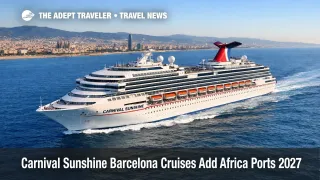
Carnival Cruise Line says Carnival Sunshine will run a Europe season from late May through October 2027, sailing a mix of Mediterranean and North African itineraries from Barcelona, Spain, and Civitavecchia, Italy. The update matters most for travelers shopping peak summer 2027 cruises, especially anyone planning to add North Africa to a Mediterranean trip, or aiming for the total solar eclipse on August 2, 2027. The practical next step is to decide whether you want a specific port mix or the eclipse week, then build a flight and hotel plan with buffers that match the ship's fixed embarkation days.
The Carnival Sunshine Mediterranean cruises change is that Carnival is pairing standard Mediterranean ports with first time Africa calls, and it is anchoring the season with a July 25, 2027 sailing designed to be at sea for eclipse viewing on August 2, 2027.
Carnival's announcement highlights two "firsts" that will drive booking behavior. The ship is slated to call at La Goulette (Tunis), Tunisia, and Tangier, Morocco, described as the line's first ever visits to African ports, and it also adds new European calls including Bari, Italy, Bar, Montenegro, and Ajaccio (Corsica), France. Carnival also says the ship will revisit ports it has not served in years, including Genoa, Salerno, Palermo, and Catania in Italy, plus Palma de Mallorca, Spain, and Izmir, Turkey.
For eclipse chasers, Carnival says a special sailing departs Barcelona on July 25, 2027, then positions the ship for eclipse viewing on August 2, 2027, with calls that include Marseilles, France, Valletta, Malta, and La Goulette, Tunisia. Separately, Carnival says Carnival Miracle will offer a similar eclipse experience on an 11 day Carnival Journeys cruise departing Dover, England, on July 29, 2027, with a dedicated eclipse day at sea on August 2, 2027.
Who Is Affected
The most directly affected travelers are those planning a 2027 Mediterranean cruise with specific ports in mind, because the "new ports plus returning favorites" mix creates a sharper difference between itineraries that may look similar at a glance. If your must have list includes Tangier or La Goulette, your viable sailing dates narrow immediately, and that tends to pull airfare and hotel demand forward in the two main gateway cities.
Embarkation logistics are a big part of the risk picture because these voyages are built around open jaw travel. Many travelers will fly into Josep Tarradellas Barcelona El Prat Airport (BCN) for Barcelona departures, or Leonardo da Vinci Rome Fiumicino Airport (FCO) for Civitavecchia departures, then fly home from a different city depending on the itinerary. That structure is convenient when it works, but it is less forgiving when a flight delay, a missed connection, or a rail disruption forces you to improvise across borders on a fixed sail away time.
Travelers who are sensitive to entry rules are also affected, because North Africa port days can add document checks and excursion constraints that are different from Schengen only cruising. Even when you do not need a visa for a short tourist stop, you still want to treat passport validity, shore tour meeting times, and port security procedures as the hard constraints, since a late return to the ship on an international itinerary can strand you in the wrong country for your flights.
Finally, the eclipse week targets a specific traveler type: people willing to plan around a single astronomical date. The National Solar Observatory's eclipse mapping shows the August 2, 2027 total solar eclipse track crossing parts of Spain and North Africa before continuing east, which helps explain why cruise lines are building "scenic cruising" days into that exact window.
What Travelers Should Do
Start by separating "ship and ports" from "transport and buffers." If you are flying in on embarkation day, shift that plan now, and add at least one pre cruise night in Barcelona or Rome so a delayed flight does not become a missed cruise. Build the same cushion on the back end if you have a tight onward flight, because late docking, port congestion, or operational changes can compress disembarkation mornings even when the cruise itself runs smoothly.
Use a clear decision threshold for booking versus watching. If you want the July 25, 2027 eclipse sailing, or you care about the first Africa calls, assume those departures will behave like event inventory and book when you see acceptable cabin and cancellation terms, not when prices feel "perfect." If your goal is simply a Mediterranean week in summer 2027 and you are flexible on ports, you can be more patient and track fare cycles, but only if you are willing to trade your first choice cabin or exact dates for value.
Over the next 24 to 72 hours after you commit, monitor the details that change trip risk more than the brochure does. Watch the cancellation schedule, final payment date, and what the line says about itinerary changes, because those policies determine whether you can adjust when flights reprice. Also watch entry guidance for Tunisia and Morocco, and keep an eye on your gateway city hotel rates, since cruise departure weeks often tighten the moment multiple lines publish their summer 2027 deployments.
Background
A Europe deployment announcement is not just a list of ports, it is a network plan that has to work across ships, ports, crews, and the traveler journey. Carnival's release includes repositioning moves that underline that reality, including a transatlantic sailing from Norfolk, Virginia, to Dover in mid May 2027, then sailings that step from Dover into the Mediterranean, and an end of season return toward Miami before the ship begins a new series from Galveston, Texas. Those long crossings help the line position the vessel where it needs to be, but for travelers they also create a different kind of trip, more sea days, higher dependence on the ship's schedule, and fewer easy "fly home early" options if something changes mid voyage.
The Africa ports matter because they introduce a new layer of variability into what many travelers assume is a routine Mediterranean cruise. First order effects show up at the port day itself, such as excursion availability, local transport capacity, and whether the ship can keep its planned alongside or tender operations. Second order ripples appear in how travelers stitch the cruise into a wider trip, such as adding pre cruise cities, aligning rail transfers, and managing cross border documentation and travel insurance assumptions. Third order effects are commercial: once a line adds "first ever" ports and an eclipse week, the demand curve changes, and that shifts hotel pricing and flight loads in the gateways that feed the ship.
The eclipse sailing is a good example of how a travel decision gets anchored to a scientific constraint. The National Solar Observatory's overview of the August 2, 2027 eclipse describes a track across Spain and North Africa, and emphasizes that safe viewing depends on proper solar filters except during totality itself. Cruise lines use that predictability to schedule "scenic cruising" time at sea, but travelers still need to treat weather, cloud cover, and the ship's final positioning as variables, which is why buffer nights and flexible travel become more valuable on eclipse week than on a normal summer itinerary.
If you are comparing this to other 2027 inventory decisions, it helps to look at how different segments are opening product at similar horizons. Luxury small ship supply is also pushing travelers to plan gateways and buffers earlier, as seen in Amangati Mediterranean Yacht Bookings Open For 2027 and Oceania Sonata Inaugural Cruises 2027 Bookings Jan 28. If you are considering the separate Dover departure for the Carnival Miracle eclipse cruise, align your entry planning early, and use UK Entry Requirements For Tourists In 2026 as a starting checklist for who needs an ETA or a visitor visa before travel.