

O'Hare Tower Pipe Burst Triggers Long FAA Delay Programs
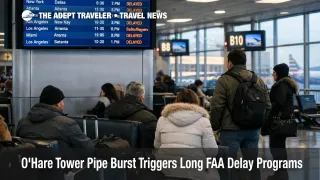
A burst water pipe inside the air traffic control tower forced an evacuation at Chicago O'Hare International Airport (ORD) and temporarily reduced the airport's ability to sequence arrivals and departures at normal rates. Tight connectors, same day turnarounds, and anyone relying on ORD as their national hub bridge were the first to feel it. The practical move is to add connection slack, simplify routings where possible, and use early rebooking thresholds so you do not get trapped in the afternoon compression.
The O'Hare tower pipe burst changed the day's operating capacity at a major U.S. hub, triggering FAA traffic management programs that raised misconnect risk well beyond Chicago.
The incident began around 110 a.m. when the pipe burst in the main tower, prompting controllers to evacuate and resume work from other tower positions, including the south tower. Just after 200 a.m., the FAA put an ORD ground delay program in place, and it remained active until around noon, a signal that arrival demand needed to be metered to keep airborne holding and surface congestion from spiraling. From a traveler's perspective, this tends to show up as planes sitting for release times, arrivals stretched out by miles in trail spacing, and gates that do not open on schedule because inbound aircraft are late.
By late afternoon, Chicago aviation officials reported conditions improving materially, with average delays dropping from the morning peak and the biggest pain concentrated on arrivals. That improvement is real, but it does not mean every itinerary is safe, because once a hub's morning bank is disrupted, the ripple carries into aircraft rotations, crew legalities, and evening departure banks that depend on earlier inbound turns.
Who Is Affected
ORD is a connection amplifier. When its arrival rate is constrained, flights from across the country are held at their origin airports to prevent an unmanageable queue over Chicago, which means the disruption becomes national even for travelers who never planned to stop in Illinois. Travelers most exposed are those with short domestic connections, international itineraries that depend on a single protected connection at ORD, and anyone on two separate tickets where a missed ORD connection becomes an out of pocket problem.
Business travelers on same day turns are at elevated risk because the margin for a late morning arrival evaporates quickly once afternoon banks start slipping. Leisure travelers are exposed differently, especially those aiming for fixed events, cruise embarkations, or prepaid ground transfers, where a two hour slip can translate into a missed handoff and an unplanned overnight.
Reaccommodation pressure tends to rise later in the day. If the system is still carrying a delay program into midday, the replacement seat pool thins fast on nonstop routes, and hotel demand grows around the airport as stranded travelers compete for the same limited set of last departures and rebooked itineraries.
What Travelers Should Do
Act early, and protect time first. If your itinerary connects at ORD, add slack now, and treat any connection under 90 minutes as a risk trade, not a plan. If you have an option to move to a nonstop, or to a single connection through a different hub, that is often safer than accepting a two connection reroute that can fail twice, once on the first delay, and again on the second bank.
Use a decision threshold for rebooking versus waiting. If your inbound delay pushes your estimated arrival inside your scheduled connection window, rebook before you land or before you reach the gate area, because the lines and the seat scarcity usually worsen after the first wave of misconnects hits customer service. If you are on separate tickets, the threshold should be stricter, because the second carrier is not obligated to protect you, and you can end up paying walk up fares when options tighten.
Over the next 24 to 72 hours, watch for secondary stressors that can turn one day of tower disruption into a multi day aftertaste. Monitor FAA airport status and NAS updates for renewed delay programs, and pay attention to winter weather compounding risk, especially if your travel window overlaps the broader pattern described in US Winter Storm Flights, Delays Likely Jan 24 to 28. If your trip must arrive on time, consider positioning earlier in the day, or staging near the hub the night before, because proactive buffer is usually cheaper than forced buffer once reaccommodation collapses.
How It Works
A tower evacuation is a distinct failure mode from runway closures or gate constraints because it directly reduces the system's ability to safely sequence aircraft at normal volume. When controllers relocate, they can often keep operations moving, but capacity can drop because teams are working from alternate positions, equipment availability may be uncertain, and traffic flows need to be rebuilt under conservative spacing.
The FAA's ground delay program tool is essentially a pressure valve. Instead of letting aircraft launch into a constrained destination and hold in the air, the system meters departures at origin airports so arrivals are spread out over time, which is why travelers far from Chicago can suddenly see "ATC delay" on a clear day. The first order effect at ORD is departure spacing and arrival metering. The second order effect is network: late inbound aircraft miss their next outbound assignment, crews time out, and airlines start swapping aircraft and canceling lower priority frequencies to protect later banks.
Recovery timing is usually not a single moment. Even after the delay program ends around midday, the system still has to unwind queues, reposition aircraft, and rebuild schedule integrity. For travelers, that means "operations returning to normal" can coexist with real misconnect risk for the rest of the day, especially on itineraries that depend on a single tight window at ORD. If you want a quick reality check on how multi region disruption days tend to evolve, compare the pattern language in Flight Delays and Airport Impacts: January 22, 2026, and keep in mind that infrastructure resilience and staffing constraints are an ongoing theme in U.S. Air Traffic Control Privatization: Reality Check.