

KLM Free WiFi on Europe Flights Starts Jan 22
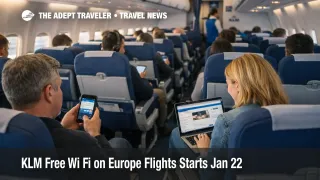
KLM has begun rolling out unlimited, complimentary WiFi on its short haul European network, turning onboard internet into a standard inclusion rather than a paid add on. The airline says free access is live on about half of the aircraft operating inter Europe rotations as the program ramps up. Travelers can use the service throughout the flight after signing in, or registering, as a KLM Flying Blue member, which effectively makes loyalty enrollment the gate to free connectivity on these routes.
KLM is positioning the move as a response to passenger demand, and as a way to make short flights more useful for planning, messaging, and entertainment. Over the next phase, the carrier says the free WiFi experience will extend across the core of its European fleet, including Airbus A321neo, Embraer 195 E2, and a portion of Boeing 737 800 aircraft.
Who Is Affected
Passengers on KLM's European routes are the direct beneficiaries, but the practical impact depends on the specific aircraft operating your flight. During a phased rollout, the same city pair can see different WiFi outcomes on different days, and even on the same day, because airlines routinely swap aircraft to recover from delays, maintenance issues, and crew positioning needs. That means the promise is real, but it is not yet uniform, and travelers who must be connected for work should treat availability as probable, not guaranteed, until the rollout reaches full coverage.
Flying Blue members are the group KLM is explicitly prioritizing, since the free tier requires a loyalty login. If you are traveling on a family booking, or on a corporate reservation where not everyone uses Flying Blue, it is worth treating account setup as a pre trip task, otherwise the friction hits at the worst moment, when you are already seated and trying to get online quickly.
This change also matters more on KLM's short haul product than it might on airlines that rely on embedded entertainment, because KLM's European fleet generally does not have seatback screens. In practice, that shifts more of the onboard experience to personal devices, so reliable connectivity becomes part of the baseline expectation for travelers who want streaming, messaging, cloud documents, or real time trip management.
What Travelers Should Do
Treat enrollment and login readiness as the first step. Create a Flying Blue account if you do not have one, and confirm you can sign in on your phone without a password reset loop, because the most common failure is not the cabin network, it is credentials that have not been used in a while. KLM and its partner information pages indicate you connect by switching to airplane mode, joining the onboard WiFi network, then following the portal steps that appear on your device.
Use clear thresholds for whether you can rely on WiFi for time sensitive tasks. If you must be online for a live meeting, a timed booking, or a security step that requires two factor authentication, assume the aircraft might change, the service might be temporarily unavailable, or coverage might be constrained by the route and network conditions. In those cases, download what you need in advance, queue messages to send on landing, and keep a backup plan such as airport lounge WiFi, an eSIM plan, or a tighter connection buffer that preserves time on the ground.
Over the next 24 to 72 hours of travel planning, monitor the right signals rather than relying on generic promises. Check your booking for aircraft type the day before and again on travel day, and watch for last minute equipment swaps in the app, especially on tight turn rotations. If you are connecting through Amsterdam Airport Schiphol (AMS) during winter operations, or during irregular days, prioritize connectivity for rebooking and coordination, since disruptions at KLM's hub can compress seat inventory and raise the value of fast self service changes. For recent examples of how quickly Schiphol disruptions can propagate across KLM's network, see KLM Cancellations Amsterdam Schiphol Flights January 5 and KLM Deicing Fluid Shortage Disrupted Schiphol Flights.
Background
Inflight connectivity on short haul routes is a layered system, and rollout claims do not always translate into uniform traveler outcomes on day one. The first order constraint is the aircraft itself, meaning the antenna, modem, cabin network, and certification work have to be installed and operating on each tail number before the airline can offer a consistent product. KLM is rolling this out in phases across the aircraft used for its European schedule, which is why free WiFi is currently available on roughly half of its European fleet rather than every flight.
The second order ripple is operational substitution. When a hub carrier is recovering from delays, maintenance events, or uneven aircraft utilization, flight numbers can be served by different aircraft than originally planned. That is good for on time performance, but it can create a mixed onboard product, where one day has free WiFi and the next does not, even on the same route. For travelers, the correct mental model is that the route is not the unit of service, the aircraft is, until the entire fleet type is equipped.
The third layer is capacity and network performance. KLM and its connectivity partner Viasat have framed the program as fast, full, and free, with an accelerated rollout across 68 aircraft in total, which suggests the airline is designing this as a durable feature rather than a limited messaging tier. Even so, real time performance can vary based on demand, satellite coverage, and the number of devices onboard, so travelers should still plan for variability when the stakes are high.