

Amsterdam Centraal Delays Hit Eurostar January 26
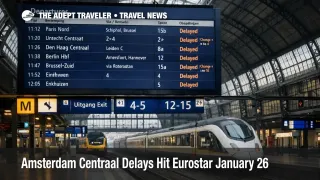
Over running maintenance work at Amsterdam Centraal slowed the rail system on January 26, 2026, and Eurostar warned passengers of delays on at least one Amsterdam service. Travelers on high speed and domestic links were affected because Amsterdam Centraal sits at the center of national routing, and even small timetable shifts can cascade into missed reserved departures. If you are traveling the same day, the practical move is to add buffer, check live status before you leave for the station, and be willing to reroute via alternative stations or modes.
The Amsterdam Centraal rail delays changed the reliability of same day rail plans by turning normal transfer slack into a misconnect risk, especially for international departures and airport positioning.
Eurostar's disruption notice tied the delay to maintenance work that ran long at Amsterdam Centraal, and it also flagged stop changes for the affected service. Separately, Dutch network engineering work in the Schiphol corridor reduced frequency and forced substitutions that matter because the Amsterdam Centraal, Schiphol, and Rotterdam axis is a core passenger artery for both locals and visitors.
Who Is Affected
International rail travelers are affected first when their itinerary relies on a single reserved departure from Amsterdam Centraal. A delayed inbound domestic train can erase the margin needed to reach the platform, complete any required check in steps, and board on time. That failure mode is most expensive for separate ticket itineraries, where a late domestic leg can turn into a missed international departure without an automatic protected connection.
Airport bound travelers using Amsterdam Airport Schiphol (AMS) are the next group to watch. Engineering work in the Schiphol corridor can force bus substitutions and reduce train frequency, which increases the chance that a missed departure becomes a long wait rather than a quick recovery. When that happens, airport plans fail at the worst moment, close to airline bag drop cutoffs, security peak periods, and fixed boarding times.
Domestic travelers moving through the Amsterdam hub are also exposed because reduced service compresses demand onto fewer trains. Late in the afternoon on January 26, an additional disruption involving a broken down train reduced intercity availability around Amsterdam Centraal and Amsterdam Sloterdijk, adding another layer of short notice timing risk before service normalized.
Cross border itineraries can be especially fragile this week if they touch Belgium. NS International warned that a Belgian strike period impacts train traffic in Belgium and the Netherlands, which can degrade feeder reliability even when international services aim to run close to normal. Related guidance is also covered in Belgium Rail Strike Disrupts Trains Jan 25 to 30.
What Travelers Should Do
Travelers departing Amsterdam Centraal on January 26 should treat their station arrival time as a controllable buffer, not an afterthought. Check your operator's live updates before you leave, and again when you are en route, then aim to be at the station early enough that a platform change or a short delay does not collapse your plan.
Use a decision threshold that is tied to consequences, not optimism. If missing one domestic train would cause you to miss a reserved international departure, an airline bag drop cutoff at Schiphol, or the last practical connection that avoids an overnight, reroute early, even if it costs more in the moment. If the consequence is only arriving later and you still have multiple viable departures, waiting can be reasonable, but only after you confirm that your next workable option is actually operating under the live service picture.
Over the next 24 to 72 hours, monitor the channels that drive operational reality. Eurostar points travelers to its travel updates and live information, and Dutch network engineering work updates can change the best transfer path into and out of Schiphol and Amsterdam. If your itinerary touches Belgium, track NS International strike period advisories as well, because cross border reliability often breaks on the feeder layer, not the headline train.
How It Works
A station centered disruption propagates in two steps, throughput loss, then recovery loss. When maintenance work runs long at a hub like Amsterdam Centraal, platform access and dispatch sequencing tighten, which pushes delays outward onto multiple lines at once. The second order ripple is where travel costs rise, because passengers miss reserved departures, crowd onto the next available trains, and trigger more platform dwell time and slower boarding, which further degrades punctuality.
Engineering work and substitutions in the Schiphol corridor amplify that effect by removing redundancy. If fewer trains run, or if buses replace a segment, the network has fewer ways to absorb missed connections, and travelers are forced into longer reroutes, earlier departures, or road transfers. That is why airport transfers become a high sensitivity node during rail disruption, even when flights are operating normally.
When multiple issues stack, for example an Amsterdam hub delay plus a separate rolling disruption such as a broken down train, the system shifts from delay to misconnect. The timetable can technically recover, but individual itineraries do not, because the chain, domestic train to hub to international departure, or hotel checkout to rail to airport, breaks at the weakest link.