

Belgium Rail Strike Disrupts Trains Jan 25 to 30
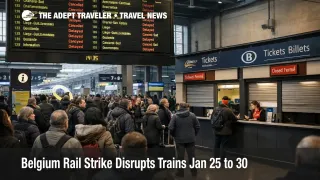
Belgium's national rail operator, SNCB NMBS, has moved from advance notice to live, day by day operating guidance for a multi day rail strike that cuts domestic train availability across the country. The disruption window begins at 10:00 p.m. CET on January 25, 2026, and runs through the last trains on January 30, 2026. Travelers transiting Belgium, including anyone using domestic trains to reach Brussels Midi for Eurostar or to position for flights, should plan for fewer options, larger gaps between departures, and heavier crowding on the trains that do run.
The practical change now is that decisions should be made from the alternative service plan as it is published, not from the normal timetable. SNCB says train availability is limited during the strike, and the operator is posting daily summaries and routing travelers to its journey planner to confirm what is actually operating.
Who Is Affected
Domestic travelers inside Belgium are affected first, especially anyone making same day city moves that depend on frequent service as the buffer. When frequency drops, a missed connection stops being a small delay and becomes a forced replan, often with longer station dwell times, and higher odds of arriving after hotel check in windows or event start times.
International rail passengers face a different failure mode, the Belgian feeder leg. Eurostar says it expects to run a near normal timetable during the strike, but it flags that domestic train traffic in Belgium could be disrupted and that connecting journeys may require extra time and extra checking with the relevant carriers. This matters most for separate ticket itineraries, or for travelers who planned tight transfers into Brussels Midi, because the international train can be operating while the domestic link to reach it is not.
Air travelers using rail for airport positioning should treat Brussels Airport (BRU) as a high sensitivity node during the strike window. Brussels Airport is warning of fewer trains, even with minimum service, and is directing passengers to plan via SNCB NMBS. If your departure has a hard baggage cutoff or you are traveling early in the morning, the strike can remove the slack that makes a rail first plan feel safe, and it can push more travelers into taxis, rideshares, and private transfers at the same time.
What Travelers Should Do
If you are traveling on January 26 through January 30, treat your Belgian rail leg as the weak link and build buffer around it immediately. Confirm your specific train in the SNCB journey planner before you leave your lodging, then choose a backup that you can actually execute if the planner shows a large gap or a cancellation. If you are positioning for a flight at Brussels Airport, assume road options will be tighter and more expensive than usual, and book them earlier rather than waiting until the station is crowded.
Use a clear decision threshold for rebooking versus waiting. If missing one train would make you miss Eurostar check in, break the last practical onward connection, or force an unplanned overnight, switch modes or move travel outside the strike window as soon as you see your preferred rail option is not operating in the alternative plan. If the consequence is only arriving later and you have multiple workable departures, waiting can be reasonable, but only after your train is explicitly shown as running under the strike day plan.
Over the next 24 to 72 hours, monitor the operator channels that actually drive outcomes. Eurostar is telling travelers to watch its live train info and travel updates, and to allow extra time where Belgian domestic connections are involved. For cross border travel beyond Eurostar, SNCB International is also publishing strike period disruption guidance for international itineraries that touch Belgium, which can help you spot when the international layer is changing even if your ticket is still valid.
Background
A national rail strike propagates through travel in two waves, capacity loss and recovery loss. The first order effect is straightforward, fewer available crews and operating resources mean fewer trains, less redundancy, and more crowding at the departures that remain, which concentrates stress at hubs like Brussels Midi and on airport access corridors.
The second order ripple is where itineraries break expensively. When domestic feeders thin out, international rail and air segments become harder to use even if they are technically operating, because the last mile to the departure station fails. That is why Eurostar can be close to normal while your trip still collapses, the connection chain is what breaks. As travelers substitute into road modes, taxi and rideshare demand rises around Brussels and other major stations, car hire inventory tightens, and nearby hotels can see forced overnight demand from missed cutoffs.
For planning context published before the strike went live, see Belgium Rail Strike Disrupts Airport Trains Jan 25-30 and Belgium Rail Strike SNCB Trains, Minimum Service Rules.
Sources
- Strikes and union actions, SNCB NMBS
- Traffic disruptions and works, SNCB International
- Disruptions, Eurostar travel updates
- Industrial action on the Belgian rail from 25 to 30 January, Brussels Airport
- Belgium travel advice, UK Foreign Travel Advice
- Everything we know so far about Belgium's five day railway strike next week, The Brussels Times