

Heathrow Security Allows 2L Liquids in Carry Ons
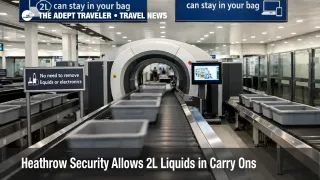
London Heathrow Airport (LHR) says passengers can now carry liquids in containers up to 2 litres each through security in any terminal, and they can leave liquids and electronics inside their bags. The change affects essentially everyone departing from Heathrow, including connecting passengers who must reclear security after a terminal change or a landside transfer. For your next trip, pack for your strictest airport first, but if Heathrow is the limiting point, you can stop buying travel size liquids and skip the tray unpacking routine.
In plain terms, the Heathrow security liquids rule removes the 100 ml bottleneck at this airport, but it does not remove it everywhere else.
Who Is Affected
The biggest win is for travelers starting a journey at Heathrow who previously had to decant toiletries and pull laptops out in the lane, which created rework, secondary screening, and queue surges when passengers missed the rule. It also helps transfer passengers when an itinerary change forces a terminal swap with a new security screening, because fewer steps at the belt reduces the chance you lose time, or misplace items mid process.
The downstream effects reach beyond the checkpoint. Faster, more predictable security throughput can reduce late gate arrivals, ease boarding pressure during peak banks, and slightly lower the chance that one delayed flight cascades into missed connections and reaccommodation demand across an airline network. Heathrow has also tied the upgrade to sustainability by eliminating the plastic bag step for liquids, which changes what retailers stock airside and what travelers buy last minute.
What Travelers Should Do
If you are departing from Heathrow, you can keep liquids and electronics packed, but do not treat this as permission to ignore all screening rules. Keep any medically necessary liquids organized for quick presentation, and expect standard outerwear and pocket emptying requirements to remain, even if the liquid bag step is gone.
Your decision threshold for packing should be conservative. If any airport on your itinerary still enforces 100 ml, pack to that stricter standard, or be ready to check a bag on the return, because liquids that cleared Heathrow outbound can still be seized on the way home. Heathrow explicitly warns that other airports may use different equipment and different limits, so verify each airport you will pass through, not only your origin.
Over the next 24 to 72 hours before travel, monitor two things: your terminal and transfer plan at Heathrow, and any entry compliance that could push you landside during a connection. If you are connecting through London and there is any chance you may need to clear passport control due to rebooking or an overnight disruption, review UK ETA Enforcement Feb 25, 2026, Denied Boarding Risk and UK Entry Requirements For Tourists In 2026 before you fly.
Background
Heathrow says the shift is enabled by a full rollout of CT security scanners across all four terminals, which produce higher resolution, three dimensional images of cabin baggage and reduce the need for passengers to separate items into trays. Heathrow priced the upgrade at about £1 billion, and it estimates almost 16 million plastic bags per year will no longer be used because liquids do not need to be presented in a separate bag.
The old 100 ml rule dates to 2006, when UK authorities introduced liquid restrictions after a foiled plot involving liquid explosives, and that regime became a global norm that shaped how travelers packed for two decades. Even as CT scanners spread, rules still vary by country and airport, and the United States, for example, continues to apply the 3.4 ounce, 100 milliliter carry on liquid limit in standard screening guidance.