

Luxembourg CFL Rail Closures Hit Carnival Week
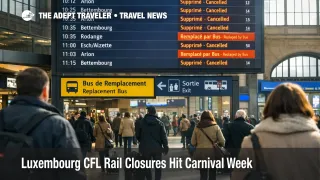
CFL has published a forward schedule of major 2026 line closure periods, and the most immediate planning problem for winter travelers is the Carnival holiday window from February 14 through February 22, 2026. During that period, the calendar flags that no trains are planned between Luxembourg City and Arlon, and that no trains are planned between Luxembourg City and Bettembourg. CFL also notes an important exception, TGV services are excluded from the Luxembourg City to Bettembourg closure and are expected to operate, which matters for travelers using Luxembourg as the start point for Paris rail.
The practical difference between a normal engineering works notice and a holiday blockade is that the blockade removes timetable redundancy for more than a weekend. When those corridors go dark, the network shifts from rail first to substitution first, with more transfers, more uncertainty around dwell times, and more pressure on station circulation at Luxembourg Gare Centrale, where most itineraries funnel. CFL's own works and disruption pages make clear that travelers should check works close to departure because adaptations can still occur, even when the works are planned months ahead.
Who Is Affected
Cross border travelers are the first group exposed. The Luxembourg City to Arlon link is a key hinge for itineraries that position through Belgium, including onward rail from Brussels, and it is also a common backbone for travelers stitching together separate tickets into Eurostar or other long distance departures. When that rail segment becomes a bus substitution or a forced reroute, the failure mode is not only delay, it is missed check in cutoffs and lost seat inventory on the onward leg.
France bound itineraries are the next group to watch, especially those that use the Luxembourg City to Bettembourg corridor as the first leg toward Thionville, Metz, and Paris. The TGV exclusion helps, but it does not eliminate risk, because many traveler plans depend on regional feeders, hotel repositioning, or family members traveling on different products on the same corridor. In practice, that means you can have a running TGV and still have a broken day if your positioning train, or your station access plan, relies on the suspended local pattern.
Airport transfer chains sit on top of that rail reality. Luxembourg Airport (LUX) is not a rail station, so many visitors reach it by getting into Luxembourg City first, then transferring to local surface transport or a car service. When rail into Luxembourg City is disrupted, the second order ripple shows up as thicker queues for taxis and private transfers, and wider variability on travel times at the exact moment you are trying to protect airline bag drop and security buffers.
For readers tracking stacked regional reliability, this closure window also lands in a broader Benelux context where rail disruption in one country often changes demand patterns in the others. If your broader trip also touches Belgium or the Netherlands, review the earlier disruption patterns and connection chain risks described in Belgium Rail Strike Cuts Trains Through January 30 and Amsterdam Centraal Delays Hit Eurostar January 26.
What Travelers Should Do
Act now on the parts you can control. If you travel February 14 to 22, 2026, lock in your plan from the disrupted reality, not the normal timetable, and give yourself a larger arrival buffer into Luxembourg Gare Centrale before any onward rail, tour start, or flight day. If you will need a taxi or private transfer during peak times, consider prebooking because substitution days can concentrate demand quickly.
Use a hard consequence test to decide whether to rebook or wait. If missing one connection would force an unplanned overnight, cause a missed long distance departure with a separate ticket, or jeopardize an airline cutoff, do not accept a marginal same day chain. Either shift the travel date outside the February 14 to 22 window, or add a buffer night so your high stakes segment starts from a stable morning position.
Over the next 24 to 72 hours before you depart, monitor the sources that actually change outcomes. Check CFL works and CFL disruptions for late adjustments, and recheck your operator's journey planner for platform and substitution details that are often only finalized closer to the date. If your plan touches Belgium, also cross check Belgian operator advisories because the feeder layer is where cross border itineraries usually fail.
How It Works
Luxembourg's network is small enough that planned blockades can remove entire city pair options, especially when works target junctions and station approaches rather than a remote segment. The 2026 plan highlights work priorities that include capacity upgrades and station area preparation, which helps long term reliability, but in the short term it requires full access windows where trains cannot safely share the corridor.
For travelers, the operational mechanic is substitution. When rail is replaced by buses, travel time becomes less predictable because road congestion, loading times, luggage handling, and interchange friction all rise. Those minutes then cascade into the wider travel system, missed rail connections tighten the remaining seat supply on later departures, missed airport transfer windows trigger rebooking costs, and missed last practical departures often become hotel nights that were not part of the original budget. CFL explicitly encourages travelers to consult works close to departure because plans can still change, which is why last minute verification is part of the safest workflow even for planned engineering works.