

Madrid Andalucía High Speed Rail Outage Reroutes
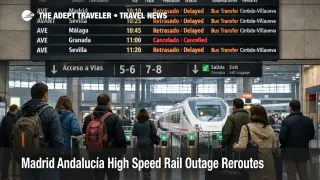
High speed rail service between Madrid, Spain, and Andalucía, Spain remains out of service after the January 18, 2026 accident near Adamuz, Spain, forcing reroutes and longer end to end journeys on the country's busiest north to south corridors. Travelers bound for Seville, Córdoba, Málaga, Granada, and Cádiz are the most exposed, especially those with tight same day connections, timed attraction entries, or onward transport booked on separate tickets. The practical next step is to recheck your specific train number, confirm whether your itinerary now includes a bus transfer, and add buffer time before you lock in hotel check ins, tours, or onward legs.
The Madrid Andalucía high speed rail outage is turning direct AVE style trips into mixed mode journeys, with longer travel times and more fragile connections while repairs and investigation work continue.
Renfe has activated and is selling an Alternative Transport Plan that keeps travel under a single title of transport by inserting a dedicated road segment between Córdoba and Villanueva de Córdoba in both directions. In practice, this means your ticket can include a train segment, a coach transfer, and then another train segment, rather than a single continuous high speed run. Renfe also states that travelers can request a free refund of their original ticket, then buy a new ticket for the plan services, or change with a refund of any fare difference.
Who Is Affected
Travelers on the Madrid to Seville and Madrid to Málaga corridors are most affected because those routes are the backbone for Andalucía leisure travel and for onward rail pairs to coastal destinations. Córdoba is a key pinch point because the alternative plan uses bus transfers in the Córdoba to Villanueva de Córdoba segment, which introduces a time and reliability variable that does not exist in normal high speed operations.
Travelers headed to Granada, Cádiz, Huelva, Algeciras, and other Andalucía endpoints should also assume indirect effects even if their final leg is not on the high speed line, because disrupted trunk capacity changes how seats are allocated, how missed connections are reaccommodated, and how crowded conventional alternates become. Adif's public network status continues to list the Madrid to Andalucía high speed link as interrupted, and it points travelers toward operator channels for the specific commercial service plans from Renfe and other operators.
If your Spain trip is also crossing Iberia during multi day weather or surface transport disruption, treat this rail outage as additive risk rather than a standalone problem, especially for station access, last mile transfers, and same day multi segment plans. Storm Kristin Portugal Spain Travel Disruption
What Travelers Should Do
Act now if you have a fixed arrival requirement, for example a nonrefundable hotel night, a tour departure, or a timed entry in Seville, Córdoba, or Málaga. Recheck your booking in your sales channel, and confirm that the coach transfer is explicitly included as part of your through itinerary, not something you are expected to self arrange. If you have separate tickets, increase your self made connection buffer substantially, because a missed connection can strand you without automatic reaccommodation.
Use a decision threshold based on what you can tolerate. If your new itinerary is now so long that it breaks your day plan, or if you are carrying tight same day connections to a cruise, a flight, or an event, pivot early to an alternative you can control, such as a short haul flight, or a one way car rental, rather than waiting for day of station surprises. If your plans are flexible and you can absorb variability, holding your rail booking can still make sense, but assume the mixed mode transfer will be slower than the timetable implies during peaks.
Over the next 24 to 72 hours, monitor two things: whether Adif changes the network status for the corridor, and whether Renfe modifies the alternative plan inventory, timings, or ticket handling. Public reporting has also signaled uncertainty around early February reopening targets, so treat any specific return to normal date as provisional until it appears in official infrastructure and operator updates.
Background
High speed rail outages propagate differently than routine delays because the blocked segment removes path capacity, not just punctuality. At the source, an interruption on the Madrid to Andalucía high speed line forces operators to either stop service, detour to slower conventional alignments, or build a bridge with buses to bypass the damaged zone, which is what Renfe has implemented between Córdoba and Villanueva de Córdoba.
The second order effects tend to show up in three layers. First, mixed mode transfers increase dwell time and reduce schedule resilience, so missed connections become more likely even when each individual segment is operating. Second, trainsets and crews that normally cycle through high speed diagrams can end up out of position, which can reduce available departures on later days as operators rebalance equipment. Third, traveler behavior shifts, with more people choosing flights or cars, which can tighten short haul airfare and compress car rental inventory, while also pushing hotels into awkward one night extensions when a same day arrival becomes impossible.