

BHX Air Rail Link Outage Slows Terminal Transfers
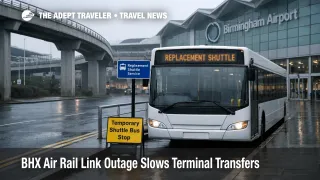
Birmingham Airport passengers saw a short, early morning interruption to the Air-Rail Link on January 30, 2026, affecting the last mile between Birmingham International rail station and the terminal. Travelers arriving by train for early departures, plus anyone landing and trying to catch a specific onward train, were the most exposed to the added friction. The practical move is to treat the station to terminal leg as a variable today, add buffer time, and know your backup path, including the replacement bus stop, walking routes, or a short taxi hop.
BHX Air-Rail Link outage terminal transfer matters because the airport's rail strategy depends on a fast, predictable shuttle, and when that link fails, the entire rail to flight chain becomes timing sensitive.
Birmingham Airport reported the Air-Rail Link was out of service around 525 a.m. local time on January 30, 2026, then reported it back in service around 615 a.m., while also pointing travelers to a free replacement bus during the stoppage. Separately, the airport has warned that the Air-Rail Link is operating on a one-shuttle pattern during essential planned maintenance through February 2026, with service roughly every six to eight minutes between 330 a.m. and 1230 a.m., which can create longer waits at peak times even when the system is technically running.
Who Is Affected
Rail arriving passengers are the first group to feel this, because a rail itinerary that looks tight on paper often assumes a near immediate two minute shuttle, not a variable queue, plus a longer platform to bus stop walk when a replacement is in use. The highest risk segment is early departures with checked bags, because bag drop cutoffs and security peaks compress the margin you have to absorb a station transfer delay.
Arriving passengers with onward rail plans are the second group, especially if the plan relies on a specific train rather than a frequent turn up and go corridor. A delayed landside transfer can turn into a missed departure, and once you miss a late evening train, alternatives thin fast.
Passengers using accessibility services, families with multiple bags, and travelers with reduced mobility are also more exposed, because switching from the automated link to a bus or a longer walking route increases effort, adds handling steps, and can extend dwell time at the station side.
What Travelers Should Do
If you are heading to the airport by train today, add buffer specifically for the station to terminal leg. In low demand periods, plan on at least 15 minutes from station arrival to terminal entry. In peak periods, especially early morning, plan on 30 minutes, and if you have checked bags and a tight cutoff, treat 45 minutes as the safer threshold so a queue does not force a missed check in.
If you need to choose between waiting versus rebooking, use a clear timing trigger. If you are inside 90 minutes of your airline's bag drop cutoff and you are still at the rail station with uncertainty on transfer timing, pivot to a taxi or a prebooked car immediately, because the cost of a short ride is usually lower than a missed flight cascade. If you are still outside that window and the link is running, you can wait it out, but you should assume uneven headways during one-shuttle operations at busy moments.
Over the next 24 to 72 hours, monitor Birmingham Airport service updates before you leave, and again when you arrive at Birmingham International, because short interruptions can recur during maintenance periods. If you land late and you are trying to catch the last onward trains, treat the overnight window as a hard constraint, since the Air-Rail Link does not operate 24 hours, and you may need to use the courtesy bus, walk, or a taxi to protect the last departure.
Background
Birmingham Airport's rail access works because Birmingham International station is effectively the airport's rail front door, and the Air-Rail Link is the connector that makes that door usable at flight timing cadence. When the connector is out of service, the airport shifts passengers onto buses, which adds road variability, boarding location ambiguity, and luggage handling friction, all of which are small individually but decisive when you are timing bag drop and security cutoffs.
The first order effect is localized, longer station to terminal transfer times, plus occasional queues during one-shuttle running. The second order ripples spread across at least two layers of the travel system. Rail passengers who do not trust the last mile may shift to taxis or private hire for short hops, or they may switch to driving and parking, which can tighten parking availability and increase curbside congestion at peak waves. On the outbound side, a missed check in window becomes a rebooking problem that can push travelers into later flights and unplanned hotel nights. On the inbound side, a delayed terminal exit to station connection can break timed rail reservations, and that can cascade into missed city check ins, tours, or onward airport positioning.
For BHX specific rail to terminal contingency patterns, see Birmingham Airport (BHX). For comparable UK cases where a single link in the chain creates disproportionate misconnect risk, see Britain CrossCountry strike: How to reach BHX, MAN, and EMA without XC and Rail Buses Replace Chester Crewe Trains Dec 16 To 19.