

Córdoba to Jaén Train Buses After Adif Speed Cap
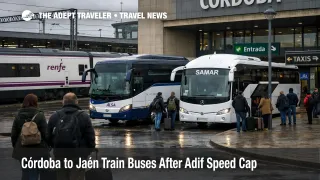
Conventional Media Distancia service between Córdoba and Jaén is running under a road substitute plan after infrastructure limits reduced reliability on the line. Adif's public railway network status for January 30, 2026, explicitly says the alternative road plan between Córdoba and Jaén remains in place, which signals the disruption is still operational for today's travel decisions. Renfe has also published a notice stating it scheduled road transport for all conventional Media Distancia Córdoba-Jaén services starting Monday, January 26, and that it will remain active until normal conditions return.
Local reporting in Andalucía ties the trigger to a temporary speed restriction on a short segment between Andújar and Villanueva de la Reina, with the slow zone described as roughly seven kilometers limited to about 10 kilometers per hour. Renfe's original day one action included canceling multiple departures and shifting passengers to coaches to avoid cascading delays, a tactic that trades rail punctuality risk for road variability.
Who Is Affected
Travelers using Renfe conventional Media Distancia trains between Córdoba and Jaén are directly affected, including day trippers, commuters, and travelers positioning for stays across Jaén province. The disruption also catches long distance travelers who arrive at Córdoba on AVE services and then plan to continue east on the conventional network, because the Córdoba to Jaén leg becomes the weak link that can break same day schedules.
Passengers should also expect indirect impacts even if their ticket is not explicitly Córdoba to Jaén. When a corridor shifts to coaches, capacity is effectively constrained, boarding takes longer, and station flows become less predictable, which can pressure taxi availability at smaller stops and tighten margins for tour pickups that were built around train punctuality.
What Travelers Should Do
Assume your Córdoba to Jaén leg will involve a coach segment, and plan your day around road timing rather than rail timing. Recheck your specific departure in Renfe channels before leaving for the station, and arrive earlier than normal because loading, luggage handling, and platform to curb transfers add friction that does not appear in rail timetables. If you are connecting from an AVE arrival at Córdoba, build a buffer that can absorb road congestion and station reboarding, not just a minimal platform change.
Use a clear decision threshold for whether to hold your plan or rework it. If you have a fixed commitment, such as a timed tour departure, a medical appointment, or a nonflexible hotel check in, treat the bus swap as a material risk and consider moving to an earlier arrival, shifting the trip to a different day, or restructuring the day so that the Jaén leg is not time critical. If your plans are flexible and you can tolerate a late arrival, keeping the rail booking can still be reasonable, but assume variability through the day.
Over the next 24 to 72 hours, monitor two signals. First, Adif's daily network status entries, which confirm whether the alternative road plan remains active. Second, Renfe notices and day of travel messages, including SMS updates, which can change how the substitute is executed and which stations are used for transfers. If you have separate tickets, treat any missed connection as your responsibility unless Renfe staff explicitly reissues your onward travel, and document disruptions in case you need to support an insurance claim.
Background
A temporary speed restriction is an infrastructure safety measure, and it can be operationally worse than a short closure because trains may technically be able to move, but the timetable becomes impossible to hold. In this case, local reporting describes an extreme slow segment near Villanueva de la Reina, and Renfe's response was to prioritize reliability by replacing conventional trains with road transport for the Córdoba-Jaén relationship. Adif's January 30 network status confirms the road plan is still in effect, which indicates the constraint has not fully cleared from an operations standpoint even if parts of the line are otherwise passable.
Disruptions on this conventional corridor propagate beyond the track segment itself. At the source, any slow zone forces dwell and crew time to expand, which can break diagrams and push knock on delays into later departures. The second order ripples hit connections and inventory, because travelers who would normally rely on rail punctuality either buffer with extra hotel nights, shift to regional buses, or pay for taxis when coach substitutes do not align with their plans. A third ripple is that Córdoba becomes a higher risk interchange point during wider Andalucía rail disruption, especially while separate high speed network issues continue to affect the region, as covered in Madrid Andalucía High Speed Rail Outage Reroutes.
Sources
- Railway network status - Adif
- Renfe ha programado desde el lunes 26 de enero un servicio alternativo de transporte por carretera para todos los servicios de Media Distancia Convencional Córdoba-Jaén
- Renfe suspende los trenes de media distancia entre Córdoba y Jaén
- RENFE anula este lunes 16 trenes en la línea convencional entre Córdoba y Jaén por una limitación de velocidad
- Cortada la línea férrea entre Jaén y Córdoba por una incidencia en Villanueva de la Reina