

Madrid Andalucía High Speed Rail Reopening Pushed to Feb 7
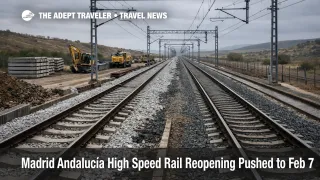
High speed rail travel between Madrid, Spain, and Andalucía, Spain is expected to remain abnormal through at least Saturday, February 7, 2026, after Spain's transport minister indicated the reopening target has slipped again. The corridor disruption follows the January 18, 2026 crash near Adamuz, Spain, and it continues to force mixed mode itineraries that swap a direct high speed run for a train plus coach bridge across the damaged segment. Travelers with tight same day plans should treat February 7 as a provisional target, confirm what is actually being sold for their date, and be ready to pivot to flights or cars if the bridge timing breaks their connection window.
The Madrid Andalucía high speed outage is now paired with a practical commercial constraint, some operators are not selling normal high speed tickets before February 7, which effectively forces rebooking decisions earlier than many leisure travelers would prefer.
Who Is Affected
Travelers moving on the Madrid to Seville and Madrid to Málaga high speed corridors are the most exposed because those flows normally anchor Andalucía weekend demand, business travel, and onward conventional rail pairs. Renfe's alternative plan keeps journeys moving by inserting a dedicated coach link between Córdoba and Villanueva de Córdoba, and that transfer adds both time and an extra failure point that does not exist in normal operations.
Travelers with same day flights out of Andalucía should plan more conservatively than usual. If a rail arrival is meant to feed a departure from Seville Airport (SVQ) or Málaga Costa del Sol Airport (AGP), the coach bridge and station handoffs increase the odds of arriving later than planned, especially during peak afternoon periods when road traffic and station crowding are less forgiving. The same logic applies in reverse for inbound flights to Adolfo Suárez Madrid Barajas Airport (MAD) that connect to rail, where a missed high speed departure can cascade into a much later arrival in Andalucía.
Travelers booking through trips that include multiple operators should also assume higher friction. Reporting tied to the February 7 target notes that operators have limited sales for pre February 7 normal high speed services, which means you may see fewer straightforward options in search results even when alternative plans exist.
For background on the earlier phase of the disruption and the initial bridge plan logic, see Madrid Andalucía High Speed Rail Outage Reroutes.
What Travelers Should Do
Travelers with fixed arrival requirements should act like the corridor will not be truly stable until normal high speed inventory is visible and confirmed in operator channels. If your trip depends on making a nonrefundable hotel check in, a timed entry, a tour departure, or a flight, rebuild the day around the bridge reality, and add a large buffer on both ends of the transfer. Start by rechecking your booking in the app or website you used, then confirm that your itinerary explicitly includes the mixed mode segment rather than assuming you can improvise a bus on arrival.
Use a clear decision threshold for rebooking versus waiting. If you need to arrive within a narrow window, for example to catch a flight, to board a cruise or tour, or to make an evening event, it is usually smarter to switch to a mode you control now, such as a short haul flight, a one way car rental, or a night earlier in your destination city, rather than gambling on day of station conditions. The reason is simple, the bridge adds a transfer variable, and a small slip can break a connection even when every segment is technically operating.
Over the next 24 to 72 hours, monitor three signals rather than focusing on rumors about exact reopening times. First, watch for any change in the minister's February 7 messaging, because it has already slipped once and is framed as a target, not a guarantee. Second, watch for operator inventory behavior, if normal high speed tickets suddenly appear for dates before February 7, that can signal a phased return, but if sales remain blocked it signals continued instability. Third, monitor infrastructure and repair progress reporting, including confirmation that track, ballast, and electrification work is progressing without weather or investigative delays.
Background
A high speed rail outage is different from routine delays because it removes path capacity from a trunk corridor, rather than simply pushing trains late. At the source, the damaged segment near Adamuz constrains or halts high speed movements between Madrid and key Andalucía cities, which forces operators into one of three options: suspend, detour onto slower conventional alignments, or bridge around the break with coaches. Renfe's stated approach is to sell a single title of transport that combines train segments with a dedicated coach transfer between Córdoba and Villanueva de Córdoba, increasing end to end journey times while keeping mobility possible.
The second order ripple shows up quickly in connections, inventory, and traveler behavior. Mixed mode transfers increase dwell time and reduce schedule resilience, so misconnect risk rises for onward rail, hotels, and flights. At the same time, limited rail capacity pushes some travelers to short haul air, which can tighten fares and seats on Madrid to Andalucía routes, and it pushes others to cars, which can compress car rental inventory and raise last minute pricing in Andalucía cities. Those shifts then spill into hotels, where travelers who cannot reliably complete a same day rail move may extend a night in Madrid or add a night in Andalucía earlier than planned. Taken together, the practical traveler takeaway is that February 7 should be treated as a planning boundary, not a promise, until normal high speed timetables and ticket sales are restored across operators.
Sources
- Renfe establece un plan alternativo de transporte
- Accidente ferroviario ocurrido en Adamuz
- High-speed train service between Malaga and Madrid could be restored on 7 February
- Óscar Puente anuncia que la línea de alta velocidad Madrid-Andalucía podría reabrirse en 10 días
- Óscar Puente retrasa hasta, mínimo, el 7 de febrero la apertura de la línea de alta velocidad Madrid - Andalucía