

Paris Gare du Nord Eurostar Delays Feb 2
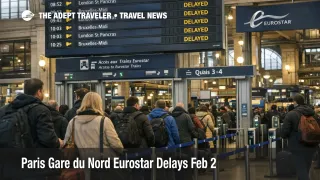
Paris Gare du Nord Eurostar delays are stacking departures on February 2, 2026, after the operator posted multiple live disruption notices tied to station level constraints and late running inbound trains. Travelers moving between London St Pancras International, Paris, Belgium, and the Netherlands are the most exposed because a delay on one rotation can roll into the next, and because boarding processes can slow when departures bunch. If you have any tight onward plans, treat today as a low slack day, protect your connections early, and be ready to pivot to later departures or an overnight buffer instead of hoping the timetable self corrects.
Eurostar's live updates for February 2 attribute delays to several overlapping triggers, including earlier trains arriving late into Paris, operational restrictions at Paris Gare du Nord, operational restrictions between Brussels-Midi/Zuid and Paris, traffic issues on the French network, and technical issues affecting Brussels station operations. The practical takeaway is that this is not a single isolated late train, it is a day of degraded throughput at a key node plus friction on at least one core approach corridor, which is exactly the recipe for knock on delays across London, Paris, Brussels, and Amsterdam itineraries.
Who Is Affected
Travelers ticketed on Eurostar services touching Paris today are affected first, especially anyone relying on a precise arrival time for a meeting, a timed attraction entry, or a same day hotel check in that cannot flex. The next tier is anyone chaining Eurostar into onward rail, including connections that route via Brussels or continue toward the Netherlands, where even moderate lateness can break reserved onward departures and leave you competing for limited reaccommodation.
Risk jumps sharply for travelers with separate ticket plans across modes. If your Eurostar arrival is supposed to feed a flight from Paris Charles de Gaulle Airport (CDG), Brussels Airport (BRU), or Amsterdam Airport Schiphol (AMS), you are not automatically protected the way a single airline itinerary can be, and a missed check in cutoff can become an expensive same day re purchase. The same is true for cruise embarkations or escorted tours that treat late arrival as a no show, even when the rail delay was clearly outside your control.
This disruption also affects travelers who are not on Eurostar, but share the same constrained space. When Paris Gare du Nord gets saturated, local transit transfers slow, taxi queues lengthen, and nearby hotels can see a short notice bump in demand as people self protect with an unplanned overnight. Those second order effects are why a station centered problem can still break itineraries well beyond the platforms.
What Travelers Should Do
Start with the actions that reduce irreversible losses. Check Eurostar's live travel updates and your specific train status, then immediately protect any downstream booking that has a hard cutoff, especially flights, cruises, and tours booked separately. If missing the connection would force an unplanned overnight or wipe out a nonrefundable reservation, shift your plan now by rebooking to a later departure you can actually make, or by adding a buffer night, rather than waiting until queues and inventory scarcity remove your options.
Use a consequence based threshold for deciding whether to hold or rebook. If your schedule can tolerate arriving 60 to 120 minutes late, waiting can be rational, but only if there is still meaningful same day recovery capacity and your next commitment can slide. If your itinerary depends on catching the last workable onward option, or if your arrival must land inside a narrow window, treat the first credible signal of compounding delay as the trigger to move, because later trains can sell out quickly when multiple services are disrupted on a reduced slack network. For broader context on how constrained inventory changes the math, see Eurostar Cuts London, Paris Trains Through Feb 8.
Over the next 24 to 72 hours, monitor stabilization cues, not just the headline delay minutes. When the disruption is improving, you typically see fewer new disruption notices, shorter predicted delays on successive departures, and less crowding at platform approaches and check in flows, while worsening conditions show new operational restriction notes, repeated late inbound trains, and growing gaps between departures. If you need an overnight Plan B near the station, use Paris Travel Guide: The Ultimate 7-10 Day First-Timer's Itinerary to choose neighborhoods that reduce friction for a next morning restart, and for comparison to a similar Paris station disruption day, see Gare du Nord Eurostar Delays Jan 14, 2026.
How It Works
Paris Gare du Nord is a critical switching point where high speed arrivals, platform turnover, and station circulation all compete for finite space. When an inbound Eurostar rotation arrives late, the delay rarely ends at the arrival board, because the same physical trainset and crews often need to be turned, cleaned, boarded, and dispatched again on a tight schedule. If station operations are under restriction, boarding waves slow, dwell times increase, and departures can bunch, which then creates a throughput problem that looks like crowding and compressed gate processes, not just a late departure time.
The ripple spreads across at least two other layers of the travel system. On the rail network layer, Eurostar is also flagging traffic issues on the French network and restrictions on the Brussels corridor, so a delayed path in one segment can force conflicts and slower running elsewhere, and even small timing losses can become meaningful when there is reduced slack. Separately, planned constraints on parts of the North high speed line in early 2026 illustrate how little margin exists on busy approaches, making it harder to absorb unplanned incidents without knock on effects.
On the traveler rights and recovery layer, Eurostar's compensation and refund rules are typically driven by final arrival delay, with compensation eligibility starting at 60 minutes, and with guidance to wait at least 24 hours before filing so systems can finalize the delay record. If you booked via a third party, exchanges and refunds often have to be initiated through the original retailer, so the operational playbook is to secure a workable alternative first, then handle claims once you are safely moving again.