

Genoa Works Cut Italo Trains Feb 6 to 9
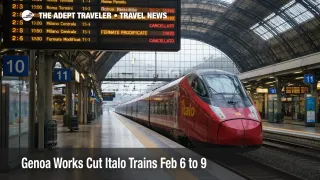
Infrastructure works near Genoa, Italy, are set to partially cancel specific Italo high speed services from February 6, 2026, through February 9, 2026, which can break carefully timed rail plans on the Liguria corridor. Travelers most exposed are those whose itineraries rely on one named train for same day repositioning, including airport transfers and cruise port arrivals. The practical next step is to verify whether your booking is on an affected train number, then lock in an alternative that still works if your original segment is removed or retimed.
The Genoa works Italo trains planning problem is that "partial cancellation" can mean your train still runs on part of its route, but not on the segment you need, forcing an on the fly swap to another train, a different station pair, or a road transfer.
Who Is Affected
Italo's customer notice identifies train numbers 9992 and 9998 as the services subject to partial cancellations during the February 6 to February 9 window, and it says booking channels have been updated to reflect the changes. Travelers who bought tickets before the notice should expect direct communication about updated travel details, but they should still verify the live itinerary shown in the app or booking flow before leaving for the station.
The highest consequence group is anyone chaining rail into a hard cutoff, especially cruise embarkation at the Port of Genoa, a flight departure from Genoa Cristoforo Colombo Airport, or a prepaid hotel check in that becomes nonrefundable after a certain hour. When a high speed segment fails, the first order impact is losing the intended departure and being pushed onto fewer remaining seats across other departures. The second order ripple is that the fallback layers that usually absorb problems, such as Intercity and regional trains, taxis, and short coastal car hires, can tighten quickly as multiple parties make the same substitution choice.
This is also a practical risk for travelers crossing Genoa as an intermediate node rather than an endpoint. Even if the rest of your long distance plan is intact, a removed segment in or out of Genoa can break the day's positioning, forcing a later arrival that then compresses luggage drop windows, dining reservations, or the final mile transfer to a ship or airport terminal.
For broader rail disruption context during the same early February period, travelers planning multi country itineraries may also want to compare how operators handle disruption windows in Spain Rail Strike Feb 9 to 11 Hits Trains Nationwide and Lombardy Rail Strike Hits Malpensa Express Feb 2. Those pieces are labor driven rather than works driven, but the traveler failure mode is similar, uneven gaps that punish tight connection assumptions.
What Travelers Should Do
Start with a ticket specific check, confirm your train number, confirm the stations you actually need, and confirm whether the affected portion overlaps your segment. If you are on Italo 9992 or 9998, treat the plan as low confidence until you see a complete, updated itinerary in the booking channel, because "partial cancellation" can remove only a slice of the route. If you must protect a same day flight or cruise cutoff, price a backup now while there is still seat inventory and before station lines build.
Set a clear decision threshold for rebooking versus waiting. If arriving two hours late would still get you to your next segment with margin, it can be reasonable to hold and ride out the operator's rebooking flow, but only if you have a viable Plan B that you could execute quickly, such as a different high speed departure, a protected connection via an alternate city station, or a car transfer for the last mile. If a slip means you miss the last feasible connection, the ship's all aboard time, or airline bag drop, rebook out of the risk window, or shift to a routing that does not depend on the impacted train numbers.
Over the next 24 to 72 hours, monitor three signals that predict whether your day will be smooth or fragile. First, watch for any additional infrastructure manager measures that extend beyond the two named trains, since Italo notes that other trains can face separate traffic measures on certain days. Second, watch seat availability on the nearest alternative departures, because tightening inventory is an early warning that many travelers are already substituting. Third, watch your ground transfer layer, taxi availability, and one way rentals, because once rail disruption pushes volume to roads, the bottleneck shifts to road capacity and pickup friction rather than track capacity.
How It Works
Works in a major rail node propagate through the system in layers. The first order effect is direct, the infrastructure manager adjusts track availability and train paths, which forces operators to cancel specific runs or trim routes when they cannot be routed through the constrained section with reliable timing. That is why a notice can focus on a small set of train numbers yet still create broad traveler pain, the fixed schedule you built your day around no longer exists in the same way.
In Genoa, ongoing network investment aims to separate regional and metro flows from long distance and freight movements, and to improve capacity and connectivity tied to the wider node development program. During intensive work periods, however, the system often has less operational slack, especially at critical station throats and junctions. Local reporting on the Genoa node works notes interventions around key track and switch systems near Genova Piazza Principe, which helps explain why some services can be forced into partial route trims rather than simple minor retimes.
The second order ripple hits traveler behavior and downstream capacity. Passengers spill from the affected high speed trains into whatever still runs, which fills the remaining seats and makes the whole day more sensitive to small delays. That demand then spills into taxis, rental cars, and hotels, especially when a missed segment forces an overnight in Genoa instead of a same day onward move. This is why the best planning move is not only to identify the canceled train, but also to protect the alternatives before the crowd reaches them.