

Lombardy Rail Strike Hits Malpensa Express Feb 2
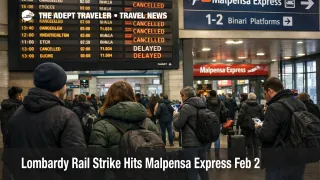
A planned rail strike in Lombardy is expected to reduce Trenord service and put Milan area airport train plans at risk. Trenord says the ORSA union has called a strike that may affect rail services from 300 a.m. on Monday, February 2, 2026, to 200 a.m. on Tuesday, February 3, 2026. Travelers are most exposed outside the guaranteed time bands, because cancellations can be uneven by line and can cascade into missed flights when the airport train is only one segment of a longer regional journey.
The practical change is that you cannot assume your usual regional or suburban train will run on February 2, 2026, even if the timetable still shows it. Trenord's guarantee structure keeps limited service in two protected windows, 600 to 900 a.m., and 600 to 900 p.m., and only trains included in the minimum service list should be treated as dependable. For airport access, Trenord has also stated it will provide non stop replacement buses if airport service trains are cancelled, which shifts the risk from outright rail cancellation to road travel time uncertainty.
This disruption does not stay contained to the rail platform. When frequency drops, more riders compress onto fewer departures, station dwell times rise, and recovery options vanish if you miss one connection. That spills into airports through late arrivals at check in, higher demand for taxis and private transfers, and a predictable behavior shift where travelers self protect by arriving earlier or adding an airport area hotel night.
Who Is Affected
Passengers using Trenord regional and suburban services in Lombardy are the core affected group, including travelers moving into Milan's main stations for onward rail connections and travelers using airport services to Milan Malpensa Airport (MXP). The strike window runs overnight into early Tuesday, which matters for late evening arrivals and very early morning airport departures that sit near the edges of service restoration and can be stranded by a single cancelled feeder train.
Airport bound travelers are affected in two different ways. The direct Malpensa Express link can be cancelled, and the upstream trip to reach the Malpensa Express origin can also fail. If you start outside central Milan, the fragile point is often the feeder, because a cancelled regional train can prevent you from reaching Milan Cadorna in time to catch any operating airport departure, even inside the protected band.
Cross border and north of Milan itineraries also need extra caution, because Trenord's notice includes the S50 Malpensa Airport-Stabio route and states that a non stop bus may be used between Stabio and Malpensa Airport if trains are cancelled. That replacement protects continuity on paper, but it adds road time variability, capacity limits, and a higher chance that you arrive later than planned.
What Travelers Should Do
Start by checking whether your specific train is in Trenord's "Guaranteed Minimum Services" list for February 2, 2026, and do not treat the published timetable as assurance by itself. If your plan involves Milan Malpensa Airport (MXP), build your airport arrival buffer around a bus substitution scenario, not a perfect rail run, and screenshot notices and real time status updates before you leave lodging.
Rebook rather than wait if your scheduled rail trip sits outside the 600 to 900 a.m. and 600 to 900 p.m. protected windows, or if a missed arrival triggers a hard penalty, such as an international flight, a cruise embarkation, or a non refundable tour start. If you can tolerate arriving a few hours late and you have no tight chain of connections, waiting can be reasonable, but only if you have a priced, ready backup, such as a taxi, a pre booked transfer, or a flexible coach option.
Over the next 24 to 72 hours, monitor three signals that predict how painful the day will be. Confirm the strike status and window, confirm whether your train is explicitly listed as guaranteed, and watch for real time cancellation patterns early on February 2, 2026, because early cancellations often foreshadow broader knock ons later in the day. If your train is cancelled and you must reach the airport, use the replacement bus guidance for Malpensa Express and assume road congestion will worsen as more travelers abandon rail at the same time.
How It Works
Italian rail strike planning often revolves around minimum service obligations that preserve limited travel in defined time bands on weekdays. Trenord's published guidance for this action states that protected service bands apply from 600 to 900 a.m., and from 600 to 900 p.m., and that trains included in the guaranteed list will operate, with the operator also describing the guarantee in terms of departures after 600 a.m. arriving by 900 a.m., and departures after 600 p.m. arriving by 900 p.m. That structure is why travelers who can shift into those windows often have better odds than travelers who try to ride out the middle of the day.
The strike's first order effect is cancellations and altered train circulation across the regional and suburban network, plus a direct hit to airport trains in Lombardy. The second order ripple is what breaks trips, because reduced frequency compresses demand, station transfers take longer, and any missed segment forces road fallbacks that are slower and more expensive. That ripple spreads beyond rail into airport curbside traffic, parking demand at Milan Malpensa, and short notice hotel demand near the airport when travelers decide that arriving the night before is cheaper than gambling on a morning transfer.
Trenord's contingency for airport connections is designed to keep a path open even if trains are cancelled, but it shifts the operating constraint from track capacity to road capacity. Trenord states that, in case of cancellation of airport service trains, non stop replacement buses will be provided between Milan Cadorna and Malpensa Airport, with buses departing from Via Paleocapa 1 at Milan Cadorna, and between Stabio and Malpensa Airport for the S50 route. In practice, buses can protect continuity while still increasing travel time variance, which is the key planning factor for flight check in cutoffs. For broader strike readiness context, travelers planning multiple European legs may also want to review Europe Transport Strike Dates 2026 for Flights and Trains and Italy Rail Strike Disrupts Trains January 20, 2026.