

Paris Airports Parafe E Gates Lag, Longer Queues
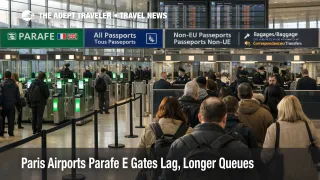
Passport control at Paris Charles de Gaulle Airport (CDG) and Paris Orly Airport (ORY) is running less predictably for many non EU travelers because the EU Entry Exit System, called EES, is still ramping up and reshaping how border checks are done. The people most likely to feel it are third country nationals, including many visa exempt visitors, and some non EU residents who assumed automated Parafe e gates would be their default. The practical move is to treat immigration as a variable segment of your journey, build more buffer before any onward rail or flight, and keep your first post arrival commitments flexible.
The friction is partly structural. EES requires new data capture on first registration, including biometrics, and France has been introducing the system gradually with full implementation expected by April 10, 2026, which means procedures can differ by location and moment as volumes increase. Separately, Parafe remains a fast track option on paper for many nationalities with biometric passports, including the United Kingdom and the United States for entry use, but real world access can still be constrained when e gate logic and EES workflows do not line up cleanly for specific traveler statuses.
Adding to the uncertainty, EU level reporting in late January and early February 2026 indicates member states have been given additional flexibility to avoid peak season congestion, and some outlets describe this as pushing full rollout pressure deeper into 2026. The key traveler takeaway is not the label on the timeline, it is that variability is likely to persist through the coming months, especially at high volume gateways like Paris.
Who Is Affected
Non EU nationals arriving into Paris from outside the Schengen area are the core group exposed to longer and less predictable queues because EES registration is aimed at short stay third country nationals and is being scaled up across border points. If you are a frequent visitor who previously experienced fast processing on a good staffing day, assume the distribution has widened, meaning the same flight arrival time can produce very different exit times depending on how many other widebodies land in the same bank.
A second, easily missed cohort is non EU residents of France, including Britons and Americans, who expected residency status to translate into e gate use at Parafe. Recent reporting indicates that some of these residents are still being routed to manual lanes due to technical difficulties tied to the evolving EES environment, which is exactly the scenario that creates surprise queues for people who planned their onward steps around automation.
Families should plan for added friction as well. Parafe use has age thresholds, and EES biometric capture rules differ for children, so mixed groups can end up split between lanes or slowed by eligibility checks. Business travelers and anyone on separate tickets are also disproportionately exposed because you often have less protection if a missed rail or air connection triggers a reprice or a no show outcome.
What Travelers Should Do
If you are arriving into CDG or ORY and you have any onward dependency, for example a TGV segment, an RER transfer to a timed appointment, or a separate ticket domestic flight, increase your buffer and treat immigration as the first major uncertainty point. For practical planning, shift fixed commitments later into the day, prebook refundable ground transport when possible, and avoid itineraries that require a tight same station rail change shortly after landing.
Use consequence based thresholds for whether to wait it out or to proactively rebook downstream pieces. If missing your connection would force a same day ticket repurchase, a missed event check in, or the loss of a nonrefundable tour slot, move earlier, not later, by choosing a later train, a later domestic flight, or an overnight buffer near your first stop. If your day is flexible and you have recovery capacity, you can often hold, but only if you stop stacking reservations that assume a precise airport exit time.
Over the next 24 to 72 hours, monitor signals that actually track border throughput. Watch whether your flight is arriving into a bank of other long haul arrivals, whether the airport or operator is flagging border control delays, and whether travelers are reporting sustained waits at passport control rather than isolated spikes. If your onward plan depends on Paris transit, also factor in surface network constraints because even a normal immigration day can fail if the city side link is degraded, and this week, Paris transit works can add additional timing risk on airport corridors. For Paris specific transit disruption context, use Paris Metro And RER Works Disrupt Travel Feb 2 to 8 as your routing and buffer baseline.
Background
Parafe is France's automated border control gate system, designed to speed eligible travelers through entry or exit checks using biometric passport data and facial recognition at equipped border points, including Roissy Charles de Gaulle and Orly. Eligibility depends on nationality, document type, and age, and it is optional, meaning travelers can still be processed manually even if they appear eligible. In a stable environment, Parafe increases throughput and reduces desk pressure, which is why many frequent travelers plan their buffers around e gate access.
EES changes the mechanics underneath that experience. France's Interior Ministry describes EES as a digital entry and exit record system for short stay third country nationals that is being introduced gradually from October 12, 2025, with full implementation expected by April 10, 2026. Registration can involve kiosks or tablet based pre registration tools to capture the required data, including biometrics, but a border guard still performs the final control, so the system can move faster or slower depending on staffing, equipment uptime, and arrival clustering.
That is how the disruption propagates through the travel system. The first order effect is slower border processing at the booths, which pushes later waves into baggage reclaim and customs, and increases the variance of exit times for the same scheduled arrival. The second order ripple hits connections and city side logistics, TGV and RER transfers become harder to time, taxi and rideshare queues spike when multiple flights release passengers at once, and timed tickets across Paris become easier to miss because the uncertainty is front loaded at the airport. A third layer follows as airlines and rail operators absorb misconnect fallout, including rebooking demand, compressed seat inventory on later departures, and unplanned hotel nights when travelers choose to self protect rather than gamble on a tight same day chain.
If you are building a first trip plan that can tolerate this kind of variability, the most robust approach is to structure day one around flexible, nearby commitments and to avoid stacking multiple prepaid timings. For a practical Paris pacing framework that reduces day one fragility, use Paris Travel Guide: The Ultimate 7-10 Day First-Timer's Itinerary. If your Paris plan depends on Eurostar timing at Gare du Nord, treat that connection as a separate risk layer during degraded days, and reference Paris Gare du Nord Eurostar Delays Feb 2 when deciding how much slack you need between modes.
Sources
- Fast-track crossing at external borders PARAFE
- The pre-registration devices for Entry/Exit Sytem EES
- European Union - EES / ETIAS, EES FAQ
- EES: Delay for British and American residents to use French passport e-gates
- EU's Entry/Exit System rollout delayed until September over fears of summer travel chaos
- EU gives countries EES 'flexibilities' to ease summer queues
- EES: a new EU control system
- Terminal maps at Paris-CDG Airport
- Terminal maps at Paris-Orly Airport