

United App and United.com Outage for SHARES Upgrade Feb 4
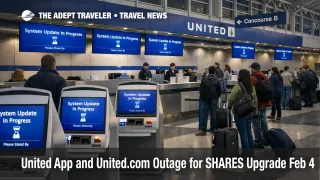
United Airlines plans to take many functions on its app and website offline early Wednesday, February 4, 2026, to complete a reservation system upgrade. United's published advisory points to a core window of 130 a.m. to 500 a.m. Central Time, which corresponds to 230 a.m. to 600 a.m. Eastern Time. Travelers who need to book, check in, retrieve a reservation, or make same day changes should do those steps before the window, or wait until after systems are restored.
The United SHARES upgrade outage matters because the reservation platform sits underneath nearly every traveler facing workflow, including online booking, mobile check in, and the tools agents use to service tickets.
Who Is Affected
Anyone attempting self service tasks during the outage window is affected, especially travelers booking last minute, checking in close to departure, or trying to fix a disrupted itinerary in the early morning hours. United has said the upgrade will take many web and app services offline, and third party reporting indicates United also adjusted its flight schedule to avoid departures during the window so the cutover can run cleanly.
The most exposed segment is early morning departures on February 4, 2026, because check in, mobile boarding passes, and kiosk flows can become slower if any channel comes back in phases. Even when the core host returns, airlines often need time to fully re open every front end, which is why travelers should not assume everything is instantly normal at the top of the hour.
There is also a ripple effect for travelers who are not flying at 3:00 a.m. but who rely on same day changes, upgrades, standby, or reissues later that morning. If the restart pushes delays into the early commute window, it can translate into longer call center queues, slower airport rebooking, and fewer remaining seats on the next available flights.
What Travelers Should Do
Take immediate actions and add buffers. If you fly on February 4, 2026, complete check in, seat assignments, and any payment or ticketing steps the night before, and save your confirmation details offline in case you cannot pull them up during the window. If you are checking bags, plan extra time at the airport, because kiosk and counter workflows can bottleneck when reservation servicing is degraded.
Use decision thresholds for rebooking versus waiting. If your itinerary depends on a tight connection, or you are on separate tickets, treat the outage window as a no changes zone, and move to an earlier flight the day before or a later flight after the window if you still have free or low cost options. If your trip is flexible and you are not flying until later in the day, the better play is usually to wait until systems are fully stable rather than repeatedly retrying changes during partial restoration.
Over the next 24 to 72 hours, monitor restoration signals that matter to travelers, not just a generic all clear. Confirm that you can retrieve your reservation, see live flight status, and complete check in end to end, then verify your seat and any paid extras still display correctly. If you were moved by an automated schedule adjustment, recheck your connection times and minimum check in deadlines, because missing a carrier deadline can still be treated as a no show even when the root cause started as a tech outage.
How It Works
SHARES is a legacy airline passenger service system, the core reservation and ticketing backbone that United inherited from Continental Airlines and adopted as part of the merger integration era. When a carrier upgrades that host environment, the first order effect is straightforward, transactions can be paused so data stays consistent during the cutover. That is why airlines warn travelers away from booking, check in, and servicing tasks during the window.
The second order ripples are what matter operationally. Airline apps and websites are just the visible layer, but airport kiosks, gate and customer service tools, call centers, travel agencies, and partner airline interfaces typically depend on the same underlying reservation access. If that access is paused, the airline can still fly aircraft already in motion, but it becomes harder to issue new boarding passes, rebook misconnected travelers, or process certain ticket changes until the host returns. That is also why airlines sometimes reshape schedules around the cutover, because a departure bank that cannot be checked in or serviced cleanly creates a cascade of missed flights, long lines, and downstream delays that take all day to unwind.
If you are trying to understand why tech issues can echo long after the initial incident, it helps to look at the broader network dynamics. Even a small early morning disruption can change aircraft rotations and crew sequences, which then shows up later as delayed inbound aircraft, compressed turn times, and fewer spare seats for reaccommodation. If your trip already runs through a heavy traffic hub like Chicago O'Hare International Airport, those network effects can stack with normal peak period congestion, making buffers more valuable than usual. For related context on United's current hub scale at Chicago O'Hare, see O'Hare United American Fare War Hits Summer Flights. For a quick read on how small constraints can cascade into broader delays, see Flight Delays and Airport Impacts: February 2, 2026.