

Flight Delays and Airport Impacts: February 2, 2026
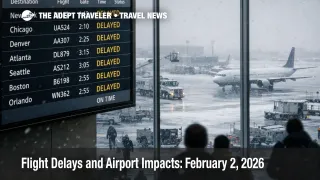
Federal Aviation Administration command center planning for U.S. flights is watching wind in the Northeast corridor, snow at Detroit, and low ceilings on the West Coast that could squeeze arrival rates later today. Travelers connecting through General Edward Lawrence Logan International Airport (BOS), Newark Liberty International Airport (EWR), Seattle-Tacoma International Airport (SEA), San Francisco International Airport (SFO), San Diego International Airport (SAN), and Detroit Metropolitan Wayne County Airport (DTW) are most exposed, because even small acceptance-rate cuts show up as gate holds at your origin. Build buffer now, watch for ground delay programs after midafternoon, and be ready to reroute around the most constrained hubs.
The US flight delays February 2 2026 story is that conditions can look mostly manageable in the morning snapshot, but the FAA still flags several high leverage hubs for late day metering if winds or ceilings tighten.
The FAA's latest operations plan keeps three weather buckets front and center. Winds are the risk driver for the BOS area and nearby Northeast airspace, snow is the constraint around DTW, and low ceilings or reduced visibility are the watch item for SEA and SFO. Even when those conditions do not force cancellations, they often reduce how many arrivals and departures can be processed per hour, which is when traffic management initiatives begin to appear.
The important nuance today is timing. The FAA planning note puts SAN in a possible ground stop window after 1400Z, then adds a possible SFO ground stop or delay program after 1630Z, and a possible EWR ground stop or delay program after 1900Z. If your itinerary is earlier in the day, the main risk is downstream propagation from these hubs, but if you are flying later afternoon or evening, you are closer to the period where metering can flip on quickly.
Beyond weather, a few operational footnotes can matter for specific itineraries. Chicago O'Hare International Airport (ORD) is flagged in the FAA planning notes for a United ramp reconfiguration and a Taxiway A closure through the end of the day, which can add surface friction even if winds and visibility cooperate. Those kinds of "small" constraints rarely make headlines, but they can stretch turns, extend taxi times, and reduce recovery margin if weather driven metering starts elsewhere.
If you want a recent baseline for how forecast risk turned into real delay minutes at Northeast hubs, compare today's setup with Flight Delays and Airport Impacts: January 30, 2026 and Flight Delays and Airport Impacts: January 29, 2026.
Who Is Affected
The highest exposure group is anyone whose itinerary depends on a tightly banked connection at BOS, EWR, DTW, SEA, SFO, or SAN. These hubs do not just move local traffic, they serve as connection engines, so when arrival rates fall, it is not only the hub's departures that slide, it is also inbound flights that arrive late, miss their outbound bank, and then take aircraft and crews out of sequence for the rest of the day.
Travelers flying transcontinental, or those chaining two domestic legs to reach an international departure, should be particularly skeptical of short connections today. A hub can look normal at your scheduled departure time, then flip into metering when ceilings lower or winds force a runway configuration change. When that happens, your first visible symptom is often a delayed pushback at the origin airport, because holding flights at the gate is safer than stacking them in the air.
There is also a second order effect that hits travelers who never touch the constrained airport. When a late day program activates at SFO or EWR, flights destined for those airports can be held across the country, and those holds then block gates, delay inbound aircraft swaps, and compress later departures at airports that have perfectly good weather. This is why a forecast of "possible" programs at a few hubs can still be relevant to travelers in other cities.
Finally, travelers with business critical schedules, same day events, cruise or tour departures, or any itinerary on separate tickets should treat today as a buffer day. Separate tickets are especially fragile because one carrier is not obligated to protect the other segment, and late day delay programs tend to wipe out your cushion right when replacement seats are hardest to find.
For broader context on why the system can feel brittle on days with only a handful of constrained nodes, see U.S. Air Traffic Control Privatization: Reality Check.
What Travelers Should Do
Start with immediate actions and buffers. Check your flight status before you leave for the airport, then check again after you arrive, because FAA initiatives can activate quickly if winds strengthen in the Northeast or ceilings drop on the West Coast. If your routing touches BOS, EWR, DTW, SEA, SFO, or SAN, build extra time into airport arrival, expect longer taxi and gate holds, and keep essentials in your personal item so an unexpected overnight is manageable without checked bags.
Use decision thresholds for rebooking versus waiting. If a delay compresses a domestic connection under about 90 minutes, or a domestic to international connection under about 2 hours, treat that as a practical trigger to look for earlier departures, nonstops, or routings that avoid the most constrained hubs, especially if your second leg is the last bank of the day. If your flight is in the late afternoon or evening and your itinerary relies on EWR or SFO, the "possible program" window is close enough that proactive rebooking can be smarter than waiting for an official ground delay program to post.
Over the next 24 to 72 hours, monitor three layers. Watch the FAA operations plan updates for whether SAN, SFO, or EWR move from "planned" into "active," watch airport status pages for whether "15 minutes or less" shifts into measurable delay minutes, and watch your airline for waiver expansion that can turn a costly same day change into a no fee move. If you are traveling Tuesday, February 3, pay attention to whether today's late day metering creates a next morning aircraft and crew positioning hangover, because that is how a single evening program becomes a next day reliability problem.
How It Works
The FAA's traffic management job is to safely match demand to what each airport and its surrounding airspace can handle per hour. When winds, snow, or low ceilings reduce that hourly throughput, the first order effect is at the runway and on the surface, arrival spacing increases, deicing and snow ops slow the departure queue, and taxi flow becomes more fragile. That reduced runway acceptance rate then propagates into gate availability, because late arrivals occupy gates longer, which delays departures that need those gates, which then delays other arrivals that cannot park.
Traffic management initiatives are the toolset that prevents a constrained hub from turning into unsafe airborne congestion. Instead of letting aircraft stack overhead, the system meters departures at their origin airports with assigned departure times, or it pauses departures to a destination for a period in a ground stop. For travelers, this is why your flight can be held at the gate in clear weather, the destination hub is protecting a limited acceptance rate caused by wind, snow, or ceilings.
Those aviation ripples spread into at least two other layers of the travel system. Connections fail first, because bank timing is tight, and once passengers misconnect, rebooking demand spikes at the same hubs that are already constrained, which is why flights fill and options vanish quickly. Ground transportation and lodging then take the second hit, because irregular arrival times shift rideshare and taxi peaks into off hours, and misconnects can create short notice demand for airport hotels. On days like today, with a calm looking national snapshot but late day program risk at a few hubs, the most useful traveler mindset is to plan for timing volatility rather than a complete shutdown.