

CocoCay Pier Damage Hits Royal Caribbean Calls
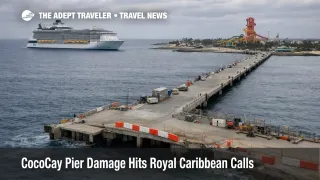
Storm damage to the pier at Royal Caribbean's Perfect Day at CocoCay, Bahamas is constraining docking operations, and at least one ship has already been diverted off the private island call. The highest exposure is on Bahamas sailings that normally schedule two ships at CocoCay on the same day, because reduced capacity can force one ship into a sea day or an alternate port after guests have boarded. Travelers should open the cruise line app, confirm the newest port list and port hours, and decide quickly whether the revised routing still works for their goals, their budget, and any tight flight or hotel timing tied to a specific CocoCay day.
The constraint appears tied to pier side availability and safety checks after catwalks reportedly fell into the water during the storm, which can keep a berth unusable until debris is recovered or the area is verified clear for maneuvering. That matters operationally because CocoCay is designed to handle multiple calls, and when one side is effectively out, the schedule becomes a daily prioritization problem.
Who Is Affected
Travelers on Royal Caribbean and Celebrity Cruises Bahamas itineraries that include Perfect Day at CocoCay are the core group at risk, especially departures in early February 2026 while repairs and underwater clearance work are still in progress. Reporting shows at least one Freedom of the Seas sailing replaced its planned CocoCay day with a sea day, and then added Cabo Rojo, Dominican Republic, which is the kind of substitution pattern travelers should expect when the private island call cannot be delivered on the planned date.
The second group affected is anyone who built trip timing around that specific private island stop, such as travelers who booked specialty experiences, paid cabana or beach club style add ons, or planned the CocoCay day as the low logistics anchor for families and multi cabin groups. When a private island day becomes a sea day, the value equation changes, and when it becomes a substitute port, the transport, crowding, and shore purchase environment changes with it.
A third group is travelers with tight pre cruise or post cruise stacks, including same day flights, nonrefundable hotels, and timed transfers. Port swaps can ripple through onboard pacing, crowding, and shore return flow, and that can increase the odds you end up making last minute decisions under time pressure.
What Travelers Should Do
Start with immediate verification and buffers. Open the Royal Caribbean or Celebrity app and confirm the current itinerary, the current port hours, and any messages about itinerary changes, then screenshot the details so you have a stable reference if the plan changes again. If you booked anything independent that assumed CocoCay, contact that supplier now to understand cancellation terms and document your options.
Use a decision threshold for rebooking versus waiting that is based on what is truly essential to your trip. If CocoCay was the single main reason you chose the sailing, or if the replacement port forces you to spend significantly more to recreate the day you wanted, treat that as a trigger to price alternate sailings now, while cabins and flights still exist. If the cruise is primarily about getting away, and you are flexible about ports, it can be rational to hold, but only after you price out the replacement day realistically.
Monitor the next 24 to 72 hours for three practical signals. First, watch for whether the cruise line is still running one ship per day at CocoCay, because that is what drives the daily triage problem when two ships were originally scheduled. Second, verify refunds for cruise line sold shore excursions if your ship misses the port, because Royal Caribbean's published policy says those cancelled excursions are refunded, but you still want to see timing and method on your statement. Third, watch for knock on substitutions that shift the day order, because a change from CocoCay to a sea day can cascade into different onboard reservation demand and different port crowding dynamics at the substitute stop.
Background
CocoCay is a private destination built around predictable berthing and guest flow, which is why pier constraints propagate quickly through itineraries. The first order effect is straightforward: if a berth is unavailable, a ship cannot safely dock on that side, and the line may substitute a sea day or another port to maintain the cruise schedule. The second order ripple is where traveler pain often shows up, because two ships that would have split across the day may instead concentrate elsewhere, which can tighten berth windows, increase crowding at an alternate port, and change the onboard experience when an unplanned sea day pushes everyone back onto the ship at the same time.
Compensation expectations need to be grounded in policy rather than hope. Royal Caribbean states it can change itineraries and ports of call for weather and other reasons, and it is not obliged to cover losses tied to those deviations, which is why independent tours, prepaid activities, and tightly stacked flights are the fragile layer of the plan. The most dependable mechanical remedy is typically the cancellation and refund of cruise line sold shore excursions for a missed port, which Royal Caribbean explicitly affirms in its FAQ.
For context on how private destination disruption can reshape a sailing after booking, see Labadee Haiti Port Calls Pulled From Royal 2026. The cause is different, but the planning lesson is the same, treat private destination days as high value but still operationally conditional, and avoid stacking nonrefundable dependencies on top of them.