

US Shutdown Ends, TSA and FAA Disruption Risk Eases
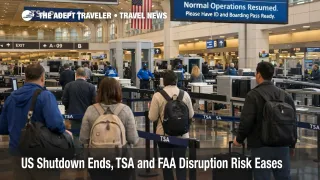
A partial U.S. government shutdown ended after President Donald Trump signed a spending package on February 3, 2026, restoring near term stability for agencies that shape airport screening and the national air traffic system. The travelers most exposed over the past several days were anyone flying during peak departure banks, plus anyone relying on tight connections, because staffing driven slowdowns can quickly turn into missed flights and scarce rebooking seats. Now that the funding lapse has ended, the practical move is to keep a lighter buffer than you would during an active shutdown, but still monitor day to day operations until agencies fully unwind contingency procedures.
The key traveler facing change is not that airports suddenly switch from bad to perfect. It is that the probability of staffing driven pinch points drops, especially the kind that forces airlines and the FAA into blunt capacity management tools. During shutdown conditions, air traffic control, ATC, and Transportation Security Administration, TSA, operations continue because those roles are essential, but unpaid status and furlough patterns reduce resilience, raise absence risk, and slow support functions that keep the system steady. With funding restored, the incentive structure and scheduling posture normalize, which typically reduces last minute program cuts, keeps lanes and towers fully staffed, and improves the odds that irregular operations recover faster when weather or tech issues hit.
There is also an important nuance for the next week. Several reports on the deal note that parts of the broader funding picture, especially within the Department of Homeland Security, remain subject to a near term deadline. That matters because TSA sits inside DHS, so a future lapse can reintroduce the same risk pattern even if the current shutdown has ended.
Who Is Affected
Domestic and international flyers using U.S. airports are the main beneficiaries of the shutdown ending, because TSA staffing levels drive how quickly passengers clear screening, and the FAA's air traffic organization governs how many flights can safely move through constrained airspace. Travelers with connections are still the most sensitive segment, because a 30 to 60 minute delay at the origin can break a tight connection and convert a simple delay into a same day reaccommodation problem.
Travelers departing during peak commute windows, holiday shoulders, and hub bank peaks tend to feel shutdown related risk first, because that is when a small staffing shortfall becomes visible as a long queue, a ground delay program, or a ripple of missed slot times. Even if your airport feels calm, you can still be affected by nationwide airspace flow decisions that protect overloaded corridors, which shows up as longer flight times, delayed departures, or inbound aircraft arriving late to operate your flight.
Travel advisors and travelers managing complex itineraries should treat the next several days as a normalization period rather than a guaranteed clean slate. A stabilized funding posture reduces the odds of new disruption, but it does not instantly erase crew and aircraft position issues that built up during the uncertainty window, especially when weather and winter operations are already stressing networks.
What Travelers Should Do
Take immediate actions and keep smart buffers. If you fly within the next 24 to 72 hours, recheck TSA checkpoint estimates for your departure airport, plan to arrive with enough slack to absorb a surprise lane closure, and keep your airline app notifications on for gate and schedule changes. If you postponed a same day change, refund request, or seat assignment during the shutdown threat window, revisit it now before call center backlogs and post disruption queues build around other events.
Use a clear decision threshold for rebooking versus waiting. If your itinerary relies on a short connection, or a same day cruise embarkation, wedding, or event start, keep the conservative buffer you would use during irregular operations and consider a reroute to a nonstop when the fare and timing make sense. If your travel is flexible, it is usually reasonable to hold your current booking and simply add time at the airport, because the end of the shutdown reduces the likelihood that staffing problems escalate into broad, multi hour capacity cuts.
Monitor a few specific signals through the next week. Watch for FAA traffic management initiatives that indicate systemic congestion, watch for TSA wait time spikes at the times you plan to arrive, and watch the funding news cycle for any renewed deadline risk tied to DHS appropriations. If you see multiple warning signs at once, for example rising departure delays plus long checkpoint lines, act early by switching to an earlier flight or moving to a larger buffer connection before the remaining seats disappear.
Background
A shutdown is not only a political event, it is an operations event that changes how the travel system absorbs stress. When funding lapses, some employees are furloughed, and many essential workers continue to work under different pay expectations and with reduced support capacity behind the scenes. For travelers, the first order effects typically show up at TSA checkpoints and within FAA managed airspace, because those are the two places where staffing margins directly shape throughput.
The second order ripples travel farther than the checkpoint and the control tower. When the FAA slows arrival rates into major hubs, airlines stack delays across the day, aircraft arrive late to their next segments, and crews risk running into duty time limits. That is how a problem that starts as a flow constraint becomes cancellations later in the day, missed connections, and overnight hotel demand near hubs. When TSA throughput slows, passengers miss flights, rebooking queues surge, and call centers and airport agents get overwhelmed, which reduces recovery speed even after the original bottleneck clears.
With the shutdown ended on February 3, 2026, those stress multipliers should ease, but travelers should remember that normalization is a process. Agencies have to unwind contingency guidance, return furloughed staff, and clear accumulated work, and airlines still need time to reposition crews and aircraft after any irregular operations window.
For additional context on the mechanics and traveler strategies, see How a government shutdown could affect travel and the earlier alert framing the risk window in real traveler terms, U.S. Shutdown Threatens Flights and TSA Screening.
Sources
- House Repasses Five Full-Year Funding Bills, Restores Government Stability
- Partial shutdown ended, as Trump signs package securing back pay for furloughed feds
- Trump signs government funding legislation, ending the partial shutdown that began over the weekend
- What to know about the partial government shutdown, now in its 3rd day
- How every House member voted on the shutdown and ICE funding