

U.S. Shutdown Threatens Flights and TSA Screening
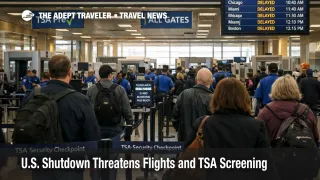
A partial U.S. government shutdown has left key transportation and security functions operating under contingency conditions, with the Department of Transportation and the Department of Homeland Security among the affected agencies. Air travel continues, but travelers are exposed if staffing strains translate into air traffic control, ATC, capacity limits or slower security screening. If you are flying in the next few days, plan for longer lines and wider delay bands, and be ready to reroute or rebook quickly if your itinerary cannot absorb disruption.
The change in plain language is that U.S. shutdown threatens flights by increasing the odds of FAA staffing constraints and TSA checkpoint stress, especially if unpaid work stretches beyond a few days.
Who Is Affected
Travelers using U.S. airports for domestic or international departures are the most directly exposed because the FAA's air traffic organization manages the flow of flights nationwide, while TSA officers staff passenger screening at checkpoints. ABC News reported that more than 10,000 FAA workers have been furloughed, and that 13,835 air traffic controllers will continue to work without pay during the shutdown, a mix that can degrade resilience even when core operations remain open.
The risk is not uniform. The most fragile itineraries are the ones with tight connection windows, separate tickets, the last connecting bank of the day, or time critical arrivals for cruises, events, or medical appointments. When a disruption hits the air traffic side, the first order effect is slower departure and arrival throughput, which pushes flights off schedule and compresses the connection window you thought you had. When a disruption hits the security side, the first order effect is missed boarding because checkpoint queues expand faster than the terminal can process people.
Second order effects show up fast because aviation runs as a tightly coupled network. If ATC programs extend flight times, hold departures, or reduce arrivals at busy hubs, aircraft rotations slip, gates fill, and crews can run into duty time limits, which forces additional delays and cancellations downstream. As travelers roll to later flights, hotel inventory near airports tightens, rental cars disappear, and rideshare demand spikes during irregular peaks, even for travelers who never touch the original problem airport. The 2025 shutdown is the most relevant recent analog because travel groups and airline advocates point to controller absences and capacity reductions as real operational outcomes when unpaid work persists.
What Travelers Should Do
If you are flying in the next 24 to 72 hours, build buffer into the parts you still control. Arrive earlier than your normal routine for departures, especially at large hubs and during morning peaks, and treat any itinerary with a connection under 90 minutes as a rebooking candidate if there is not a later backup on the same ticket. Use Flight Delays and Airport Impacts: February 2, 2026 as a quick baseline for how fragile the system already is before layering shutdown stress on top.
Use decision thresholds instead of hoping it clears. If your trip has a hard arrival requirement, move now to a routing with fewer connections, earlier departures, or a different hub, even if the fare is slightly worse, because same day seats tend to vanish quickly when capacity is constrained. If your plans are flexible and you have a nonstop or a wide buffer, it can be rational to wait, but only while your airline still has reasonable alternatives in inventory, and only if you are on a single ticket that protects your onward segments.
Over the next one to three days, monitor three specific signals. First, the status of the House vote to restore funding, because the duration is the variable that most changes operational risk. Second, your airline's travel alerts and the estimated departure time trend for your flight number, because repeated small pushes often precede larger schedule failures. Third, airport operations messaging and ATC delay programs, because those are early indicators that the system is being managed under constraint rather than running normally. If you want a concrete example of how an FAA issued alert can alter day of flight planning and buffer math, Federal Aviation Administration SAFO 26001 Warns U.S. Flights of Rocket Debris shows how quickly airspace management can create knock on delays, even without a weather system.
Background
Federal aviation and security functions do not shut down cleanly. Many FAA and TSA roles are designated essential, which keeps planes flying and checkpoints open, but it can also force people to work without pay until Congress restores funding, creating predictable morale and attendance strain if the lapse drags on. In this shutdown, DOT has warned that portions of the department are affected, and ABC reported the FAA has furloughed thousands while keeping controllers on the job without pay.
The reason travelers feel this so quickly is that the system has limited slack. Airlines schedule aircraft and crews in tight rotations, and ATC capacity is already sensitive to staffing levels at key facilities. If arrival rates are throttled, delays compound because late aircraft become the next flight's late departure, and a single constrained hub can export delays nationwide as aircraft and crews move through the network. The travel industry is pressing Congress to avoid repeating that pattern, and to adopt structural fixes that would keep controllers paid during future funding gaps, including the Aviation Funding Solvency Act (H.R. 6086) and the Aviation Funding Stability Act (S. 1045). For deeper context on why staffing and modernization limits make the network less forgiving when shocks hit, U.S. Air Traffic Control Privatization: Reality Check explains the underlying constraints that turn small disruptions into nationwide delay days.
One detail worth treating skeptically is the dollar estimate for prior shutdown damage, because different credible industry sources cite different totals. Business Travel News reported U.S. Travel's estimate of $6.1 billion for the 2025 shutdown, while Airlines for America cited a $7 billion figure for the last shutdown's economic impact. The exact number matters less than the direction: once unpaid work persists long enough to trigger staffing absences or capacity cuts, travelers experience it as delays, missed connections, and expensive recovery.
Sources
- Assessing the Partial Gov't Shutdown Effect on Travel
- What to know about the partial government shutdown, now in its 3rd day
- Travel Industry to Congress: End Shutdowns That Punish Workers and Disrupt Americans
- A4A Asks Congress to Pay ATC During Looming Shutdown
- Trump-backed deal to end shutdown faces tight House vote
- H.R.6086, Aviation Funding Solvency Act
- S.1045, Aviation Funding Stability Act